The Role of Low-Code/No-Code in Rapid Conveyor Automation
Low-code/no-code platforms are transforming conveyor automation by replacing complex custom programming with intuitive, graphical interfaces. This approach can slash implementation times by up to 70% and reduce reliance on specialized PLC engineers, enabling warehouses to adapt their logistics processes with unprecedented speed and agility.

In the fast-paced world of European logistics, the ability to adapt is paramount. Seasonal peaks, new product lines, and evolving customer expectations demand that warehouse automation is not just efficient, but also flexible. Traditionally, modifying conveyor systems has been a slow, costly process, shackled by the complexities of custom programming. However, a new paradigm is emerging: low-code and no-code platforms are democratizing automation, enabling rapid deployment and modification of conveyor logic without needing an army of programmers.
Definition
Low-code/no-code platforms for conveyor automation are software environments that allow users to configure and control conveyor systems using graphical user interfaces, pre-built logic blocks, and drag-and-drop functionality, rather than writing thousands of lines of traditional code for a Programmable Logic Controller (PLC). This approach abstracts away the complexity, enabling faster implementation and easier modification by in-house technicians.
Key Numbers
| Metric | Typical range (EU 2026) | Notes |
|---|---|---|
| Implementation Time | 4-8 weeks | Compared to 3-6 months for traditional, code-heavy PLC projects. |
| Initial Setup Cost Reduction | 15-30% | Primarily from reduced specialized software engineering hours. |
| Operator Training Time | 10-20 hours | For basic configuration, vs. 200+ hours for advanced PLC programming. |
| Reconfiguration Speed | 2-4 hours | For a typical workflow change, versus days or weeks for recoding. |
| System Integration Cost | €5,000 - €25,000 | Per connection to a WMS/ERP, often streamlined via pre-built connectors. |
| Required Skill Level | Technician / Process Engineer | Reduces dependency on scarce, expensive PLC software developers. |
| Return on Investment (ROI) | 12-24 months | Accelerated due to lower initial costs and faster operational uptime. |
The Traditional Challenge: Custom PLC Programming
For decades, the brain of any conveyor system has been the PLC. These ruggedized industrial computers are robust and reliable, but they require highly specialized knowledge to program, typically using languages like Ladder Logic or Structured Text. When a warehouse needed to install a new conveyor line or change an existing one—say, to add a new divert or change sorting logic—a chain of events was triggered:
- Define Requirements: Operations managers outline the new process flow.
- Engage Specialists: An external systems integrator or a scarce in-house PLC programmer is tasked with the project.
- Code Development: The programmer writes, tests, and debugs hundreds, if not thousands, of lines of custom code. This can take weeks or months.
- On-site Implementation: The new code is deployed to the PLC, often requiring downtime for the conveyor line and extensive on-site testing.
This process is slow, expensive, and creates a rigid system that is difficult and costly to change. Any minor adjustment requires re-engaging the specialists, making true operational agility nearly impossible.
How Low-Code/No-Code Platforms Work for Conveyors
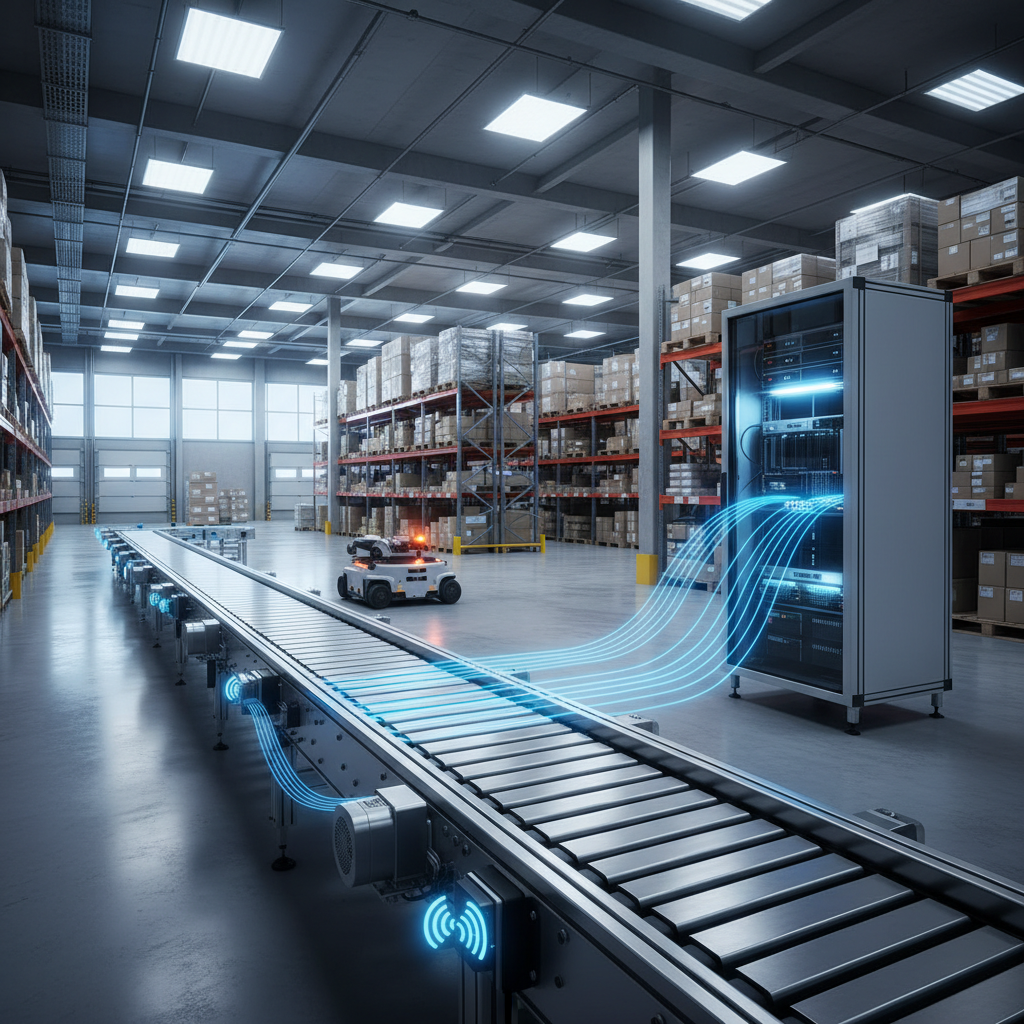
Low-code platforms insert a user-friendly software layer between the operations manager and the PLC. Instead of programming the PLC directly with complex code, you configure the conveyor’s behavior through a visual interface. This might involve:
- Dragging and dropping icons representing conveyor sections, motors, and sensors onto a digital twin of the layout.
- Using simple drop-down menus to define rules (e.g., "If barcode starts with 'EUR', divert to lane 3").
- Connecting logic blocks to create complex workflows, such as zone-based accumulation or routing packages based on weight.
This configuration is then automatically translated into the necessary instructions for the PLC or a corresponding motion controller, often a Motor Driven Roller (MDR) controller. This empowers the people who actually run the warehouse—the process engineers and maintenance managers—to make changes themselves.
Core Benefits of Low-Code for Warehouse Automation
Speed of Deployment
The most significant advantage is a dramatic reduction in implementation time. By eliminating the need for extensive custom coding and debugging cycles, a new conveyor line can be made operational in a fraction of the time. What traditionally took a quarter can now be achieved in a month. This speed allows businesses to respond to market opportunities, like launching a new e-commerce product line, with unprecedented agility.
Reduced Cost & Skill Gap
Specialized PLC programmers are a scarce and expensive resource in Europe, with hourly rates often exceeding €100-€150. Low-code platforms reduce the reliance on these specialists. In-house technicians and engineers can be trained in a matter of days to handle most configuration and modification tasks. This not only lowers direct project costs but also helps bridge the growing skills gap in the industrial automation sector. As detailed in our guide to WMS, WCS, and WES, this control layer is critical for an integrated system.
Flexibility and Scalability
Market dynamics change. A distribution center that primarily handles pallets today might need to process a high volume of individual parcels tomorrow. With a low-code approach, reconfiguring a conveyor line is no longer a multi-month project. An operator can visually remap the logic for a new sorting pattern or adjust the speed of a belt conveyor in hours. This makes the entire material handling system modular and adaptable, a core principle of modern logistics. This agility is key for companies experiencing rapid growth, as their physical processes can finally keep pace with business expansion, a challenge we discussed on our Easy Systems blog.
Comparing Low-Code, No-Code, and Traditional PLC Development
| Aspect | Traditional PLC Programming | Low-Code Platform | No-Code Platform |
|---|---|---|---|
| Target User | Specialized Automation Engineer | Process Engineer, Technician | Operations Manager, Supervisor |
| Flexibility | Extremely high (but complex) | High (within platform's framework) | Moderate (limited to pre-defined options) |
| Implementation Speed | Slow (months) | Fast (weeks) | Very Fast (days/hours) |
| Cost per Change | High (€2,000 - €10,000+) | Low (often internal time) | Negligible |
| Example Use Case | Complex, high-speed sortation system with custom safety protocols. | A modular conveyor line for assembly or packing with evolving workflows. | A simple transfer conveyor where the only variable is on/off or speed. |
Use Cases in a Modern European Warehouse
Reconfiguring a sortation line
Imagine a German 3PL provider that secures a new contract for a fashion retailer. They need to change their main sortation conveyor to handle smaller polybags instead of boxes and update the divert logic for 50 new destination stores. Traditionally, this would be a 4-6 week software project. With a low-code platform, the warehouse’s own process engineer can access the web-based interface, adjust the sensor trigger parameters for the smaller items, and remap the destination logic from a CSV file provided by the client. The changes can be tested in a digital twin and deployed overnight, minimizing downtime to less than 4 hours.
Integrating a new packing station
A French e-commerce fulfillment center wants to add three new manual packing stations along an existing roller conveyor line. This requires adding logic to stop totes at the correct station, signal the operator, and release the tote once packing is complete. Using a low-code environment, a technician can drag three new "stop" points onto the visual representation of the conveyor, link them to the physical photocells and pneumatic stops, and define the simple "stop-and-go" logic using a pre-built function block. The entire integration, from physical install to go-live, can be completed in a single day.
The Pivotal Role of the Warehouse Execution System (WES)
Low-code platforms for conveyor control do not operate in a vacuum. They are a crucial component of a broader software ecosystem managed by a Warehouse Execution System (WES). The WES acts as the central brain, coordinating all automated equipment in real-time. It receives orders from the Warehouse Management System (WMS), orchestrates the movement of goods across conveyors, sorters, and AGVs, and makes intelligent decisions to optimize flow.
The low-code platform provides the agility at the machine-control level, while the WES provides the overarching intelligence. The WES might tell a conveyor section, "Route this tote to packing zone B," and the low-code configured PLC/MDR controller executes that command flawlessly, managing the motor speeds, sensor readings, and diverts to make it happen.
Easy Systems: Your Partner for Agile Automation
The transition to more flexible, responsive automation requires more than just new software; it requires a partner who understands both the technology and the operational realities of a modern warehouse. At Easy Systems, we specialize in designing and implementing modular conveyor solutions that are built for change. Our systems are designed from the ground up to integrate seamlessly with modern low-code control platforms and Warehouse Execution Systems.
We don't just sell conveyors; we provide agile material handling solutions. By leveraging pre-engineered modules, standardized interfaces, and intelligent control software, we deliver systems that can be deployed faster and adapted more easily than traditional custom-built solutions. We help you move beyond the rigid constraints of old automation paradigms, creating a logistics environment that can evolve and grow with your business. Partner with us to build a warehouse that is ready for the challenges of today and the opportunities of tomorrow.
Frequently asked questions
What is the main difference between low-code and no-code for conveyor systems?+
Low-code platforms provide a high degree of flexibility using visual logic blocks and minimal scripting, targeting process engineers. No-code is simpler, using purely pre-defined templates for operators to make basic changes, like adjusting speed, but offers less customization. A typical low-code change might take 2-4 hours, whereas a no-code adjustment could take minutes.
How much can I realistically save using a low-code approach?+
You can expect to reduce initial software development and implementation costs by 15-30%. For a medium-sized project of €200,000, this can translate to €30,000 - €60,000 in savings, primarily by reducing the hours needed from expensive, specialized PLC programmers.
Do low-code platforms work with any conveyor hardware?+
Compatibility varies. Most modern low-code platforms are designed to work with standard industrial communication protocols like OPC UA and can control a wide range of hardware, especially Motor Driven Roller (MDR) systems. However, it's crucial to ensure the platform supports your specific brand of motors, sensors, and PLCs. Leading platforms support over 80% of common hardware.
Is a low-code controlled conveyor system secure?+
Yes, when implemented correctly. These platforms run on secure industrial networks, separate from general IT traffic. They incorporate user-based permissions, audit logs for all changes, and operate through robust controllers and PLCs. Security is comparable to traditional systems, with the added benefit of transparent, logged configuration changes.
Can I integrate a low-code conveyor system with my existing WMS?+
Absolutely. Integration is a key feature. Low-code platforms typically offer pre-built connectors or straightforward APIs to communicate with Warehouse Management Systems (WMS) and Warehouse Execution Systems (WES). A standard integration for exchanging order data and routing commands can often be configured in 20-40 hours.
What happens if the low-code software provider goes out of business?+
This is a valid concern. To mitigate this risk, choose platforms that generate standard PLC code or have an option to export the control logic. This ensures that even if the software provider disappears, the underlying PLC program remains accessible and can be maintained by a skilled programmer. Also, opt for vendors with a large, established user base in Europe.

The Easy Systems editorial desk reviews and fact-checks every Conveyor-Design article against Benelux project experience. Editors translate engineering decisions — throughput, peak factors, layout, integration — into plain-language guides for operations managers, project leads and decision-makers.
- Warehouse layout & slotting
- Order-profile analysis
- Vendor-neutral comparison
- Benelux logistics market