AI in Real-Time Conveyor Route Optimization for Logistics
AI is revolutionizing warehouse logistics by dynamically optimizing conveyor routes. By analyzing real-time data, AI algorithms boost throughput, reduce energy costs, and increase operational resilience, moving beyond the limitations of static PLC logic.
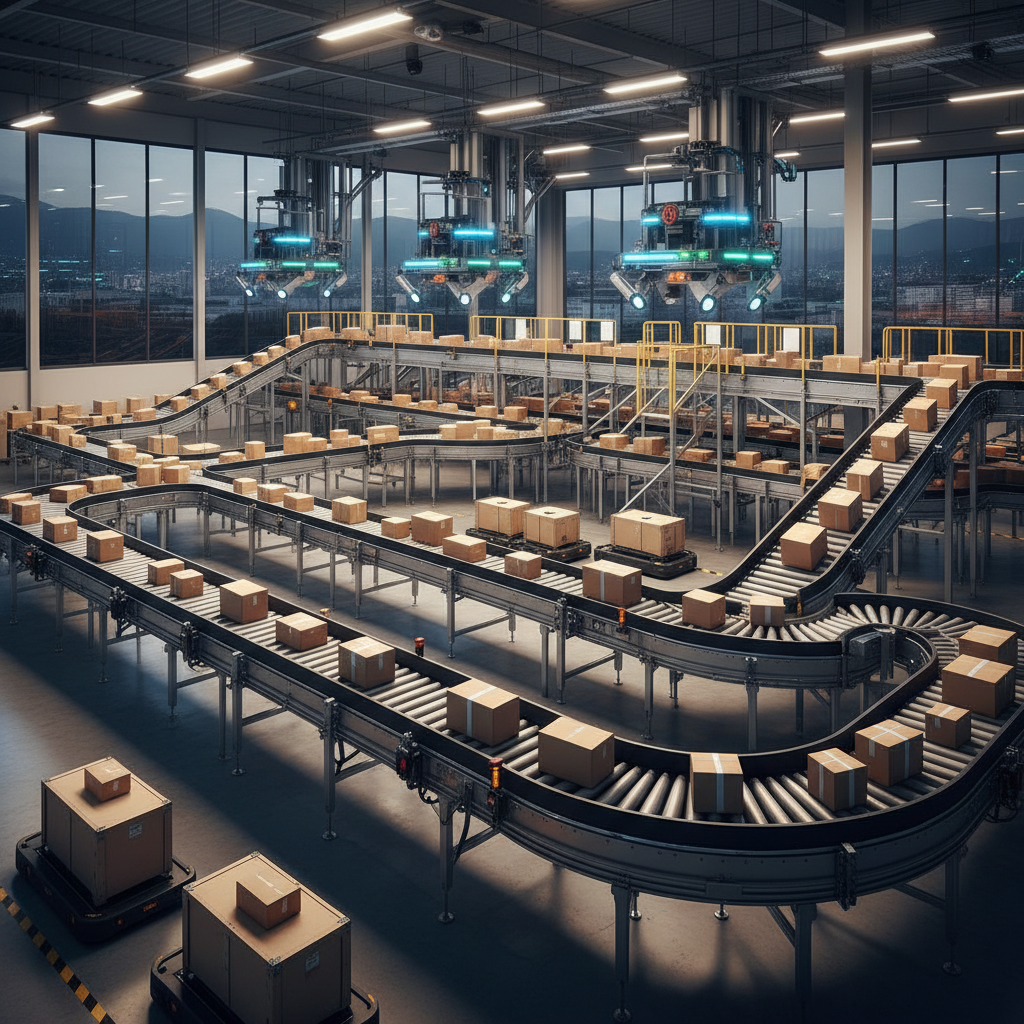
Key numbers
| Metric | Typical range (EU 2026) | Notes |
|---|---|---|
| Overall Throughput Increase | 20-30% | Compared to static PLC-based routing with same hardware. |
| Energy Consumption Reduction | 10-20% | Achieved by running conveyors only when needed ('sleep mode') and optimizing paths. |
| ROI for Implementation | 18-36 months | Based on throughput gains, energy savings, and reduced manual intervention. |
| AI Decision Time per Parcel | 50-200 ms | Time for the system to calculate the optimal route upon scanning an item. |
| Congestion-Related Downtime Reduction | 60-80% | Decrease in system stoppages caused by bottlenecks or jams on main lines. |
| Typical Software Integration Cost | €150,000 - €500,000 | For a medium to large DC, excluding hardware upgrades. |
In the high-stakes world of modern logistics, every second and every centimeter counts. As European warehouses grow larger and more complex to meet surging e-commerce demand, the limitations of traditional, static conveyor routing are becoming a critical bottleneck. The answer lies not in more hardware, but in smarter software: Artificial Intelligence is reshaping material flow by enabling real-time, dynamic optimization of conveyor routes.
Definition
AI-powered conveyor route optimization is the use of machine learning algorithms to continuously analyze real-time data from a warehouse's material handling system and dynamically select the most efficient path for each parcel, tote, or pallet. This data-driven approach replaces fixed, pre-programmed logic to improve speed, flexibility, and efficiency.
The Constraints of Traditional Conveyor Routing
For decades, conveyor systems have been the reliable workhorses of the warehouse, governed by Programmable Logic Controllers (PLC). While robust for simple, linear tasks, this control method struggles with the variability of modern logistics operations.
Static Paths and PLC Logic
Traditional systems rely on basic rule-based logic. A typical setup uses what is known as Zone Routing, where a conveyor network is divided into segments (zones). A PLC determines a fixed path for a package based on a simple destination scan. For example: "If barcode prefix is 4, send to sorter B." This logic is fast but incredibly rigid. If Sorter B is congested, the system cannot decide to temporarily send the package on a longer but faster route via Sorter C. Manual reprogramming by an engineer is required to change these locked-in paths.
Common Bottlenecks and Inefficiencies
This rigidity leads to predictable problems in a high-volume environment:
- Congestion Points: A sudden influx of parcels for a specific destination can overwhelm a single conveyor line, causing backups that ripple through the entire system.
- Underutilization: While one path is jammed, alternative routes with ample capacity may sit idle because the system's logic cannot see the bigger picture.
- Wasted Energy: Conveyors often run continuously or in long segments, consuming electricity even when no items are present. A 100-meter belt conveyor running at 0.75 m/s can consume over 1.1 kWh, and multiplying this across a facility highlights a significant operational cost.
How AI Revolutionizes Conveyor Optimization
AI transcends the simple "if-this-then-that" world of PLCs. By processing vast amounts of data in real-time, it makes intelligent, holistic decisions that optimize the entire network, not just a single zone.
Real-Time Data Inputs
An AI model, often integrated into a WES (Warehouse Execution System), serves as the system's brain. It constantly ingests data from multiple sources:
- Sensor Data: Photo-eyes, 3D cameras, and in-motion scales provide real-time information on parcel volume, dimensions, weight, and location on the conveyor.
- System Data: The WMS and WES provide order details, destination, priority level, and dispatch deadlines.
- Equipment Status: The AI monitors the operational status of every motor, sensor, and sorter, including energy consumption and predictive maintenance alerts.
Core AI Technologies at Play
This optimization is primarily driven by machine learning, specifically reinforcement learning. The AI learns the "reward" for a good decision—like reduced transit time or energy use—and gets a "penalty" for a bad one, like causing a jam. Over millions of simulated and real-world iterations, it teaches itself the optimal routing strategy for virtually any scenario. This is often tested and refined in a "digital twin," a complete virtual replica of the warehouse, before being deployed.
AI Routing vs. PLC Logic: A Comparative Analysis
The shift from PLC logic to AI-driven control represents a fundamental change in warehouse orchestration. While PLCs remain essential for low-level control (e.g., physically turning a motor on/off), the high-level routing decisions are elevated to the AI.
Decision-Making and Adaptability
A PLC makes a decision in microseconds, but it's a simple, pre-defined one. An AI might take 50-100 milliseconds, but its decision considers the state of the entire facility. It can ask complex questions like: "What is the fastest path for this priority parcel right now, considering current traffic, potential congestion in 5 minutes, and the energy cost of each available route?"
| Feature | Traditional PLC Logic | AI-Powered WES |
|---|---|---|
| Decision Basis | Pre-programmed if-then rules | Real-time, multi-factor analysis |
| Adaptability | Low (requires manual reprogramming) | High (self-learning and adaptive) |
| Scope | Local / Zonal | System-wide (holistic) |
| Typical Throughput Gain | Baseline | +15-25% |
| Energy Savings Potential | Minimal | 10-15% |
| Indicative Implementation Cost | €10,000 - €50,000 (for logic) | €80,000 - €250,000+ (for WES/AI layer) |
Tangible Benefits in a European Context
Implementing AI-driven routing delivers measurable results that directly address the pressures faced by European logistics operators, from labor shortages to sustainability targets.
Increased Throughput and Capacity
For a distribution center in Germany preparing for the Black Friday rush, AI can increase carton-per-hour (CPH) capacity on the existing hardware. By intelligently balancing flow and preventing jams, a system rated for 5,000 CPH might consistently achieve 6,000 CPH or more during peak times, without adding a single meter of new conveyor.
Reduced Energy Consumption
With the EU's Green Deal pushing for greater industrial efficiency, energy savings are paramount. AI contributes directly by selecting the shortest physical route and powering down unused conveyor segments. Over a year, a large-scale system can see a 10-15% reduction in electricity consumption, translating to tens of thousands of Euros in savings and a significantly lower carbon footprint.
Implementation: Integrating AI into Your System
Transitioning to an AI-optimized conveyor network is a strategic upgrade that involves software, sensors, and system architecture. The journey requires careful planning and partnership with automation experts.
The Central Role of the WES
The AI brainpower is typically a component of a modern Warehouse Execution System (WES). While the WMS manages inventory and the PLC controls hardware, the WES acts as the real-time traffic conductor, using AI to make split-second routing decisions to optimize flow. For many businesses, growth is a positive sign, but it often brings unforeseen challenges when internal processes fail to scale accordingly. This is where strategic automation becomes critical. Read more about how growing companies must evolve their processes.
Sensorization and Data
AI is only as smart as the data it receives. Upgrading a facility often requires "sensorization"—installing a comprehensive network of sensors on the roller conveyor or belt conveyor lines. This includes high-speed cameras for barcode reading, 3D scanners for volume, and embedded sensors that report on the operational health of system components.
The Future: Towards Fully Autonomous Intralogistics
The application of AI in conveyor routing is just the beginning. The next frontier is the complete integration of all automated systems under a single AI-powered orchestration platform.
Predictive Rerouting
Future systems won't just react to a breakdown; they will prevent the disruption. By analyzing vibration and temperature data from a motor, a predictive AI model will be able to forecast a potential failure hours in advance. It can then automatically de-prioritize that conveyor line and reroute flow, all while scheduling a maintenance ticket—turning unplanned downtime into planned upkeep.
Conveyors, AMRs, and AGVs in Concert
The ultimate goal is a seamless dance between fixed and mobile automation. The AI-WES will not only optimize the conveyor route but also direct an AMR to the precise conveyor offload point at the exact right moment, creating a continuous, fully autonomous flow from inbound to outbound.
Easy Systems: Your Partner for Intelligent Conveyor Automation
The transition to AI-driven logistics can seem daunting, but the competitive advantages are undeniable. At Easy Systems, we specialize in designing and implementing intelligent conveyor solutions that are robust, scalable, and future-proof. Our expertise lies not just in the high-quality modular hardware, but in the sophisticated control and software layers that unlock true efficiency. We partner with European businesses to analyze their unique operational challenges and build tailored systems that leverage smart technologies, from advanced PLC programming to full-scale WES integration with AI capabilities. We help you move beyond static routes to create a resilient, adaptive, and highly efficient material handling network ready for the demands of tomorrow.
Frequently asked questions
Can AI be added to an existing, older conveyor system?+
Yes, retrofitting is common. It involves integrating a Warehouse Execution System (WES) with AI capabilities, adding modern sensors, and ensuring PLCs can communicate with the new software. A typical retrofit project can see a throughput increase of 20% on existing hardware, making it a viable upgrade.
What is the typical ROI for an AI routing project?+
The Return on Investment for AI-driven conveyor optimization typically ranges from 18 to 36 months. This is achieved through increased throughput on existing hardware, energy savings of 10-20%, reduced labor needs for clearing jams, and minimized system downtime, justifying the initial software investment.
Does AI replace the WMS or PLC?+
No, AI complements them. The WMS manages inventory, the PLC executes low-level hardware commands (e.g., run motor), and the AI-driven WES makes high-level routing decisions in real-time, instructing the PLCs. This synergy increases decision-making speed by over 10x compared to human oversight.
How exactly does AI save energy?+
AI saves energy by routing items to minimize total travel distance and activating 'sleep modes' for empty conveyor sections. Instead of running continuously, up to 40% of a conveyor network can be safely powered down during off-peak moments, directly reducing electricity costs by 10-20%.
Is AI routing only for new warehouses?+
No, it's highly effective in older, complex facilities. Brownfield sites with convoluted layouts often gain the most, as AI can find non-obvious, efficient paths that human programmers would miss. Retrofitting can unlock an additional 2-4 years of competitive operational life from existing hardware.

The Easy Systems editorial desk reviews and fact-checks every Conveyor-Design article against Benelux project experience. Editors translate engineering decisions — throughput, peak factors, layout, integration — into plain-language guides for operations managers, project leads and decision-makers.
- Warehouse layout & slotting
- Order-profile analysis
- Vendor-neutral comparison
- Benelux logistics market