The Role of AI in Optimizing Conveyor Routing & Sorting
AI-powered algorithms are transforming conveyor systems by enabling dynamic, real-time routing and intelligent sorting. This significantly enhances warehouse throughput, reduces errors, and lowers operational costs for European logistics hubs facing increasing complexity.
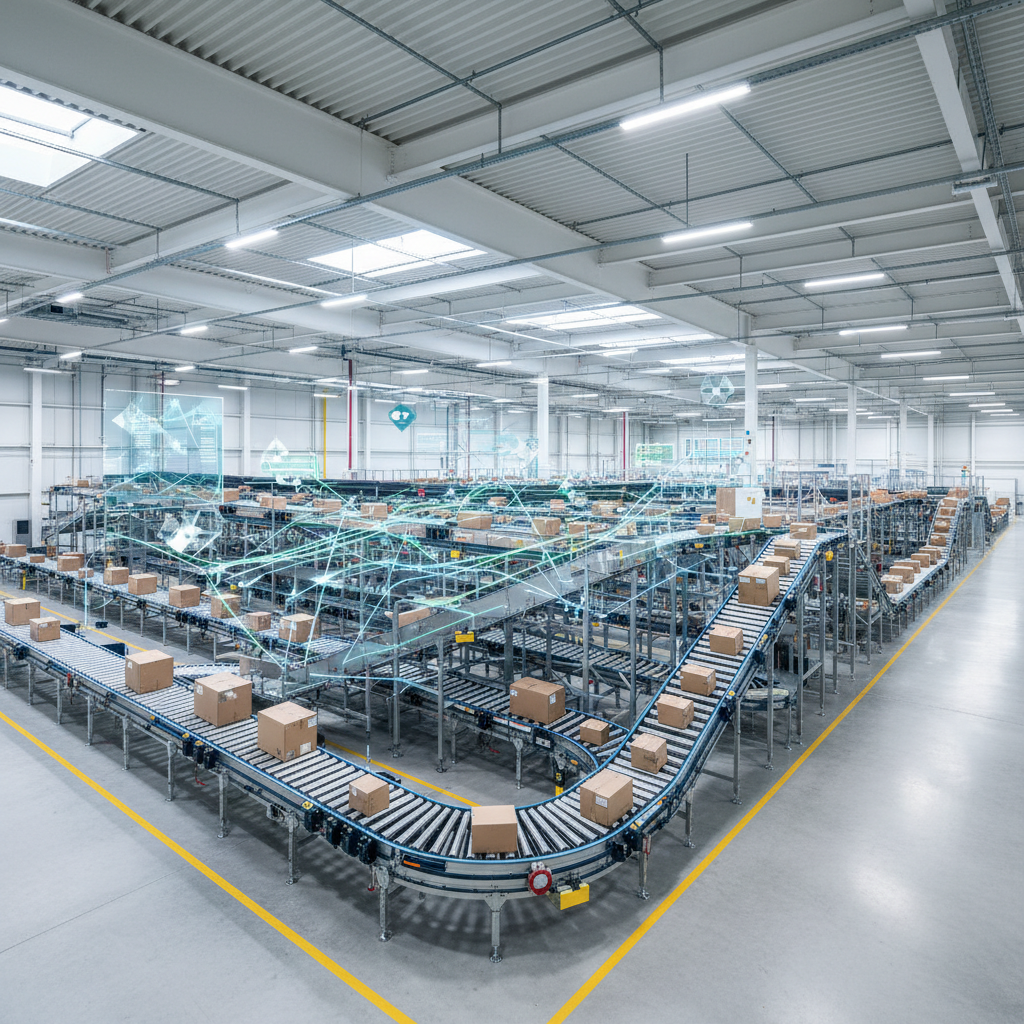
Key numbers
| Metric | Typical range (EU 2026) | Notes |
|---|---|---|
| Throughput Increase | 15-30% | Compared to a similar system with traditional PLC/WCS logic. |
| Sorting Accuracy (AI Vision) | > 99.9% | Reduces costs associated with mis-sorted parcels and manual correction. |
| Operational Cost Reduction | 5-10% | Derived from higher efficiency, reduced labour, and lower energy use. |
| AI Software Retrofit Cost | €50,000 - €150,000 | Per primary sorting system/line, excluding hardware upgrades. |
| Return on Investment (ROI) | 18-36 months | Varies based on system scale, volume, and operational complexity. |
| System Decision Time | 50-200 ms | The time for the AI to analyse data and issue a new routing command. |
In the high-stakes world of European logistics, where every second and every square meter counts, the efficiency of your conveyor system is paramount. Traditional, rule-based systems are struggling to keep pace with the demands of e-commerce and just-in-time fulfillment. Enter Artificial Intelligence (AI)—the transformative technology that turns rigid conveyor lines into intelligent, self-optimizing networks.
Definition
AI-driven conveyor optimization is the use of machine learning algorithms and advanced analytics to make real-time, data-backed decisions about how items are transported, routed, and sorted within a warehouse. Instead of following fixed paths, the system dynamically adapts to changing conditions to maximize efficiency and throughput.
How Traditional Conveyor Logic Falls Short
For decades, conveyor systems have been the workhorses of the warehouse, reliably moving goods from A to B. Their logic has traditionally been programmed into a PLC (Programmable Logic Controller) or managed by a Warehouse Control System (WCS). This approach is based on a fixed set of "if-then" rules. For example: "If barcode scan shows postal code range 1000-2000, divert to sorter lane 5."
This rigid logic works well in a stable, predictable environment. However, modern logistics is anything but predictable. Issues that challenge traditional systems include:
- Unexpected Volume Surges: A sudden influx of orders for a specific SKU can overwhelm a designated packing area or sorting lane.
- Downstream Bottlenecks: A problem at a packing station or a full sorter chute can cause items to back up, leading to system-wide gridlock.
- Inefficient Routing: The "shortest path" is not always the "fastest path." A conveyor line might be shorter in meters but heavily congested, while a longer, underutilized route would be quicker.
- Lack of Adaptability: Rule-based systems cannot learn from past events or adapt to gradual changes in order profiles.
The AI-Powered Shift: From Reactive to Predictive Control
AI introduces a paradigm shift from reactive to predictive and prescriptive control. Instead of just reacting to a sensor that detects a full lane, an AI-powered system anticipates the problem before it occurs and pre-emptively reroutes traffic. This is achieved through a continuous cycle of data analysis and decision-making.
Real-Time Data Analysis
AI algorithms process thousands of data points every second. This data comes from sensors across the conveyor network: item scanners, volumetric dimensioners, photo-eyes measuring lane capacity, and motor performance metrics. The AI fuses this data to create a complete, real-time digital picture of the entire system's status.
Predictive Bottleneck Detection
Using machine learning models trained on historical data, the AI can recognize patterns that typically precede a bottleneck. It might learn, for instance, that when the flow from Zone A increases by 20% while the pick rate in Zone C drops by 10%, a blockage is likely to occur at the main merge point in five minutes. Armed with this prediction, it can start diverting a portion of the flow from Zone A through an alternate route to maintain system fluidity.
Core Benefits of AI in Conveyor Operations
The business case for integrating AI into conveyor logistics is compelling, with measurable improvements in speed, accuracy, and cost-efficiency. A well-integrated AI can handle the kind of complex decision-making that is impossible for a human operator or a static WCS. As many businesses find, processes don't always scale with growth, but AI provides the intelligent layer needed to manage that increased complexity effectively.
| Parameter | Traditional PLC/WCS Logic | AI-Driven Control |
|---|---|---|
| Decision-Making | Static, rule-based ("If X, then Y") | Dynamic, context-aware, predictive |
| Adaptability | Low; requires manual reprogramming for new rules | High; self-learning and adapts to new patterns |
| Typical Throughput (packages/hr) | Baseline (e.g., 8,000 pph) | Baseline +15-25% (e.g., 9,200 - 10,000 pph) |
| Sorting Accuracy | ~99.5% | >99.9% |
| Response to Bottlenecks | Reactive (stops upstream flow when full) | Proactive (reroutes flow before bottleneck occurs) |
| Initial System Cost | Standard automation cost | Standard cost + €30,000 - €100,000+ for software/integration |
Key AI Technologies in Action
Several specific AI technologies are powering this revolution in warehouse logistics.
Machine Learning Algorithms
At the heart of AI-driven routing are reinforcement learning and other machine learning models. The system is essentially a "player" whose goal is to achieve the highest "score" (maximum throughput). It constantly tries different routing strategies. Routes that lead to faster delivery with fewer stops are "rewarded," reinforcing that behavior. This allows the system to discover highly efficient routing combinations that a human programmer would never have conceived of.
Computer Vision for Sorting
AI-powered cameras can do much more than just read a barcode. They can:
- Identify Damaged Packages: A camera can spot a crushed corner or a tear and automatically divert the package to a quality control station.
- Read Unstructured Text: Advanced Optical Character Recognition (OCR) can read addresses even from handwritten labels.
- Classify Items without Barcodes: For certain applications, an AI can be trained to recognize products by their appearance (e.g., a specific bottle shape or package design), enabling sorting even when a label is missing or unreadable.
Digital Twins for Simulation
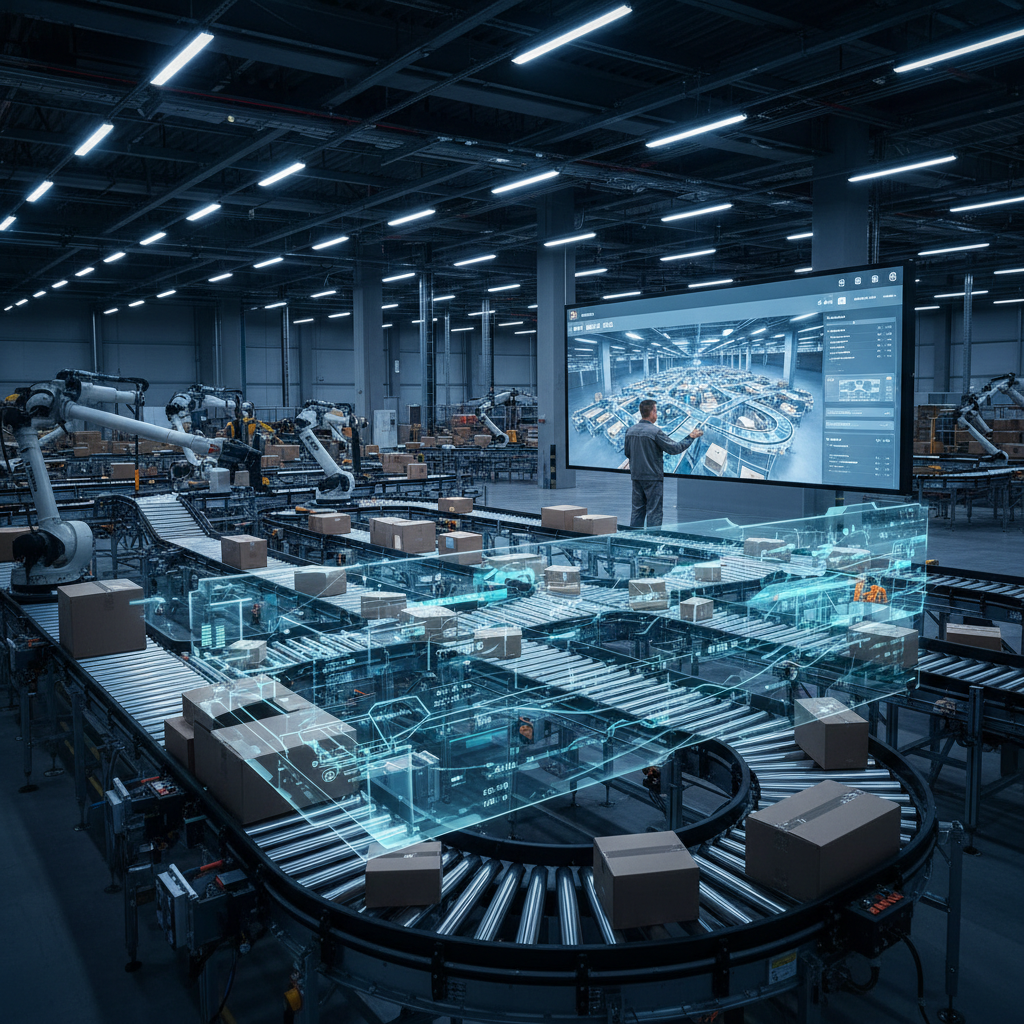
A digital twin is a virtual replica of your entire conveyor system. Before deploying a new routing algorithm on the live warehouse floor, it can be tested in this risk-free simulation environment. The digital twin can run thousands of scenarios in a matter of minutes—simulating peak season volumes, specific machine failures, or changes in product mix—to validate that the AI will perform as expected under real-world pressure.
Concrete Applications in the European Context
The pressure on European supply chains makes AI particularly valuable. For an e-commerce giant in Germany, AI-routing is essential for managing the extreme volume fluctuations during Black Friday. The system can predict which product categories will spike and pre-emptively allocate more outbound sorting capacity, ensuring OTIF (On-Time In-Full) delivery promises are met.
In the Netherlands, a major fresh food distributor uses AI-powered vision to sort produce. The system identifies the size, color, and ripeness of fruits and vegetables on the conveyor, sorting them into different quality grades at speeds of several items per second—a task that is slow and subjective for human workers.
Integrating AI with Your Existing Systems
Implementing AI does not necessarily mean ripping and replacing your entire infrastructure. Often, the AI layer sits on top of the existing WMS and WCS. The WMS still manages inventory and orders, and the WCS still directly controls the motors and diverters. The AI engine acts as an "intelligent coordinator," taking in data from the WCS and sending back strategic routing commands. This integration-focused approach allows for a phased implementation, delivering incremental ROI without disrupting core operations.
Why Easy Systems is Your Partner for Intelligent Automation
At Easy Systems, we are at the forefront of integrating intelligent automation into the material handling systems of European businesses. We understand that AI is not a magic bullet but a powerful tool that must be expertly applied to solve specific operational challenges. Our approach is grounded in deep engineering expertise and a commitment to practical, scalable solutions.
We design modular conveyor systems that are "AI-ready," featuring the sensor density and control architecture needed to support advanced analytics. Our team works with you to understand your unique product flow and bottlenecks, designing a solution that leverages intelligent routing and sorting to unlock new levels of efficiency and resilience. We help you move from a fixed-rule environment to a dynamic, learning-based operation fit for the future of logistics.
Frequently asked questions
What is the main difference between AI-based routing and traditional WCS logic?+
Traditional WCS logic uses rigid 'if-then' rules, which can cause system-wide blockages. AI-based routing is dynamic, using machine learning to analyse thousands of data points and predict congestion. This allows it to make smarter, adaptive routing decisions in under 200 milliseconds, boosting overall system fluidity and preventing slowdowns before they occur.
How much can AI realistically improve sorting accuracy?+
While standard barcode-based sorting is already quite high, AI-powered computer vision can push accuracy from ~99.5% to over 99.9%. It achieves this by identifying damaged packages, reading imperfect labels, and even recognizing items by shape or packaging, significantly reducing costly mis-sorts.
Does implementing AI routing require a complete hardware overhaul?+
Not necessarily. In many cases, an AI software layer can be retrofitted onto existing conveyor hardware and PLCs. This AI 'brain' integrates with current sensors and control systems, offering performance gains of 15-30% without the heavy capital expenditure of a full mechanical replacement. The core investment is in software and data infrastructure.
What is the typical Return on Investment (ROI) for an AI conveyor project?+
For a medium-to-large European distribution centre, the typical ROI period for an AI conveyor optimization project is between 18 and 36 months. This is achieved through increased throughput, reduced labour costs from fewer manual interventions, higher sorting accuracy, and decreased energy consumption. The initial software investment is often recouped within three years.
How does AI reduce energy consumption in conveyor systems?+
AI reduces energy consumption by enabling 'sleep-on-demand' functionality and optimizing flow. Instead of running continuously, motors for specific conveyor sections can be powered down when the AI predicts a lull in traffic. It also calculates the most energy-efficient route, potentially reducing overall conveyor run-time by 5-15% for the same level of throughput.

The Easy Systems engineering team designs, integrates and commissions conveyor systems and warehouse automation across Belgium, the Netherlands and Luxembourg. Combined experience covers roller and belt conveyors, sorters, AGV/AMR fleets, AutoStore, shuttle AS/RS and WMS/WCS integration for distribution centers and e-commerce fulfillment operations.
- Conveyor design (roller, belt, modular plastic)
- Sortation & merge logic
- AGV / AMR fleet integration
- AutoStore & shuttle AS/RS
- WMS / WCS integration