Automated Conveyor Quality Control: Vision & AI Integration
Integrating AI-powered machine vision for automated quality control on conveyor systems is crucial for modern logistics. This technology detects defects, verifies labels, and ensures package integrity, boosting throughput and accuracy in European distribution centers.
In the high-stakes world of European e-commerce and distribution, speed must be matched by absolute precision. A single mislabeled package or damaged item can trigger a costly chain reaction of returns, customer dissatisfaction, and reputational damage. This is why leading logistics operations are moving beyond manual checks and embracing automated quality control directly on the conveyor line, powered by machine vision and artificial intelligence.
Definition
Automated conveyor quality control is the integration of high-resolution cameras, advanced sensors, and AI-driven software with conveyor systems to automatically inspect, verify, and validate products and packages in real-time without manual intervention. It serves as a critical checkpoint to ensure items meet predefined standards before they proceed to the next stage of the logistics chain, such as sorting or shipping.
Key Numbers: Vision System Performance
| Metric | Typical Range (EU 2026) | Notes |
|---|---|---|
| Throughput | 3,000 - 10,000 CPH | Dependent on item size and inspection complexity. |
| Conveyor Speed | 0.5 - 3.0 m/s | Requires high-speed cameras and synchronized lighting. |
| System Investment | €15,000 - €80,000 per line | Includes hardware, software, and integration with the existing WCS. |
| Typical ROI | 1.5 - 3 years | Based on reduced labor, fewer returns, and improved customer retention. |
| Detection Accuracy | > 99.5% | For trained defect types; significantly higher than manual inspection. |
| Energy Consumption | 0.2 - 0.8 kWh | Primarily for industrial PC and LED lighting; minimal impact on total system energy. |
The Core Components of an Automated QC System
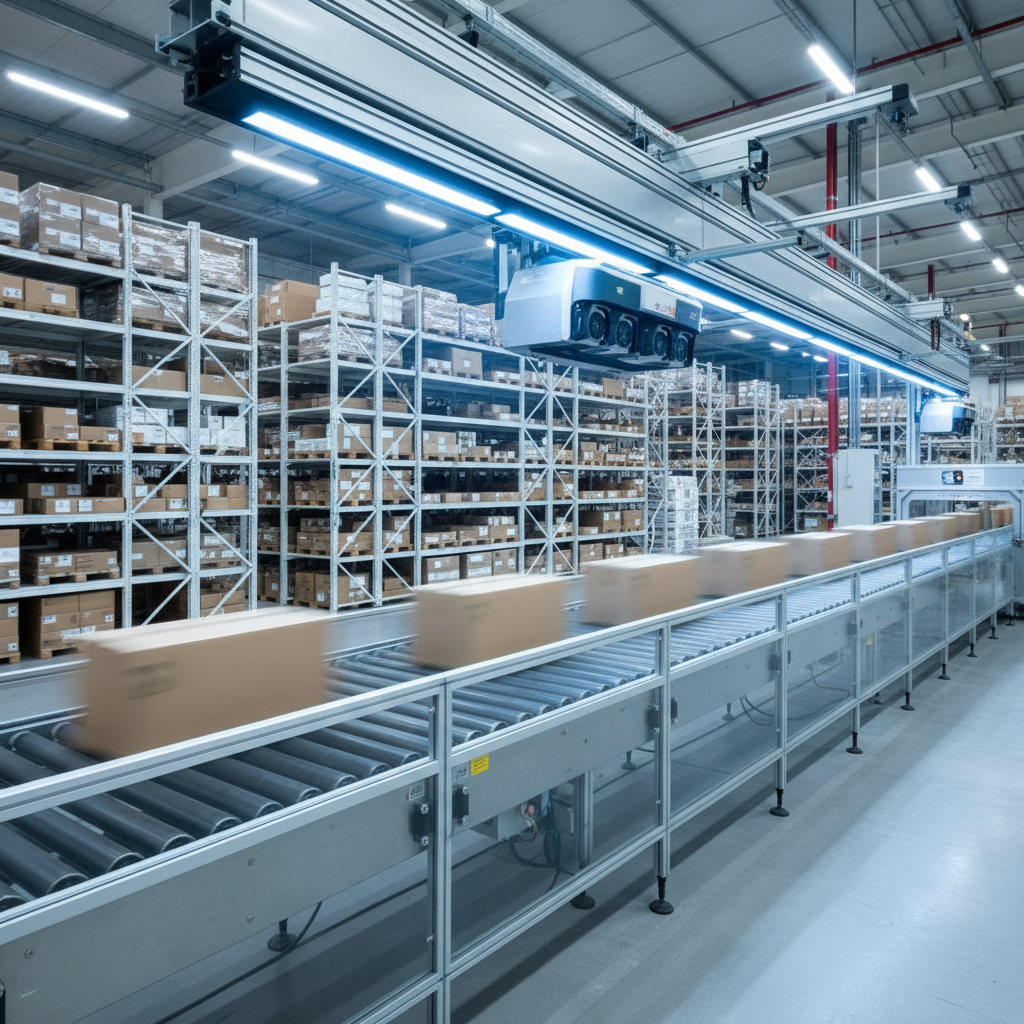
An effective automated quality control station on a roller conveyor or belt conveyor is more than just a camera. It's a synchronized ecosystem of hardware and software designed for high performance in demanding industrial environments.
Hardware Integration
- Industrial Cameras: High-resolution (2MP to 20MP) area scan or line scan cameras are the workhorses. Line scan cameras are ideal for inspecting continuous flows on fast-moving belts, while area scan cameras capture static images of items as they pass.
- Optics & Lighting: The correct lens determines the field of view and image sharpness. Controlled, high-intensity LED lighting (e.g., dome lights, bar lights, backlights) is critical to eliminate shadows and create high-contrast images, enabling the software to reliably detect features.
- Processing Unit: An industrial PC or edge computing device processes the image data locally. This real-time processing is essential for making immediate decisions, such as activating a rejection mechanism or flagging an order in the WCS.
- Physical Integration: The entire assembly is mounted on a sturdy frame over the conveyor. For reject handling, it can trigger a downstream pneumatic pusher, a diverter arm, or a cross-belt sorter cell to move a flagged item to a rework or quarantine lane.
Software and AI: The Brains of the Operation
The real power of these systems lies in their software, increasingly driven by AI.
Comparison of Vision Software Approaches
| Approach | Description | Best For | Limitations |
|---|---|---|---|
| Rule-Based Algorithms | Uses explicitly programmed rules to analyze pixels, edges, and contrasts. E.g., "count black pixels in this area to verify a barcode is present." | Simple, repetitive tasks like barcode presence/absence, basic dimension checks. | Inflexible; cannot handle variations in lighting, position, or unexpected defects. High maintenance. |
| Template Matching | Compares a captured image against a "golden template" of a perfect product. | Verifying label placement, logo correctness, and gross-level completeness. | Struggles with natural variations in packaging, slight rotations, or complex surface textures. |
| AI/Deep Learning | A neural network is trained on thousands of images of "good" and "bad" examples to learn what constitutes a defect on its own. | Complex tasks with high variability: detecting subtle damage, classifying defect types, reading varied text (OCR). | Requires a large dataset for initial training and significant computational power. |
The Role of the WES
The vision system does not operate in a vacuum. It communicates directly with a Warehouse Execution System (WES). When a defect is detected, the vision system sends a signal to the WES, which then orchestrates the response. This could mean updating the order status to "QC Failed," directing the conveyor to route the package to a rework station, and logging the event for analytics. This integration is vital for creating a closed-loop system where data drives physical action.
Common QC Tasks in European Logistics Hubs
In a typical distribution center in Germany, France, or the Benelux, automated vision systems perform several key tasks simultaneously:
- Barcode & Label Verification: Reading 1D/2D barcodes to confirm the right item is in the right tote and verifying that the shipping label is correct, legible, and properly applied. This single check prevents a huge number of shipping errors.
- Package Integrity Checks: Identifying physical damage such as dents, tears, crushed corners, or improperly sealed flaps on cardboard boxes.
- Item Counting & Completeness: For open-top totes or transparent polybags, the system can verify that the correct number of items is present.
- Foreign Object Detection (FOD): Ensuring no stray materials, tools, or debris are left in the shipping container.
Many companies find that their internal processes are a bottleneck for growth. They might have a great product and a growing customer base, but if the fulfillment process can't keep up, it puts a brake on the entire operation. As discussed in a previous analysis, companies grow, but their processes don't always grow with them, leading to inefficiencies that automated QC can directly solve.
Implementation Challenges and Best Practices
Integrating a vision system requires careful planning.
Key Considerations:
- Product & Packaging Mix: The system must be robust enough to handle the full range of product sizes, shapes, and packaging materials. A system trained only on brown cardboard boxes may fail when shiny, reflective packaging is introduced.
- Environmental Factors: Ambient light from skylights or windows can interfere with the controlled lighting of the vision system. Dust and vibrations from machinery can affect camera stability and image quality.
- Data and Training: For AI-based systems, collecting and labeling a large, diverse dataset of good and bad examples is the most critical and time-consuming part of the project. A typical training set might require 5,000-10,000 labeled images.
Positioning Easy Systems as Your Trusted Partner
At Easy Systems, we understand that quality control is not an isolated function but an integral part of your entire material flow. We don't just sell conveyor hardware; we engineer comprehensive solutions. Our expertise lies in designing modular and intelligent conveyor systems—from roller and belt conveyors to complete sorting solutions—that are pre-engineered for seamless integration with third-party technologies like AI-powered vision systems. We work with leading vision partners across Europe to ensure that the physical transport layer is perfectly synchronized with the digital inspection layer. Our approach guarantees that your investment in automation delivers not just speed, but the logistical perfection your customers demand, ultimately protecting your bottom line and brand reputation.
Frequently asked questions
What is the cost of an automated quality control system for a conveyor?+
The cost for a single inspection point on a conveyor line typically ranges from €15,000 to €80,000 in Europe. This price includes the camera, lighting, industrial PC, software, and integration. The final cost depends on the complexity of the inspection tasks and the conveyor speed.
How fast can AI vision systems inspect products on a conveyor?+
Modern AI vision systems can reliably inspect products on conveyors moving at speeds up to 3 meters per second. This allows for throughputs of 3,000 to 10,000 items per hour, depending on the size of the items and the complexity of the checks being performed.
What kind of defects can an automated vision system detect?+
AI-powered vision systems can detect a wide range of defects, including incorrect or unreadable barcodes, damaged packaging (dents, tears), improper seals, incorrect product color or shape, missing items within a package, and the presence of foreign objects. The system is trained on your specific quality criteria.
What is the accuracy of AI-based quality control in a warehouse?+
AI-based quality control systems regularly achieve over 99.5% accuracy in detecting trained defects. This is a significant improvement over manual inspection, which typically has an accuracy rate of 80-90% and is prone to fatigue and human error, especially at high speeds.
How long does it take to integrate a vision system into an existing conveyor line?+
The physical installation of a vision system over a conveyor can be done in a few days. The main time investment is in software configuration and AI model training, which can take 2 to 6 weeks. This involves collecting images of your products and training the system to meet your specific quality standards.
Can a vision system check if my packages are sealed correctly?+
Yes, checking for proper sealing is a common application. Using specific lighting techniques, the vision system can detect gaps in tape, unclosed flaps, or bulging lids on boxes. It can measure the gaps and flag any package that exceeds a preset tolerance, ensuring secure transit.

The Easy Systems editorial desk reviews and fact-checks every Conveyor-Design article against Benelux project experience. Editors translate engineering decisions — throughput, peak factors, layout, integration — into plain-language guides for operations managers, project leads and decision-makers.
- Warehouse layout & slotting
- Order-profile analysis
- Vendor-neutral comparison
- Benelux logistics market