Modular Conveyor Systems: The Agile Solution for Benelux Logistics
Modular conveyor systems offer unparalleled flexibility for businesses facing a volatile market. Learn how these adaptable systems are revolutionizing logistics and manufacturing in the Benelux, enabling rapid scaling and reconfiguration to meet changing demands.
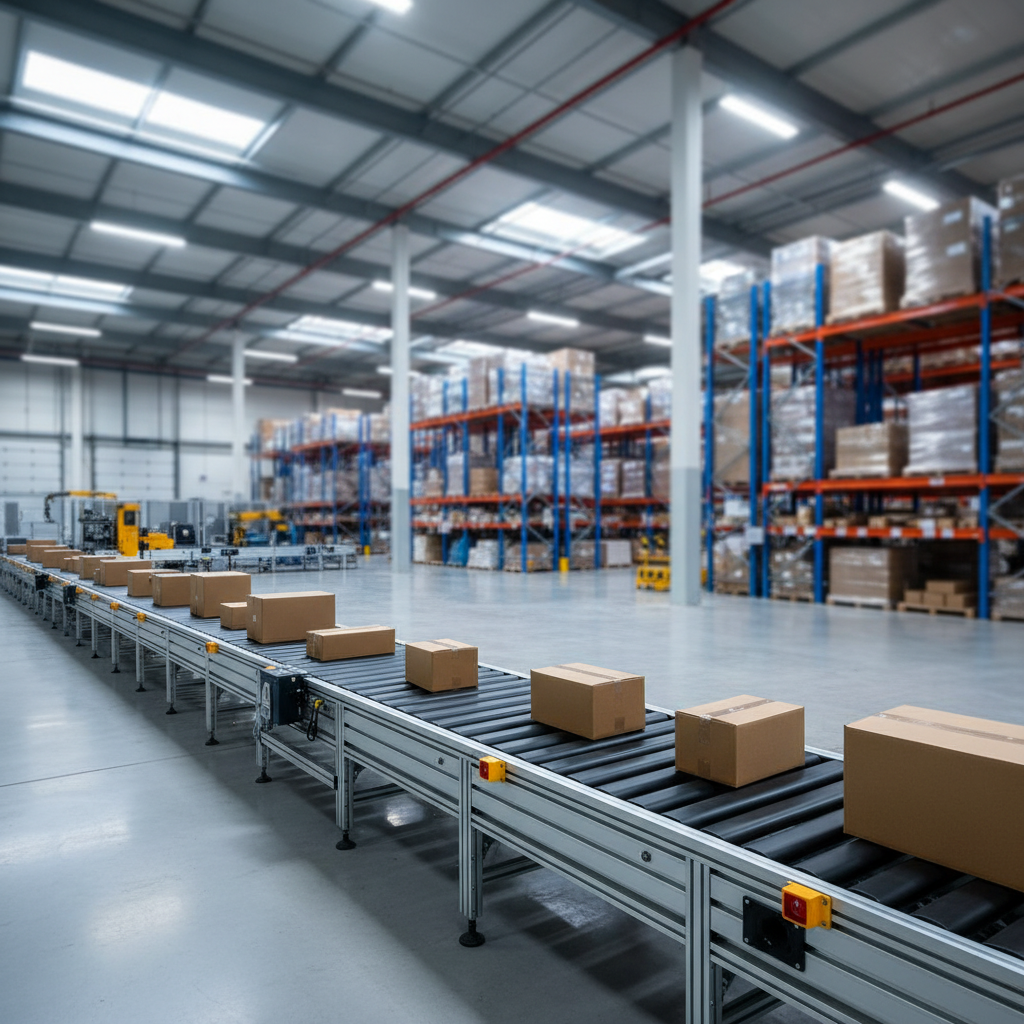
In the fast-paced logistics landscape of the Benelux—a crucial crossroads for European trade—the ability to adapt is not just an advantage; it's a necessity. E-commerce growth, fluctuating consumer demand, and persistent labor shortages require warehouse and production facilities to be more agile than ever. Traditional, fixed conveyor systems are proving too rigid for this new reality. This is where modular conveyor systems emerge as a strategic solution, offering unparalleled flexibility to future-proof operations.
Definition
A modular conveyor system is a material handling solution built from standardized, interconnecting modules. These pre-engineered sections—such as straight tracks, curves, transfers, and inclines—can be easily assembled, reconfigured, or expanded to create a custom transport path, much like building with LEGO blocks. This contrasts sharply with traditional systems that are custom-fabricated as a single, monolithic unit.
Why Flexibility is King in the Benelux Market
The logistics reality in Belgium, the Netherlands, and Luxembourg is defined by high density, high throughput, and proximity to major European ports like Antwerp and Rotterdam. This creates a unique set of pressures:
- E-commerce Volatility: Seasonal peaks (like Black Friday or Sinterklaas) and unpredictable trends require layouts that can be quickly adapted, for instance, to increase packing stations or re-route goods for a temporary promotion.
- Product Lifecycle Changes: As products are introduced or retired, the ideal process flow changes. A modular system can be adjusted without requiring a complete overhaul, saving significant time and capital expenditure.
- Space Optimization: Real estate in the Benelux is expensive. Modular systems allow for compact, three-dimensional layouts (e.g., using spiral conveyors) and can be reconfigured to make the most of available square meters as needs evolve.
- Labor Shortages: Automation is key to bridging the labor gap. Flexible conveyors can be easily integrated with automated packing machines, robotic palletizers, or pick-and-place systems, allowing businesses to automate processes incrementally.
Modular vs. Traditional Conveyor Systems
The fundamental difference between modular and traditional systems lies in their design philosophy. One is built for change, the other for permanence. This has significant implications for cost, downtime, and long-term value.
| Feature | Modular Conveyor System | Traditional Conveyor System |
|---|---|---|
| Scalability | High (add, remove, or replace modules in hours) | Low (requires cutting, welding, and significant engineering) |
| Installation Time | Low (typically 1-5 days) | High (weeks or even months for complex systems) |
| Reconfiguration Downtime | Minimal (hours) | Extensive (days or weeks), causing major operational disruption |
| Initial Investment (€) | Moderate (e.g., €15,000 - €30,000 for a 20m system) | Low to High (can be cheaper for very simple, straight lines) |
| Total Cost of Ownership (TCO) | Lower over 5+ years due to reuse and adaptability | Higher due to costly modifications, scrap, and extended downtime |
| Ideal Application | E-commerce, 3PL, food, pharma; operations with changing needs | Long-term, stable, high-volume production with a fixed process |
Core Components of a Modular System
A robust modular system is composed of several key building blocks:
- Drive & Tail Units: The start and end points, housing the motor (typically a 24V or 400V drive) and tensioning system.
- Intermediate Sections: Standard straight sections, available in lengths from 250 mm to 3,000 mm, forming the bulk of the conveyor.
- Curves & Bends: 45° or 90° curve modules to navigate corners. These can be simple roller curves or powered belt curves for maintaining product orientation.
- Transfers & Junctions: Special modules for moving items from one conveyor line to another, crucial for sorting or merging flows.
- Specialized Modules: This includes inclines/declines, accumulation sections like a Zero-Pressure Accumulation conveyor, and integration frames for printers or scanners.
The Financial Case: Calculating the ROI of Modularity
While a modular system might have a slightly higher initial purchase price than a simple, welded belt conveyor, its Return on Investment (ROI) is realized through avoided costs and enhanced agility.
Consider a hypothetical 3PL in Brussels that needs to re-route its main outbound line. With a traditional system, this could mean 5 days of downtime. At an operational cost of €20,000 per day, that’s a €100,000 hit to the business, plus the cost of engineering and fabrication. With a modular system, the same reconfiguration could be done over a weekend by an internal maintenance team, costing perhaps €5,000 in labor and involving zero operational downtime during peak hours. The ROI is achieved in a single event.
It's a common story we see across the region. As described in a recent analysis, companies grow, but their processes don't always keep up. Investing in infrastructure that can grow and change with the business is the most effective way to manage this challenge and protect long-term profitability.
Integration with Your Warehouse Ecosystem
Modern logistics is a system of systems. A modular conveyor is not an island; it must communicate seamlessly with other warehouse technologies. This is another area where modularity shines. Standardized modules often come with pre-built support for common sensors, photo-eyes, and motor controls (e.g., MDRs). For a deeper dive into roller conveyor types, see our Roller Conveyor Guide.
Connecting to the Brains of the Operation
The physical flexibility of modular conveyors is mirrored by their control-system compatibility. They are designed to be controlled by a PLC (Programmable Logic Controller) or a WCS (Warehouse Control System), which in turn integrates with the overarching WMS (Warehouse Management System). This allows the conveyor's behavior—speed, routing, accumulation—to be dynamically adjusted based on real-time data, such as order volume or downstream equipment status.
Easy Systems: Your Partner for Agile Automation in the Benelux
Choosing the right conveyor system is a strategic decision that impacts your operational capacity for years to come. At Easy Systems, we specialize in designing and implementing modular conveyor solutions tailored to the unique demands of the Benelux market. Our deep experience in logistics and production—from e-commerce fulfillment centers in the Netherlands to manufacturing plants in Belgium—allows us to see beyond the initial installation.
We partner with you to understand not just your current needs, but also your future growth ambitions. Our approach is to provide a robust, scalable "LEGO set" that empowers you to adapt, innovate, and thrive. We don’t just sell conveyors; we deliver long-term operational agility, ensuring your material handling infrastructure is a competitive advantage, not a bottleneck. Let's build a flexible future for your facility together.
Frequently asked questions
What is the typical lifespan of a modular conveyor system?+
With proper maintenance, modular conveyor components can last 10-15 years or more. Because individual modules like motors, belts, or rollers can be swapped out in minutes, the system's useful life is virtually indefinite.
Can modular conveyors handle heavy loads?+
Yes, specific modular systems are designed for heavy-duty applications. Modular belt and chain conveyors can handle unit loads well over 50 kg, while modular pallet conveyor systems are engineered for loads up to 1,500 kg per pallet. The key is to select the right module type for the application.
How quickly can a modular conveyor system be delivered and installed in the Benelux?+
Thanks to standardized components, lead times are significantly shorter than for custom systems. Many standard modules are stocked locally. A medium-sized system (e.g., 50 meters with a few curves) can often be delivered within 2-4 weeks and fully installed and commissioned in a Benelux warehouse within 3-5 days.
Are modular systems compatible with automation from other vendors?+
Absolutely. This is a core benefit. Modular conveyors are designed for integration. Using standard electrical connections and control protocols like EtherNet/IP or PROFINET, they easily connect to robotic cells, printers, scanners, and Warehouse Control Systems (WCS) from various suppliers.

The Easy Systems engineering team designs, integrates and commissions conveyor systems and warehouse automation across Belgium, the Netherlands and Luxembourg. Combined experience covers roller and belt conveyors, sorters, AGV/AMR fleets, AutoStore, shuttle AS/RS and WMS/WCS integration for distribution centers and e-commerce fulfillment operations.
- Conveyor design (roller, belt, modular plastic)
- Sortation & merge logic
- AGV / AMR fleet integration
- AutoStore & shuttle AS/RS
- WMS / WCS integration