How to Integrate AGVs & AMRs with Existing Conveyor Systems
Learn how to seamlessly merge the flexibility of AGVs and AMRs with the high throughput of your existing conveyor infrastructure. This step-by-step guide, tailored for the Benelux market, covers analysis, hardware selection, software integration (WCS/WES), and testing to create a future-proof logistics process.
Key numbers
| Metric | Typical range (EU 2026) | Notes |
|---|---|---|
| AGV/AMR Integration Project Cost | €80,000 - €500,000+ | Depends on fleet size (3-15 robots), WES complexity, and physical modifications. |
| Payback Period (ROI) | 1.5 - 3 years | Faster in high-wage countries or 3-shift operations. |
| Handover Cycle Time | 25 - 60 seconds | Time from robot arrival at conveyor to departure; includes alignment, transfer, and communication. |
| Throughput per Handover Point | 60 - 120 totes/pallets per hour | Assumes robot is immediately available; overall system throughput depends on travel distance. |
| WES/WCS Response Time | <100 ms | Time for the system to assign a new task to a robot after it completes a transfer. |
| Operator Hours Saved (per robot) | 2 - 4 hours per shift | Directly replaces manual transport tasks, freeing up staff for value-added work. |
As warehouses and distribution centers across the Benelux strive for higher throughput and greater flexibility, many are looking beyond their fixed conveyor systems. The challenge is clear: conveyors are champions of high-speed, point-to-point transport, but lack adaptability. The solution? Integrating the dynamic, intelligent movement of Automated Guided Vehicles (AGVs) and Autonomous Mobile Robots (AMRs). This hybrid approach combines the best of both worlds, creating a robust, adaptable, and scalable material handling ecosystem. This guide provides a practical, step-by-step approach to achieving this powerful synergy.
Definition
Integrating AGVs and AMRs with conveyor systems is the process of creating a seamless material flow between fixed, high-throughput transport lines and flexible, mobile robots. This involves establishing physical handover points (e.g., a conveyor top on an AGV) and a digital connection, typically managed by a Warehouse Control System (WCS) or Warehouse Execution System (WES), to orchestrate tasks and ensure fluid, uninterrupted transport of goods.
Step 1: Analysis & Process Mapping
Before any hardware is purchased, a deep dive into your current operations is critical. The goal is to identify the "why" behind the integration. Where are the bottlenecks? Where does the rigidity of your conveyor system hinder efficiency? Common areas include:
- End-of-Line Transport: Moving finished pallets from a production line wrapper to a staging or storage area.
- Goods-to-Person (GTP) Interfacing: AMRs bringing totes or shelves to a picking station that is fed or cleared by a conveyor.
- Cross-Docking & Sorting: Using mobile robots to provide flexible connections between inbound and outbound conveyor lines, bypassing fixed sorters for specific tasks.
Map your material flows, quantifying a "day in the life" of your facility. Note volumes, peak times, and distances. In the Netherlands and Belgium, where logistics real estate is at a premium and labor costs are high (€35-€45/hour all-in for a warehouse operator), the business case often centers on freeing up staff from repetitive "human conveyor" tasks. Quantify this potential saving. For instance, if an operator spends 3 hours per shift moving pallets over 100 meters, an AGV can directly replace that, offering an ROI within 18-24 months.
Step 2: Choosing the Right Mobile Robot
Not all mobile robots are created equal. The choice between an AGV and an AMR is fundamental and depends entirely on your process. This is a crucial decision point discussed in our AGV vs. AMR guide.
AGV vs. AMR for Conveyor Integration
The primary distinction lies in navigation and flexibility. AGVs are the reliable workhorses, following predefined paths (magnetic tape, QR codes, laser triangulation). AMRs are the smart, flexible explorers, using technologies like SLAM to navigate dynamically, much like a car with GPS. For conveyor integration, this has specific consequences:
| Feature | Automated Guided Vehicle (AGV) | Autonomous Mobile Robot (AMR) |
|---|---|---|
| Navigation | Follows fixed paths (lines, tags). Low deviation. | Dynamic, obstacle avoidance. High flexibility. |
| Integration Complexity | Simpler. Handover points are fixed and predictable. Requires precise alignment. | More complex. Can approach from multiple angles, but software needs to manage this. |
| Conveyor Handover | Typically requires a fixed conveyor stop with sensors to confirm exact AGV position. | Can use a wider "handshake" area. May use vision systems for final alignment. |
| Ideal Use Case | Repetitive, high-volume transfer between two fixed points (e.g., end-of-line to stretch wrapper). | Many-to-many or many-to-few operations (e.g., moving goods from multiple conveyor spurs to packing stations). |
| Cost per Unit (EUR) | €30,000 - €80,000 | €40,000 - €100,000+ |
The Physical Handshake
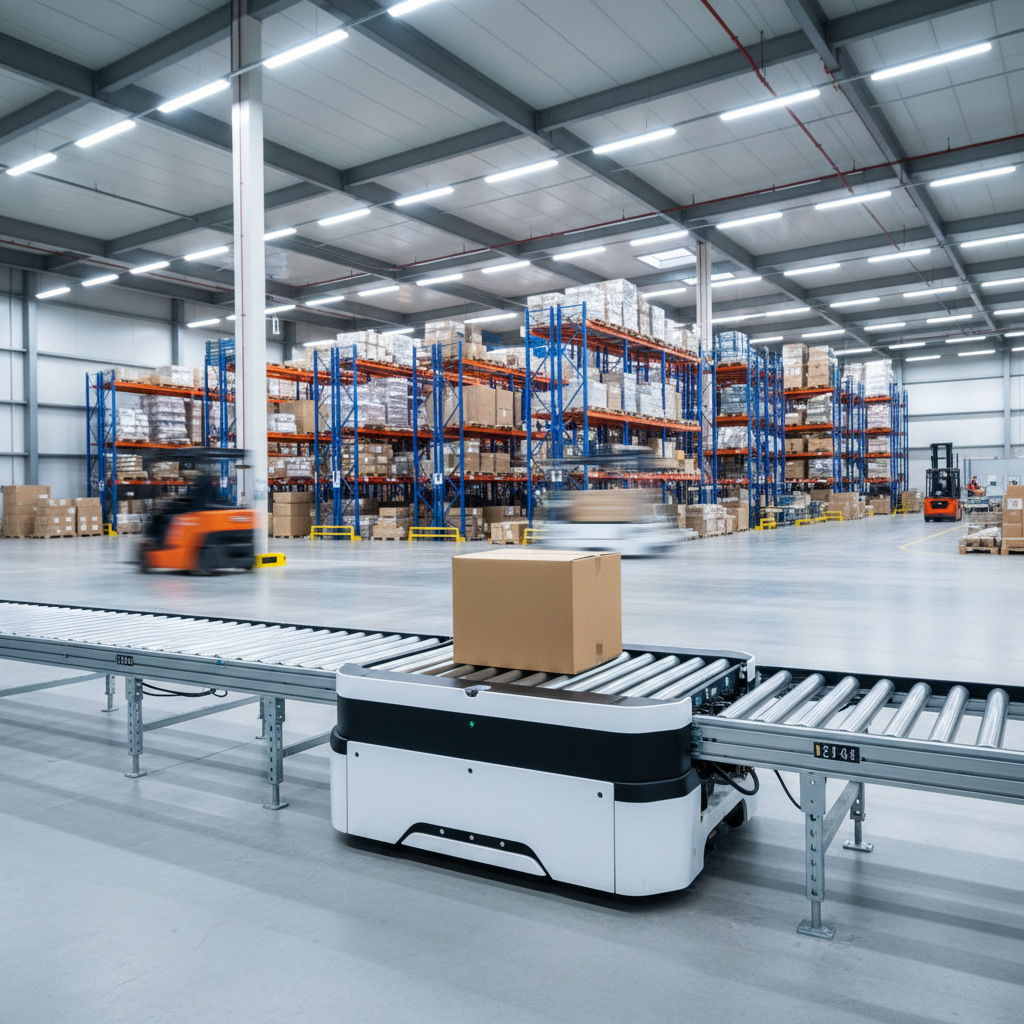
The robot must physically interact with your conveyor. This is often achieved with a "conveyor top" module on the mobile robot itself. For a standard 900mm wide roller conveyor, the AGV would be equipped with a matching roller or chain conveyor segment. When the AGV docks, it raises its module to the same height (e.g., 500mm), and the PLC/WCS signals the transfer.
Step 3: Software & Systems Integration (The Brains)
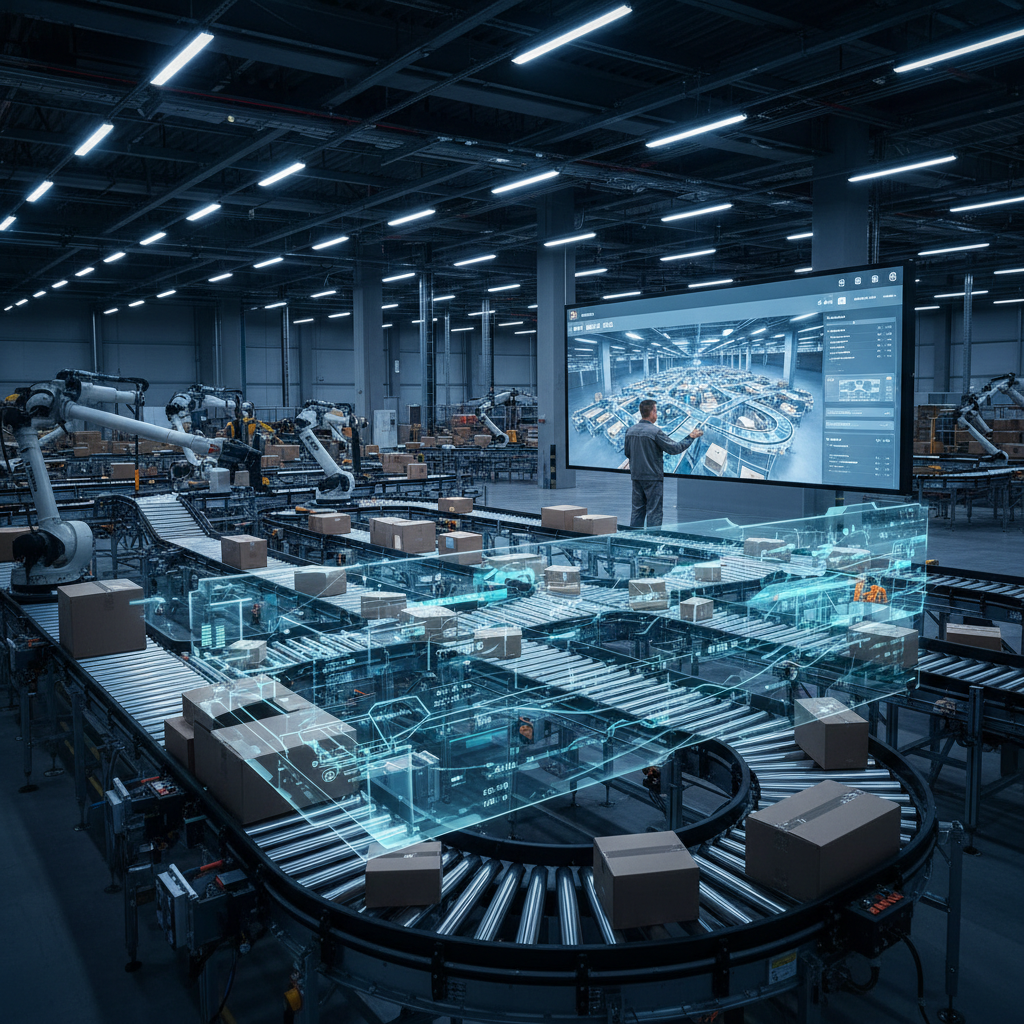
This is where the magic, and the complexity, lies. Your existing conveyors are likely controlled by a PLC (Programmable Logic Controller). Your new robot fleet has its own Fleet Management System (FMS). Your warehouse has a Warehouse Management System (WMS). These three systems must communicate seamlessly. This is the role of a Warehouse Execution System (WES).
The Role of the WES
Think of the WES as the air traffic controller for your warehouse. The WMS knows *what* needs to be done (e.g., "move pallet 123 from A to B"), but the WES knows *how* to do it most efficiently.
- The WMS sends a task to the WES: "Move pallet 123 from conveyor outfeed #4 to shipping door #9."
- The WES checks the status of conveyor #4 via the PLC. Is the pallet ready?
- The WES analyzes the availability and position of all mobile robots via the FMS. It assigns the nearest available robot.
- The WES commands the conveyor to transfer the pallet onto the robot.
- The WES tells the FMS to direct the robot to shipping door #9.
Without a WCS or WES, you are left with a "islands of automation" problem, where operators have to manually bridge the gap between the systems. As many Benelux companies have discovered, processes don't always scale as the business grows. Investing in a robust software layer is crucial for future-proofing your operations, a topic we've explored in-depth on our blog: Why Growing Companies Struggle with Scalable Processes.
Step 4: Implementation, Testing & Go-Live
Integration is a project, not a product. It requires a structured approach.
The Pilot Phase
Don't try to automate everything at once. Select one specific process flow for a pilot project. For example, the transfer from a single packaging line to a stretch wrapper. This allows you to test the technology, validate your ROI calculations, and get your team comfortable with the new "colleagues". A typical pilot might involve 1-2 robots and a single conveyor handover point, running for 4-6 weeks.
Safety First
In a mixed environment where people and robots work alongside fixed machinery, safety is paramount. The system must adhere to European standards (e.g., ISO 3691-4). This includes ensuring clear floor markings, safety scanners on the robots, and emergency stop protocols that can halt both the robot and the relevant conveyor section instantly. The handover zone is a critical safety area that must be designed to prevent any human access during the transfer process.
Training and Change Management
Your team is a key part of the integration. They need to understand how the system works, how to interact with it safely, and what to do when exceptions occur. Clear communication, hands-on training, and highlighting how the technology frees them up for more value-added tasks are key to a smooth transition.
Conclusion: Position Yourself as a Trusted Partner
Integrating AGVs and AMRs with conveyor systems is more than a technical upgrade; it's a strategic step towards building a resilient, flexible, and future-proof warehouse. While the initial analysis and software integration can seem daunting, the rewards in efficiency, scalability, and cost reduction are substantial, particularly in the competitive Benelux market.
At Easy Systems, we are more than just a conveyor supplier; we are your partners in process automation. With decades of experience in the Benelux and a deep understanding of both conveyor technology and an ecosystem of automation solutions, we help you navigate the complexities of integration. From initial process analysis and system design to seamless implementation, we ensure that your fixed and mobile automation work in perfect harmony, delivering the throughput and flexibility your business demands.
Frequently asked questions
What is the biggest challenge when integrating AMRs with conveyors?+
The biggest challenge is software integration. Getting the WMS, AMR fleet manager, and conveyor PLC to communicate via a WES is key. This 'digital handshake' can account for 40-60% of the total integration time and budget, as it is often more complex than the physical handover of goods.
Can I use AGVs from one brand and conveyors from another?+
Yes, this is standard. A capable integrator uses open protocols (like VDA 5050) to connect the systems. The AGV/AMR fleet manager handles the robots, a PLC handles the conveyor, and a WES orchestrates tasks between them. A typical project involves at least 3 different vendors.
What is the typical ROI for AGV-conveyor integration in the Benelux?+
In the high-wage Benelux region, where total operator costs can exceed €45/hour, the ROI is fast. By replacing manual pallet transport, a single AGV working across two shifts can save over €50,000 annually. This typically leads to a full return on investment within 18-24 months.
What are the physical requirements for the handover location?+
The floor must be perfectly level and flat (per DIN 18202) at the handover point to ensure millimeter-perfect alignment. A clearance of at least 2 meters around the transfer station is recommended for safe robot maneuvering. The conveyor end must have sensors to confirm load stability, a check taking 3-5 seconds.
How many pallets or totes can be transferred per hour?+
A well-integrated handover point can achieve 60 to 120 transfers per hour. However, the overall system throughput is determined by the robot's travel distance and task logic. A 200-meter travel loop for an AGV might limit the effective rate to 30 pallets per hour for that specific robot.
How is safety ensured at the AGV-conveyor interface point?+
Safety is multi-layered. The interface point is protected by light curtains or area scanners that create a safety field. If a person enters this field (a 1-meter zone, typically), the system performs an emergency stop within 250 milliseconds, halting both the robot and the conveyor section to prevent accidents.

The Easy Systems engineering team designs, integrates and commissions conveyor systems and warehouse automation across Belgium, the Netherlands and Luxembourg. Combined experience covers roller and belt conveyors, sorters, AGV/AMR fleets, AutoStore, shuttle AS/RS and WMS/WCS integration for distribution centers and e-commerce fulfillment operations.
- Conveyor design (roller, belt, modular plastic)
- Sortation & merge logic
- AGV / AMR fleet integration
- AutoStore & shuttle AS/RS
- WMS / WCS integration