Conveyor Safety Standards in the Benelux: A Guide to Compliance
Achieving operational compliance for conveyor systems in the Benelux requires adherence to the EU Machinery Directive 2006/42/EC and key standards like EN 620. This involves a mandatory risk assessment, proper guarding, and certified safety components.
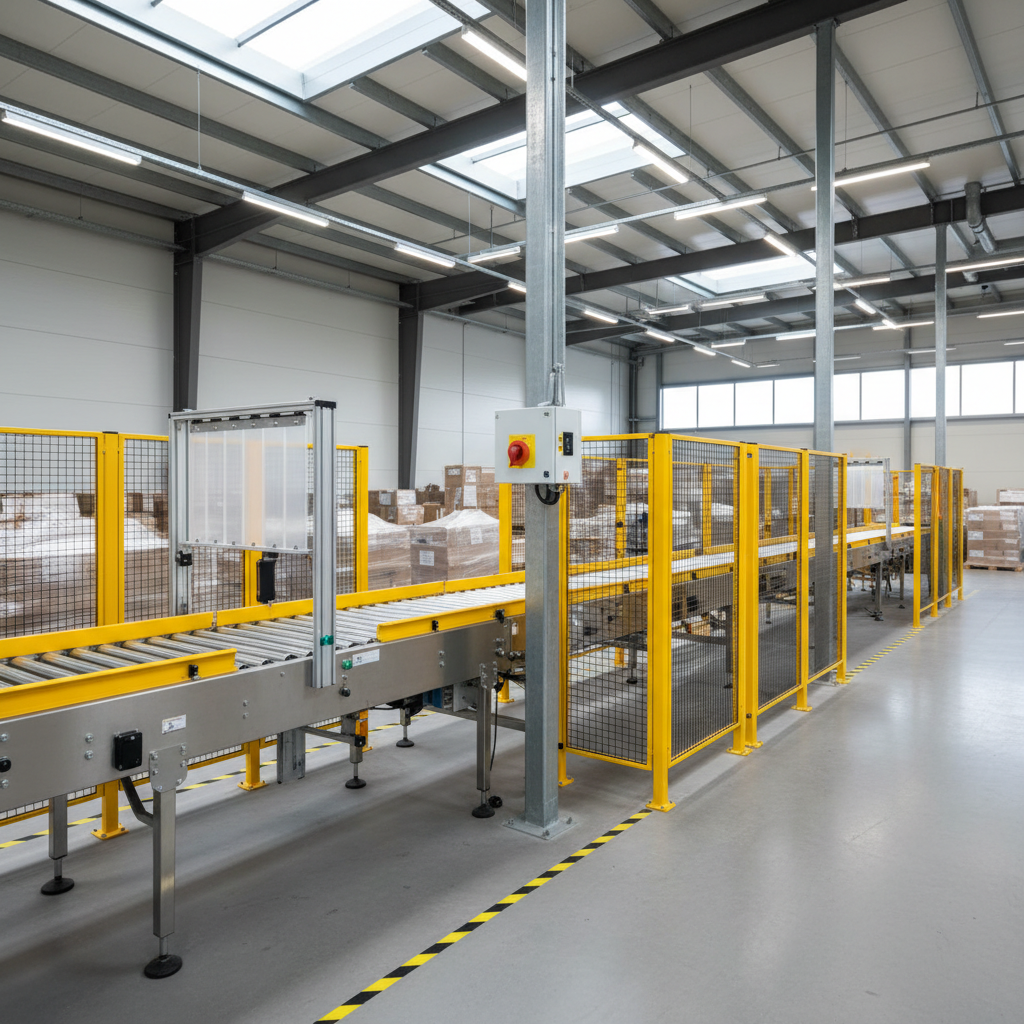
Ensuring the safety of conveyor systems is not just a legal obligation in the Benelux; it's a critical component of operational excellence and a cornerstone of a productive, reliable warehouse. Navigating the complex web of European and local regulations can be daunting, but understanding the core principles, key standards, and practical implementation steps is essential for any facility manager or systems integrator.
Definition
Conveyor safety standards are a set of regulations, directives, and harmonised technical norms designed to minimise the risk of accidents and injuries associated with the design, installation, operation, and maintenance of belt conveyor systems and other material handling equipment. In Europe, these are primarily driven by the Machinery Directive 2006/42/EC, which provides the legal framework for CE marking.
Key numbers
| Metric | Typical range (EU 2026) | Notes |
|---|---|---|
| Cost of Non-Compliance Fine (NL) | €50,000 - €820,000 | Per incident, depending on severity and company size. |
| Safety Upgrade Investment | €1,500 - €10,000 / system | Includes E-stops, light curtains, and PLC integration. |
| ROI on Safety Investment | 1-3 years | Calculated based on avoided downtime, fines, and insurance premiums. |
| Accident Reduction Rate | 60% - 90% | Post-implementation of robust safety measures and training. |
| Required Guarding Clearance | 120 mm (finger) - 850 mm (full body) | Based on EN ISO 13857 (Safety distances). |
| Emergency Stop Response Time | < 0.5 seconds | From activation to complete motor stop. |
The Core Legal Framework: Machinery Directive 2006/42/EC
At the heart of all equipment safety in the European Union, including the Benelux, is the Machinery Directive 2006/42/EC. This directive is not a detailed technical manual but a legal act that sets out the essential health and safety requirements (EHSRs) that machinery must meet before being placed on the market. For conveyor systems, this means the manufacturer or integrator must:
- Conduct a comprehensive risk assessment.
- Design and construct the machine to be inherently safe.
- Implement necessary protective measures (guarding, safety circuits).
- Provide clear instructions for use and maintenance.
- Compile a technical file and affix the CE mark, declaring conformity.
Failure to comply is not a technical issue; it's a legal one. Authorities in Belgium, the Netherlands, and Luxembourg can and will order non-compliant systems to be shut down until they are brought into conformity.
Harmonised Standards: The "How-To" for Compliance
The Machinery Directive defines the "what," while harmonised standards under the EN (European Norms) system define the "how." Adhering to these standards provides a "presumption of conformity" with the directive. For conveyor systems, the most critical ones are:
EN 620:2021: Continuous handling equipment and systems
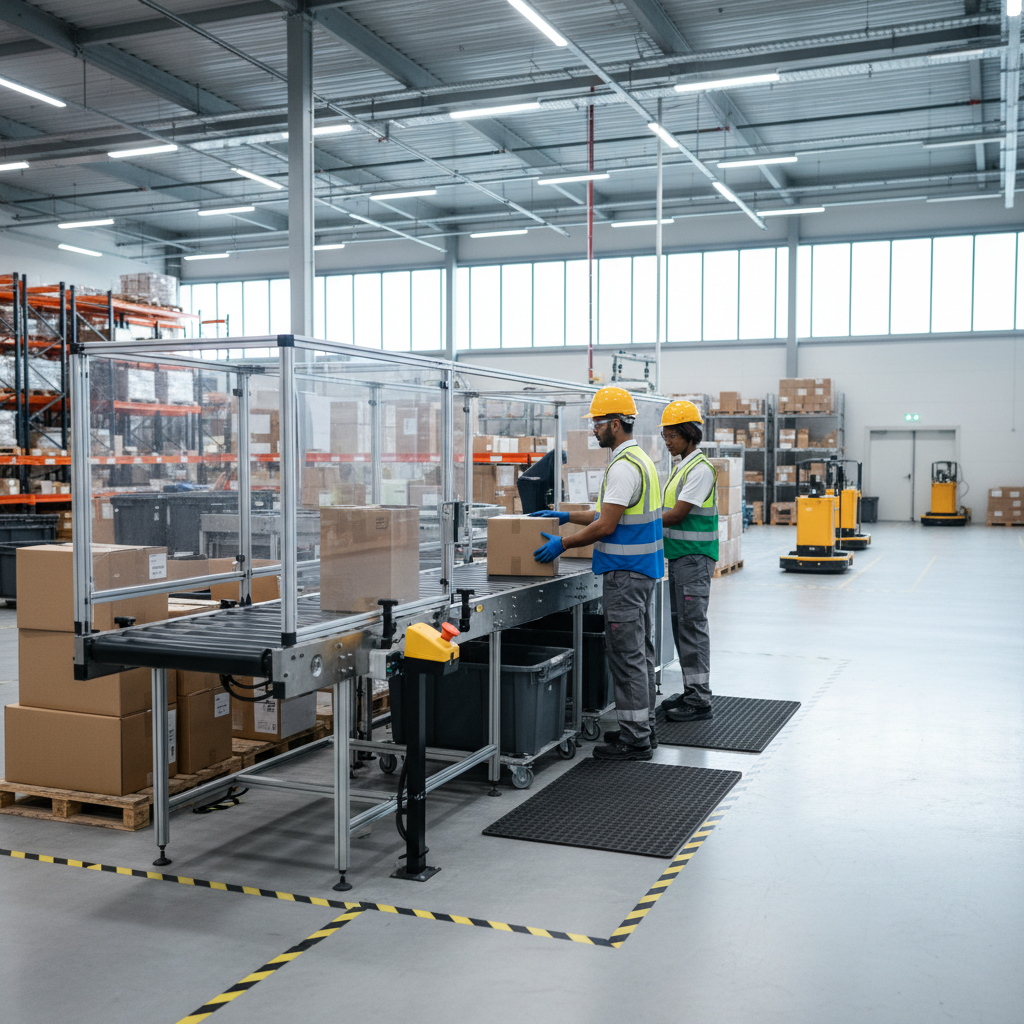
This is the primary standard for conveyor systems. It specifies safety and EMC (electromagnetic compatibility) requirements for fixed systems, including belt, roller, and chain conveyors. It covers everything from the prevention of crushing and shearing hazards to the requirements for walkways and emergency stops. It's a detailed document that forms the basis for any safe design.
EN ISO 13849-1: Safety of machinery — Safety-related parts of control systems
This standard governs the design of safety control systems. It introduces Performance Levels (PL), ranging from PL 'a' (low) to PL 'e' (high), which dictate the required reliability of safety components like emergency stops, light curtains, and interlock switches. For example, a simple E-stop on a slow roller conveyor might only require PL 'c', while a high-speed sorter might demand PL 'd' or 'e'. A certified PLC (Programmable Logic Controller) is often used to manage these safety functions.
EN ISO 13857: Safety of machinery — Safety distances
This standard provides the specific dimensions required for safety guards to prevent personnel from reaching danger zones. It defines how large openings can be and how far guards must be placed from moving parts to prevent access by fingers, hands, arms, or the full body. Using these prescribed distances is non-negotiable for physical guarding.
Risk Assessment: The Foundation of Safety
You cannot design a safe system without first understanding its risks. The risk assessment process (mandated by EN ISO 12100) is a systematic procedure:
- Identify Hazards: Mechanical (crushing, shearing), electrical (shock), thermal (hot motors), noise, etc.
- Estimate the Risk: Evaluate the severity of potential harm and the probability of its occurrence.
- Evaluate the Risk: Decide if the risk is acceptable or requires reduction.
- Reduce the Risk: Apply the three-step method: 1) Inherently safe design, 2) Technical protective measures (guards, safety devices), and 3) Information for use (labels, manuals, training).
| Safety Technology | Typical Application | Performance Level (PL) | Approx. Cost per point (€) |
|---|---|---|---|
| Emergency Stop Button | All conveyor sections, operator stations | PL c to PL e | €150 - €400 |
| Pull-Cord Switch | Long belt conveyor lines | PL c to PL d | €500 - €1,200 |
| Interlocked Guard Door | Access points for maintenance | PL d to PL e | €400 - €900 |
| Light Curtain | Pallet infeed/outfeed, robotic cells | PL d to PL e | €1,200 - €3,000 |
| Safety Scanner | Irregularly shaped zones, AGV paths | PL d | €2,500 - €5,000 |
Benelux-Specific Considerations
While the EU directives provide a common legal basis, enforcement and specific labor laws are managed at the national level.
- The Netherlands: The 'Arbowet' (Working Conditions Act) and the supporting 'Besluit en Regeling' are strictly enforced by the Inspectie SZW (formerly Arbeidsinspectie). They have the authority to levy significant fines (up to €820,000) and issue binding instructions, including immediate operational stops ('stillegging').
- Belgium: The 'Codex welzijn op het werk' mirrors the Arbowet. Enforcement is handled by the 'Federale Overheidsdienst Werkgelegenheid, Arbeid en Sociaal Overleg'. The focus is heavily on the employer's responsibility to provide a safe work environment through a dynamic risk prevention system.
- Luxembourg: The 'ITM' (Inspection du Travail et des Mines) is the regulatory body. While the legal framework is similar, there is a strong emphasis on tripartite social dialogue between the government, employers, and trade unions.
In all three countries, language is a practical consideration. Safety warnings, user manuals, and training materials must be provided in the official languages of the region where the equipment is installed (Dutch, French, German).
For businesses experiencing rapid expansion, it is often the operational processes that struggle to keep pace, creating unforeseen safety risks. As noted in a recent analysis on our Dutch blog, companies grow, but their processes don't always grow with them, which underscores the need for scalable and compliant safety systems from the outset. For a deeper dive into the specific components, our guide to roller conveyor systems provides valuable context.Your Trusted Partner for Compliant Automation
Navigating the legal and technical requirements for conveyor safety can feel overwhelming. At Easy Systems, we don't just sell conveyors; we deliver compliant, turnkey solutions. As your Benelux-based partner, we integrate these safety standards into every design from day one. Our process includes a formal risk assessment, documented component choices according to EN ISO 13849-1, and the creation of a complete technical file to ensure your system is not just efficient, but verifiably safe and fully compliant with all European and local regulations. We take on the responsibility of CE marking for the integrated system, giving you peace of mind and a future-proof, safe operational environment.
Frequently asked questions
What is the most important safety standard for conveyors in Europe?+
The most important standard is EN 620:2021. It provides specific safety requirements for continuous handling equipment like belt and roller conveyors, covering everything from guarding to emergency stops, and gives manufacturers a direct path to comply with the overarching Machinery Directive 2006/42/EC.
Do I need to CE mark my existing conveyor line?+
If you significantly modify an existing line (e.g., change its function, add a new motor, or substantially increase its speed), it is considered a 'new' machine and must undergo a new risk assessment and CE marking process. A typical re-certification project can cost between €5,000 and €20,000.
What is the difference between a safety light curtain and an interlocked guard?+
An interlocked guard is a physical barrier (like a fence or door) with a sensor that stops the machine if opened. A light curtain creates an invisible infrared barrier. It is used where frequent access is needed, like pallet loading stations, and typically offers more operational flexibility but at a higher initial cost of around €1,200-€3,000.
Who is responsible for conveyor safety: the manufacturer or the user?+
Both have responsibilities. The manufacturer is responsible for placing a safe, CE-marked product on the market. The end-user (employer) is responsible under local laws (like the Arbowet in NL) for ensuring the system is used correctly, maintained, and that operators are trained, with usage-based risk assessments.
How often should I have my conveyor safety systems inspected?+
Legally, a periodic inspection is required, typically annually. The exact frequency should be determined by your risk assessment, considering the intensity of use and the operational environment. Best practice involves daily visual checks by operators and a formal documented inspection by a competent person at least once a year.
Can I use a standard PLC for safety functions?+
No, you must use a dedicated safety PLC or safety relays that comply with EN ISO 13849-1. A standard PLC does not have the required diagnostic coverage or redundant architecture to be considered sufficiently reliable for safety functions like emergency stops or light curtains. These safety PLCs cost about 30-50% more than standard versions.

The Easy Systems engineering team designs, integrates and commissions conveyor systems and warehouse automation across Belgium, the Netherlands and Luxembourg. Combined experience covers roller and belt conveyors, sorters, AGV/AMR fleets, AutoStore, shuttle AS/RS and WMS/WCS integration for distribution centers and e-commerce fulfillment operations.
- Conveyor design (roller, belt, modular plastic)
- Sortation & merge logic
- AGV / AMR fleet integration
- AutoStore & shuttle AS/RS
- WMS / WCS integration