AGVs and Conveyors: A Guide to Seamless Warehouse Integration
Integrating Automated Guided Vehicles (AGVs) with conveyor systems bridges automation gaps, creating a fluid, uninterrupted material flow. This powerful combination boosts efficiency, flexibility, and throughput in European distribution centers.
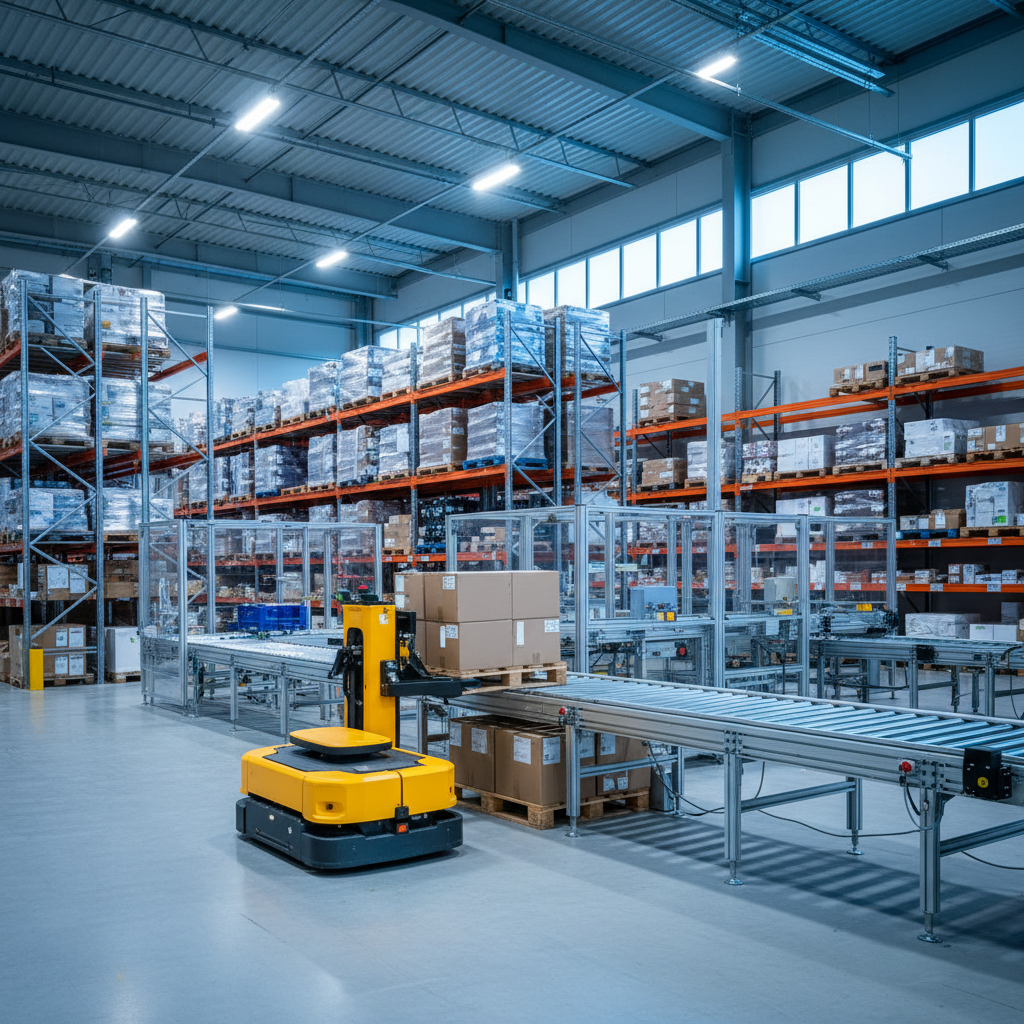
In the fast-paced world of European logistics, particularly within the bustling hubs of the Netherlands, Belgium, and Luxembourg, efficiency is not just a goal; it's a prerequisite for survival. Warehouses are evolving from static storage spaces into dynamic fulfillment centers. The key to this evolution lies in intelligent automation, and one of the most powerful combinations emerging is the integration of Automated Guided Vehicles (AGVs) with traditional conveyor systems, creating a truly seamless and responsive material flow.
Definition
The integration of Automated Guided Vehicles (AGVs) and conveyor systems is a hybrid automation strategy where mobile robots transport goods between fixed conveyor lines or other automated workstations. This approach creates a unified, fluid, and flexible material handling network that overcomes the limitations of using either system in isolation.
Why Combine AGVs and Conveyors? The Best of Both Worlds
Conveyor systems and AGVs are cornerstones of warehouse automation, but they serve different purposes. Understanding their individual strengths reveals why their combination is so effective.
- Conveyor Systems: These are the high-capacity highways of the warehouse. A roller conveyor or belt conveyor system excels at moving a high volume of goods continuously along a fixed path. They offer impressive speeds (often 0.5 to 2 m/s) and reliability for point-to-point transport over long distances. However, their fixed nature can also be a limitation, creating islands of automation that are not easily connected.
- Automated Guided Vehicles (AGVs): AGVs are the flexible couriers. Instead of being fixed in place, they navigate along pre-defined paths (using magnetic tape, lasers, or optical guidance) to transport pallets, bins, or carts. Their primary strength is flexibility; routes can be changed, and they can serve multiple pick-up and drop-off points. However, their throughput is typically lower than a continuous conveyor.
By integrating the two, you get the best of both: the high-speed, high-throughput capacity of conveyors connected by the intelligent, flexible routing of AGVs. This synergy allows for the creation of a fully connected, end-to-end automation ecosystem.
Common Applications in Benelux Warehouses
The dense logistics network and high operational costs in the Benelux make this integrated solution particularly valuable. Here are some common applications:
1. Bridging Production and Logistics
At the end of a production line, finished goods are often palletized. An AGV can automatically pick up a full pallet (e.g., 800 kg) from an accumulation conveyor at the end of the line and transport it to a stretch-wrapping station or directly to an outbound staging conveyor, without any manual intervention.
2. Connecting Receiving to Storage
When goods arrive at the receiving docks, they are often unloaded onto pallet conveyors. An AGV can then pick up these pallets and transport them to the infeed station of an Automated Storage and Retrieval System (AS/RS). This decouples the unloading process from the storage process, improving dock-to-stock time.
3. Goods-to-Person (G2P) Fulfillment
In large e-commerce fulfillment centers, AGVs or AMRs can retrieve mobile shelving units and bring them to a picking station. The operator picks the required items and places them into totes on a takeaway conveyor, which then whisks them away to packing and shipping. The AGV returns the shelf to storage. This drastically reduces picker travel time.
System Synergy: The Role of WMS, WCS, and WES
An integrated system is only as smart as its software. The seamless coordination between a moving AGV and a static conveyor requires a sophisticated software hierarchy. For more on this, see our in-depth guide to warehouse software.
- Warehouse Management System (WMS): The overall brain, managing inventory and order information. It knows what needs to move, but not necessarily how.
- Warehouse Control System (WCS): Manages the real-time activities of the automated equipment. It communicates directly with the conveyor PLCs (Programmable Logic Controllers).
- Warehouse Execution System (WES): This is the critical layer for AGV-conveyor integration. The WES acts as an air traffic controller, receiving orders from the WMS and orchestrating the tasks for both the AGVs and conveyors in real-time. It manages AGV traffic, assigns tasks based on location and priority, and signals the conveyor to start or stop to ensure a perfect handover.
When an AGV approaches a conveyor pickup/drop-off (P&D) stand, it communicates its arrival to the WES. The WES then instructs the conveyor PLC to activate the motors, smoothly transferring the pallet or tote. This level of integration prevents bottlenecks and maximizes asset utilization.
AGV vs. Conveyor: A Head-to-Head Comparison
Choosing the right technology, or combination of technologies, depends on the specific need. The table below compares the two systems across key operational parameters.
| Parameter | Conveyor System | Automated Guided Vehicle (AGV) |
|---|---|---|
| Typical Speed | High & Constant (0.5 - 2.0 m/s) | Moderate & Variable (1.0 - 1.7 m/s) |
| Throughput | Very High (continuous flow) | Lower (batch flow, dependent on travel distance) |
| Flexibility | Low (fixed paths) | High (paths can be reprogrammed) |
| Scalability | Difficult (requires physical extension) | Easy (add more vehicles to the fleet) |
| Footprint | Permanent, can be elevated to save floor space | Requires clear floor paths and charging stations |
| Cost (indicative) | €300 - €1,500+ per meter | €20,000 - €80,000+ per vehicle |
| Ideal Use Case | High-volume, fixed-route transport between two points | Variable routes, connecting multiple points, flexible tasks |
Implementation Costs and ROI in a European Context
Investing in an integrated AGV and conveyor system requires significant capital, but the return on investment (ROI) in a high-wage region like the Benelux is compelling. A project's cost can be broken down as follows:
- Hardware Costs: This includes the price of the AGVs (€20k - €80k each), the cost per meter of the conveyor system (e.g., €800/m for a 24V motorized roller conveyor), plus charging stations and safety sensors.
- Software & Integration Costs: The WES software license and the critical engineering work to integrate it with the WMS, AGV fleet manager, and conveyor PLCs. This can often represent 20-30% of the total project cost.
- Infrastructure & Installation: This includes laying navigation guides (magnetic tape), installing P&D stands, and commissioning the system.
A medium-sized project in Belgium or the Netherlands, involving a few hundred meters of conveyor and a fleet of 5-10 AGVs, could range from €250,000 to over €1,000,000. However, the ROI is typically achieved within 2-4 years, driven by:
- Labor Savings: Eliminating manual transport tasks allows employees to be re-assigned to value-added activities. This is crucial in a tight labor market.
- Increased Throughput: The system can operate 24/7 with consistent performance, increasing the facility's overall capacity without physical expansion.
- Accuracy & Safety: Automation drastically reduces product damage and workplace accidents associated with forklift traffic.
Many Benelux companies find that as they expand, their internal logistics fail to keep pace. As detailed in a recent analysis, growing businesses often find their processes don't scale effectively, creating bottlenecks that an integrated AGV and conveyor system can solve by introducing scalable automation.
Your Trusted Partner for Integrated Automation
Designing an automation system that seamlessly blends the fixed paths of conveyors with the dynamic flexibility of AGVs is a complex challenge. It requires deep expertise in material flow analysis, software integration, and hardware engineering. At Easy Systems, we specialize in creating modular and scalable conveyor solutions that form the backbone of these hybrid systems.
We understand that conveyors are not just standalone products but crucial components of a larger, integrated logistics puzzle. Our approach is to provide robust, reliable, and intelligent conveyor systems that are ready to communicate with WES software and interact with AGVs and other robotic systems. By focusing on modular design and standardized components, we deliver solutions that are not only efficient today but also scalable for the growth of your Benelux operations tomorrow. Partner with us to build the automated foundation for your future success.
This article is part of the Conveyor-Design knowledge hub, edited by Easy Systems engineers who design conveyor and warehouse automation systems across the Benelux every week.
Frequently asked questions
What is the main difference between an AGV and an AMR?+
An AGV (Automated Guided Vehicle) typically follows fixed paths like magnetic tape or wires. An AMR (Autonomous Mobile Robot), on the other hand, uses advanced navigation like SLAM (<a href="/glossary#slam">Simultaneous Localization and Mapping</a>) to create its own routes and navigate dynamically around obstacles. This makes AMRs generally more flexible, while AGVs are more predictable for high-traffic routes. We compare them in-depth in our <a href="/guide/agv-vs-amr">AGV vs. AMR guide</a>.
How much does an AGV-conveyor system cost?+
The cost varies widely based on scope and complexity. A simple roller conveyor might cost €300-€900 per meter, while a single AGV can range from €20,000 to €80,000+. A complete system integration project in a medium-sized Benelux warehouse can range from €150,000 to over €1,000,000.
What kind of software is needed to manage AGVs and conveyors together?+
A Warehouse Execution System (<a href="/glossary#wes">WES</a>) is crucial. While a WMS manages inventory, the WES acts as the traffic controller, dispatching tasks to both the conveyor PLC and the AGV fleet management software in real-time to ensure smooth, synchronized operation.