The Future of Intralogistics: Digital Twins in the Benelux
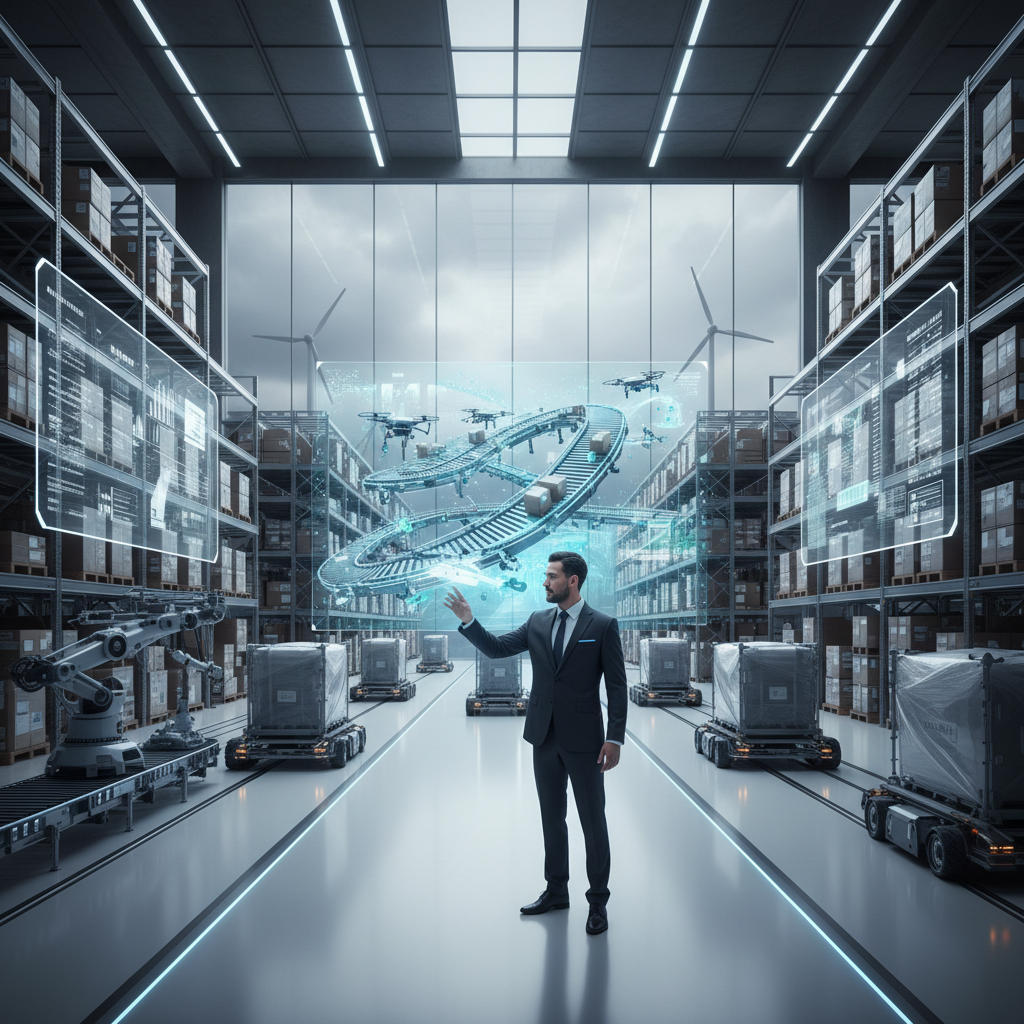
Digital Twins create dynamic virtual replicas of physical warehouse operations. For companies in the Benelux, this technology is a game-changer, enabling real-time simulation and optimization to drastically improve efficiency and cut operational costs.
Key numbers
| Metric | Typical range (EU 2026) | Notes |
|---|---|---|
| Operational Cost Reduction | 15-25% | Achieved through process optimization, energy savings, and reduced downtime. |
| Throughput Increase | 10-25% | Resulting from optimized layouts, better resource allocation, and bottleneck removal. |
| Predictive Maintenance Accuracy | >95% | Ability to forecast component failure based on sensor data (e.g., vibration, temperature). |
| Pilot Project Cost | €50,000 - €150,000 | For a single, well-defined process like a sorting line or picking zone. |
| Full Implementation ROI | 18-36 months | Time to recoup investment through efficiency gains and cost savings. |
| Simulation Speed | 5-15 minutes | Time required to simulate a full 24-hour operational cycle to test a hypothesis. |
In the hyper-competitive logistics landscape of the Benelux, where every square meter and every second counts, companies are looking beyond traditional automation for their next leap in efficiency. The answer isn't just more hardware; it's smarter data. Enter the Digital Twin, a groundbreaking Industry 4.0 technology that is fundamentally transforming how warehouses in Belgium, the Netherlands, and Luxembourg are designed, managed, and optimized.
Definition
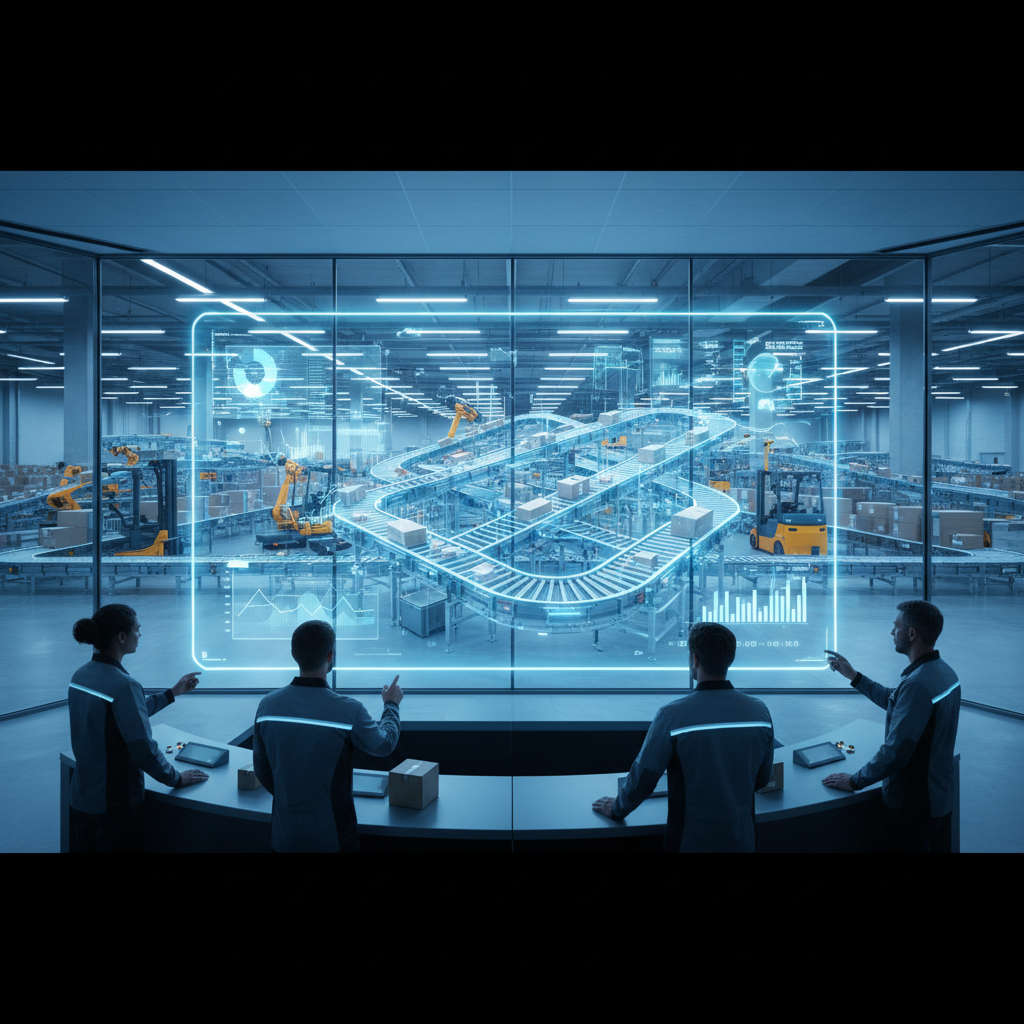
A Digital Twin in intralogistics is a comprehensive virtual model of a physical warehouse, distribution center, or production environment. It is not a static blueprint but a living, dynamic replica that is continuously updated with real-time data from IoT sensors on machinery, control systems, and even staff wearables, creating a perfect mirror of the physical operation in a digital space.
How Digital Twins Function in a Warehouse Environment
Creating and utilizing a Digital Twin is a cyclical process that bridges the physical and digital worlds. It relies on a seamless flow of data to provide actionable insights.
Phase 1: Data Aggregation
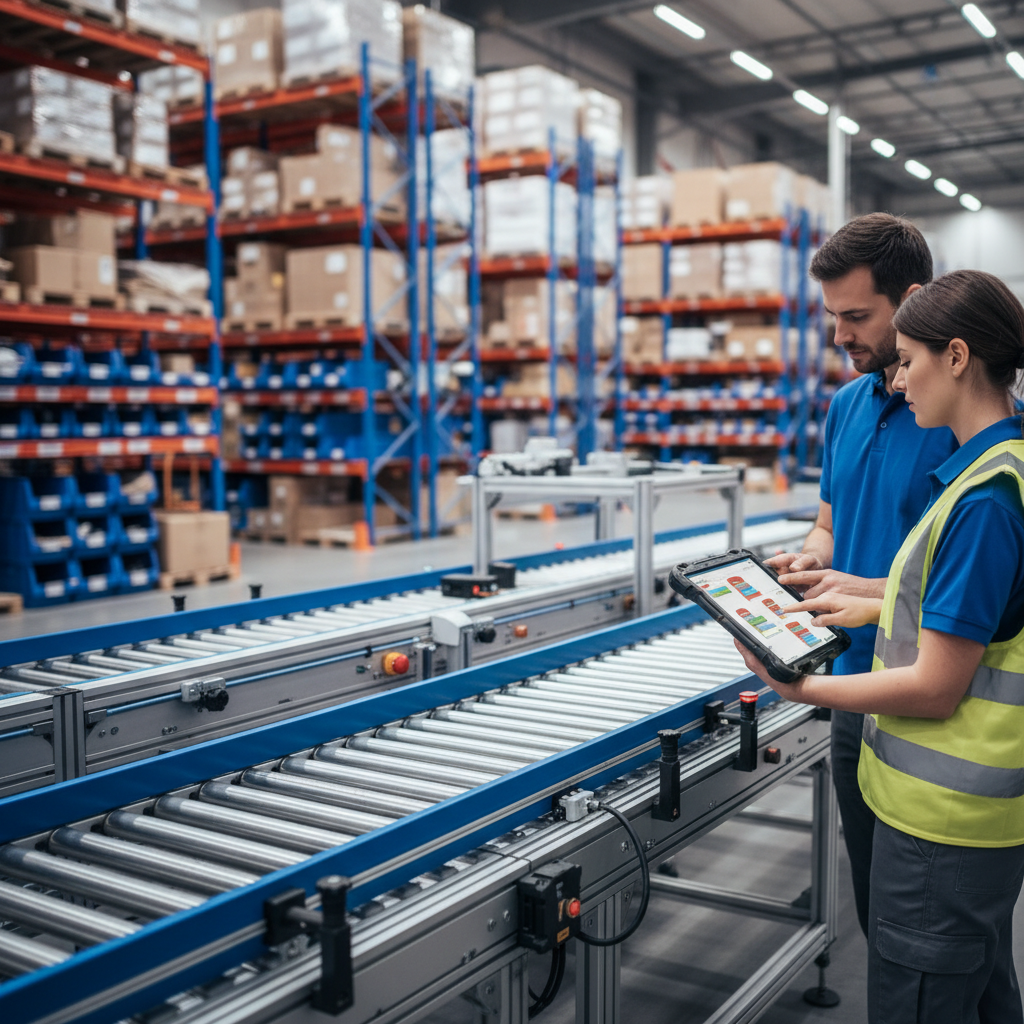
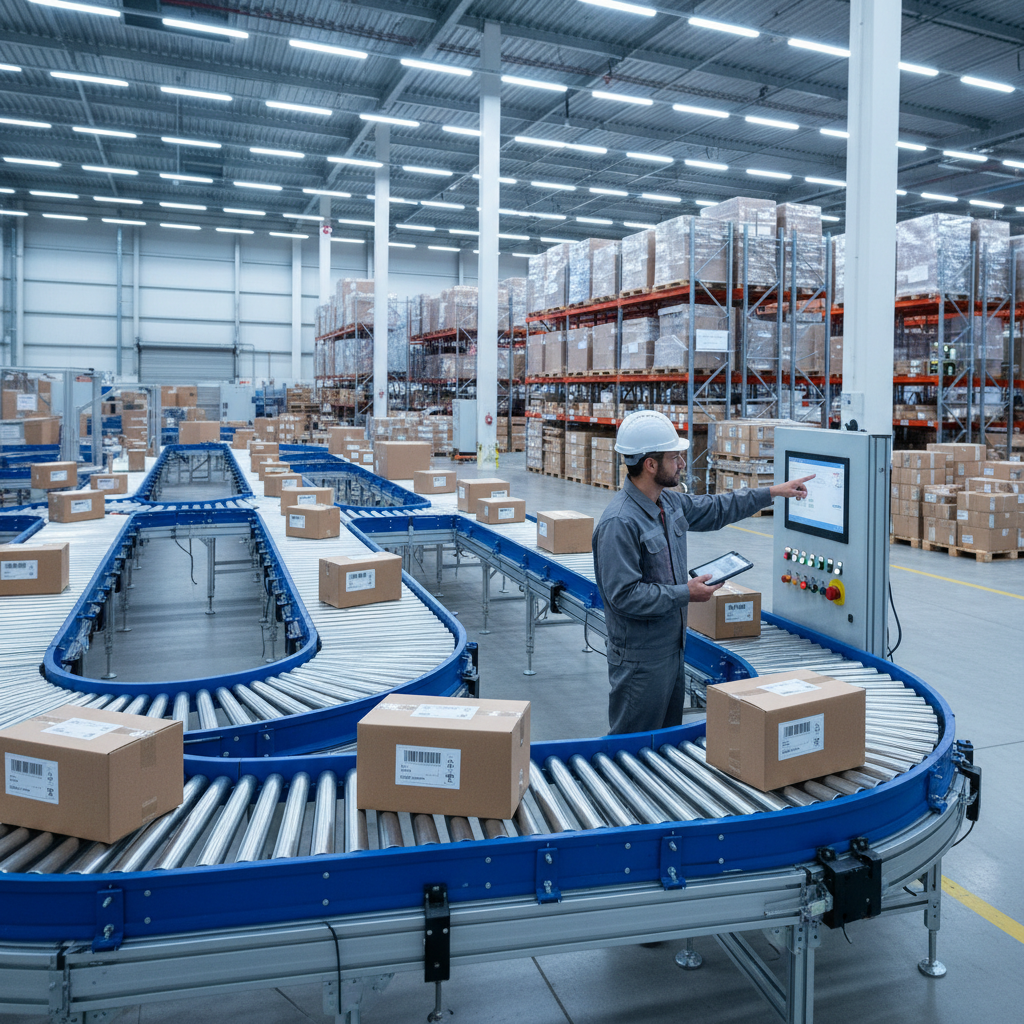
The foundation of any effective Digital Twin is data. Sensors are placed on key components of the warehouse: motors on a roller conveyor, scanners on sorting systems, batteries in AGVs, and cameras overlooking picking zones. These IoT devices collect millions of data points per hour: speed, temperature, weight, position, throughput, error rates, and energy consumption. This data is standardized and communicated, often using protocols like OPC UA to ensure interoperability between different machines and systems.
Phase 2: Virtual Model Creation
This raw data is fed into a sophisticated software platform that houses a 3D model of the warehouse. This model includes not just the static layout (racking, columns) but also the dynamic components: conveyor belts moving at specific speeds (e.g., 0.8 m/s), robots navigating paths, and even simulated workers performing tasks. The result is a high-fidelity, virtual representation of what is happening in the real world at that exact moment.
Phase 3: Simulation and Analysis
This is where the magic happens. With a live, accurate model, logistics managers can run "what-if" scenarios without risking disruption to the actual operation. For example:
- "What happens to our throughput if we increase the speed of the main sorting line by 0.2 m/s?"
- "How will introducing 10 new AGVs affect traffic and potential bottlenecks in aisle 7?"
- "Can we reconfigure this picking zone to reduce travel time for workers by 15%?"
The Twin can simulate hours or days of operation in minutes, revealing emergent problems and optimization opportunities that would be impossible to spot otherwise.
Core Benefits for Benelux Logistics Hubs
For the dense logistics network stretching from the Port of Antwerp to the e-commerce hubs around Utrecht, Digital Twins offer tangible, competitive advantages:
- Predictive Maintenance: Instead of waiting for a critical motor on a conveyor to fail during peak season, the Twin can predict failure based on vibration and temperature data, scheduling maintenance during off-hours and saving thousands in downtime.
- Process Optimization: By analyzing historical and real-time data, the Twin can identify subtle inefficiencies. It might discover that re-routing a specific product flow can increase overall Cases Per Hour (CPH) by 5%.
- Capital Investment Validation: Before spending €2 million on a new sorting system, a company can build a digital version and test it within their existing virtual warehouse to verify the supplier's claims and calculate a precise ROI.
- Enhanced Safety and Training: New employees or complex procedures can be tested in the virtual environment. A new AGV traffic management plan can be rolled out virtually to ensure it is collision-free.
Digital Twin vs. Traditional Simulation: A Comparative Analysis
While often confused, Digital Twins are a significant evolution from traditional simulation software.
| Feature | Traditional Simulation | Digital Twin |
|---|---|---|
| Data Source | Static, historical, or assumed data | Live, real-time sensor data from the physical asset |
| Update Frequency | One-time or manual updates | Continuous, automated, in real-time |
| Purpose | Design and planning (What if?) | Operational optimization and prediction (What is, and what will be?) |
| Data Flow | One-way (Physical to Digital for model creation) | Bi-directional (Physical to Digital for monitoring; Digital to Physical for control) |
| Typical Cost | €10,000 - €50,000 (per project) | €50,000 - €1,000,000+ (as a platform) |
Key Distinctions
The crucial difference is the live, bi-directional link. A simulation might help you decide where to place a conveyor. A Digital Twin tells you that same conveyor is vibrating outside of tolerance and needs a new bearing in the next 72 hours, automatically creating a work order in the maintenance system.
Implementing a Digital Twin: Strategy and Costs
Embarking on a Digital Twin journey requires a strategic approach. It's rarely a "big bang" implementation but rather a phased rollout. A common starting point is to focus on a single, high-value process, such as a bottle-necking sortation area or a complex picking process.
The investment can be broken down:
- Sensors & Connectivity (Hardware): Equipping existing machinery with IoT sensors. Cost can range from €5,000 to €100,000 depending on the scale.
- Platform & Software (License): The core software license for the Digital Twin platform itself. This is often a recurring cost.
- Implementation & Integration (Service): The most critical part. This involves integrating the platform with your existing WMS, WCS, and WES, building the 3D models, and configuring the data streams. This often accounts for 50-60% of the initial project cost.
A pilot project for a single process can range from €50,000 to €150,000. A full-scale digital twin of a large, automated distribution center in the Benelux can exceed €1 million. However, the ROI is compelling: a typical project sees a 15-25% reduction in operational costs within 24 months. Many businesses correctly view this not as a cost, but as a crucial investment in future-proofing their operations. As we often see, companies grow, but their processes don't always grow with them; a Digital Twin provides the roadmap for that growth.
The Future is Self-Optimizing
The next evolution is already underway: integrating Artificial Intelligence (AI) and Machine Learning (ML) with Digital Twins. An AI-powered Digital Twin doesn't just present data for a human to analyze; it actively learns from the data and proposes its own optimizations. In the near future, we will see Twins that can autonomously decide to re-slot fast-moving inventory, adjust conveyor speeds to balance flow and energy use, and dynamically change AGV routes to avoid congestion—all before a human manager even realizes there is a problem.
Easy Systems: Your Partner in Digital Transformation
In the fast-paced Benelux market, embracing technologies like Digital Twins is not a luxury, but a necessity for staying competitive. Simply installing hardware is no longer enough. The real value lies in intelligent control, data-driven insight, and continuous optimization. At Easy Systems, we design and build modular, future-proof conveyor systems and automation solutions that are ready for Industry 4.0 integration. Our systems are designed with data connectivity in mind, providing the perfect physical foundation for your Digital Twin strategy. We understand that warehouse processes are dynamic and that growth requires adaptable, intelligent systems. Let us be your trusted partner in building the resilient, efficient, and data-driven intralogistics operation of the future.
Frequently asked questions
What is a Digital Twin in the context of intralogistics?+
A Digital Twin is a dynamic virtual model of a warehouse, fed by real-time IoT data from equipment like conveyors running at 0.8 m/s. It mirrors the complete physical operation—layout, machinery, staff—in a digital space. This allows for live monitoring, predictive analysis, and risk-free simulation of changes, enabling continuous process optimization.
What is the primary advantage of a Digital Twin over a standard simulation?+
The main advantage is the live, continuous data feed. A standard simulation is a static, one-time model used for initial design. A Digital Twin is a dynamic replica updated constantly, enabling ongoing optimization, predicting equipment failure weeks in advance, and simulating changes that can boost throughput by over 20% without physical disruption.
How can a company start with Digital Twin technology?+
Most companies begin with a pilot project on a single process, like a packing line, costing €50,000-€150,000. This proves the ROI by demonstrating tangible benefits, such as improving efficiency by 15%, before planning a full-scale, warehouse-wide implementation.
What data is required for a warehouse Digital Twin?+
An effective Digital Twin requires data from the WMS, PLC controls on conveyors, and IoT sensors. These sensors track metrics like motor temperature, conveyor speed (e.g., 0.5-1.5 m/s), AGV position, and energy consumption, often transmitting millions of data points per hour.
What is the typical ROI for a Digital Twin project?+
The Return on Investment (ROI) for a Digital Twin is typically realized within 18-36 months. Initial gains from process optimization can increase throughput by 10-25%. Over time, predictive maintenance provides major savings, reducing equipment downtime by over 70% and cutting related costs significantly.

The Easy Systems engineering team designs, integrates and commissions conveyor systems and warehouse automation across Belgium, the Netherlands and Luxembourg. Combined experience covers roller and belt conveyors, sorters, AGV/AMR fleets, AutoStore, shuttle AS/RS and WMS/WCS integration for distribution centers and e-commerce fulfillment operations.
- Conveyor design (roller, belt, modular plastic)
- Sortation & merge logic
- AGV / AMR fleet integration
- AutoStore & shuttle AS/RS
- WMS / WCS integration