The Future of Intralogistics: AI in Benelux Conveyor Systems
Artificial Intelligence and Machine Learning are no longer buzzwords but tangible drivers of efficiency in Benelux intralogistics. They are transforming traditional conveyor systems into predictive, self-optimizing networks, drastically reducing downtime and boosting throughput for warehouses in the Netherlands, Belgium, and Luxembourg.
Key numbers
| Metric | Typical range (EU 2026) | Notes |
|---|---|---|
| Predictive Maintenance Downtime Reduction | 20-35% | Compared to reactive or scheduled maintenance schedules. |
| AI-Vision Sorting Accuracy | >99.95% | Includes reading of damaged or poorly oriented labels. |
| Throughput Increase (Dynamic Routing) | 5-15% | Achieved by eliminating bottlenecks and optimizing flow in real-time. |
| Energy Consumption Reduction | 8-12% | From optimized motor activation and load balancing. |
| Implementation ROI Period | 18-36 months | Driven by OPEX reductions in labour, maintenance, and error correction. |
| Real-time Decision Speed | <20 ms | Time for AI to make a routing or load-balancing decision. |
The Benelux region, a pivotal logistics gateway to Europe, is currently navigating a period of intense transformation. With the Port of Rotterdam being the largest in Europe and Antwerp not far behind, the pressure on inland distribution and fulfillment centers has never been higher. The rapid growth of e-commerce has stretched traditional intralogistics systems to their limits. The answer to this mounting pressure lies not in simply adding more hardware, but in making existing systems smarter. Artificial Intelligence (AI) and Machine Learning (ML) are emerging as the core technologies driving this evolution, turning standard conveyor systems into the intelligent arteries of the modern warehouse.
Definition
AI and Machine Learning in Intralogistics refers to the application of intelligent algorithms to warehouse automation systems, particularly conveyor networks, enabling them to learn from data, make autonomous decisions, and perform predictive analysis. This transforms hardware from merely executing pre-programmed commands into a dynamic, self-optimizing system that improves efficiency, routing, and maintenance.
The State of Play: Intralogistics in the Benelux
Logistics in the Netherlands, Belgium, and Luxembourg is characterized by high density, high labor costs, and an urgent need for efficiency. Warehouses are under pressure to increase throughput, shorten dock-to-stock times, and deliver on increasingly demanding service-level agreements (SLAs). While automation has been a staple for years, traditional systems often operate based on fixed rules programmed into a PLC (Programmable Logic Controller) and managed by a Warehouse Control System (WCS). This approach lacks the flexibility to adapt to sudden demand spikes, complex order profiles, or minor mechanical wear that can precede a major system failure.
The E-commerce Catalyst
The Benelux e-commerce market continues to show robust growth, fundamentally changing order profiles from large palletized shipments to a high volume of small, individual parcels. This shift requires a move away from bulk handling towards granular, high-speed sorting and routing. An AI-powered conveyor system can dynamically re-route parcels based on real-time network load, carrier pickup schedules, and even live traffic data, ensuring optimal flow and preventing bottlenecks that traditional systems cannot foresee.
Predictive Maintenance: From Reactive to Proactive
One of the most immediate and impactful applications of AI on conveyor systems is predictive maintenance. In a traditional setting, maintenance is either scheduled (regardless of actual need) or reactive (fixing something after it breaks), leading to unnecessary costs and costly downtime. An AI-driven approach changes the paradigm completely.
Sensors measuring vibration, temperature, and energy consumption on motors and bearings feed data into an ML model. This model learns the normal operating signature of each component. When it detects subtle deviations—a slight increase in motor temperature or a new vibration frequency—it flags the specific component for inspection long before it fails. This allows maintenance teams to schedule repairs during non-operational hours, armed with the exact knowledge of what needs fixing. This can result in a downtime reduction of up to 30% and a decrease in maintenance costs by 25%.
AI-Optimized Routing and Sorting
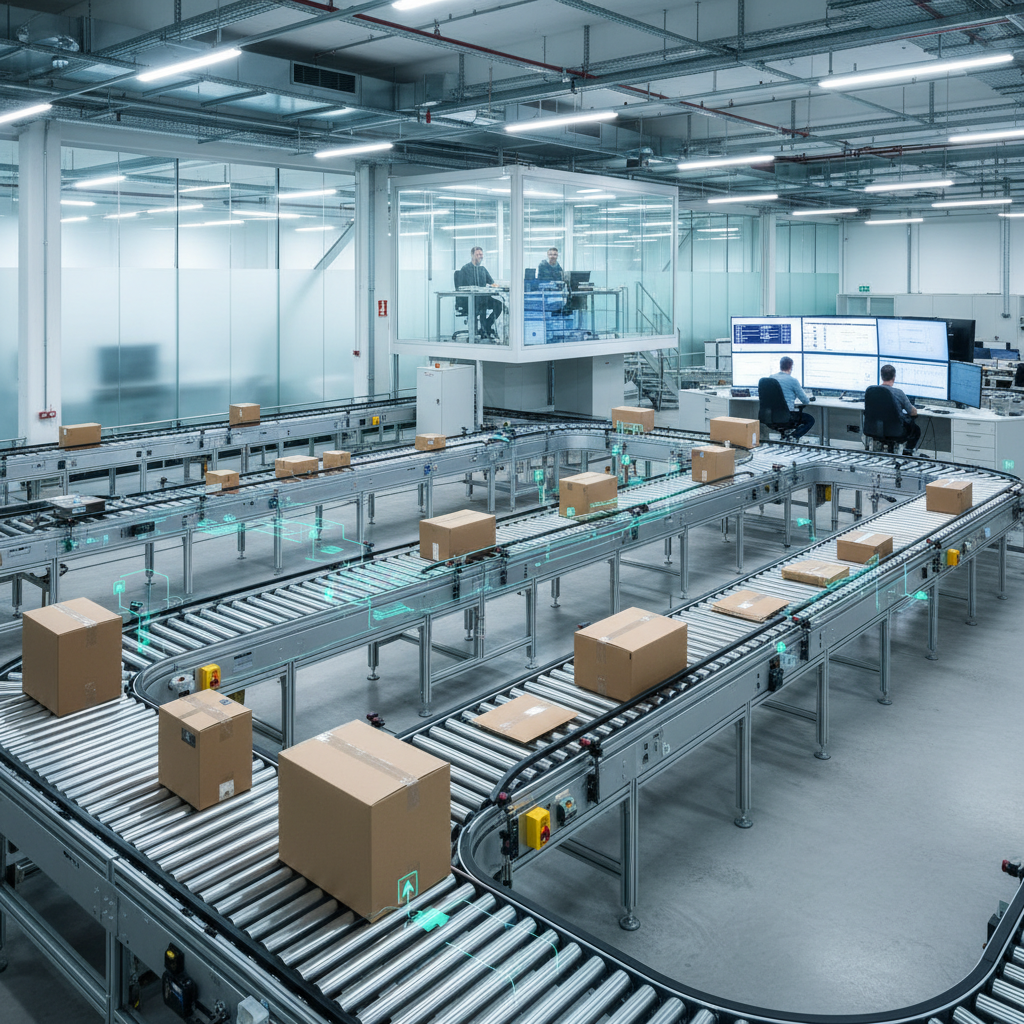
In a large-scale distribution center, a conveyor network is a complex web of intersecting lines, spirals, and sorters. The decision of which path a parcel should take is critical for efficiency. Traditional systems use fixed logic, which can lead to congestion on one line while another is underutilized.
Dynamic Decision-Making Engine
AI acts as a central brain, overseeing the entire conveyor network. It analyzes the flow of goods in real-time and makes dynamic routing decisions. If a primary sorting lane nears its capacity of, for instance, 6,000 parcels per hour, the AI can divert lower-priority parcels to an alternative route. It integrates with the Warehouse Management System to understand order priorities, carrier cut-off times, and fulfillment deadlines, creating a holistic and intelligent sorting strategy. As explored in our guide on WMS/WCS integration, this deep level of communication between software layers is what unlocks next-level efficiency.
Comparative Analysis: Traditional vs. AI-Enhanced Conveyor Systems
The advantages of integrating AI become crystal clear when comparing key performance indicators against traditional systems. The difference is not incremental; it's transformative.
| Metric | Traditional Conveyor System | AI-Enhanced Conveyor System | Impact |
|---|---|---|---|
| Throughput (Parcels/Hour) | 5,000 - 10,000 (Fixed/Rule-Based) | 6,000 - 12,500+ (Dynamic & Optimized) | ~20-25% improvement |
| Sorting Accuracy | 99.5% | 99.98% | Drastic reduction in costly mis-sorts |
| System Downtime | 3-5% (Reactive Maintenance) | <1% (Predictive Maintenance) | Significant increase in availability |
| Energy Consumption (per 1,000 units) | ~1.2 kWh | ~0.9 kWh (On-demand activation) | ~25% energy savings |
| Average Cost per Conveyor Meter | €1,500 - €2,500 | €1,800 - €3,200 (incl. sensors/software) | Higher initial CAPEX, lower OPEX |
Vision Systems and Quality Control
AI-powered computer vision is another game-changer for conveyor lines. High-resolution cameras mounted above a roller conveyor can perform tasks that were previously manual or impossible at high speeds.
- Barcode/Label Reading: AI vision systems can read damaged, poorly printed, or obscured barcodes with much higher accuracy than traditional scanners, reducing the number of parcels sent to a manual exception handling station.
- Damage Detection: The system can identify crushed corners, tears, or leaks on a package as it moves at speeds of up to 2.5 m/s, automatically diverting it for inspection.
- Content Verification: For open-top totes or transparent packaging, vision systems can verify that the correct items and quantities are present, cross-referencing the image with order data in real-time.
These capabilities are critical in minimizing errors, which is a key factor in customer satisfaction and operational cost. Many businesses find that as they expand, their internal processes fail to scale gracefully. As detailed in the post "Bedrijven groeien, maar hun processen groeien niet altijd mee," this process-growth gap is a major hurdle that intelligent automation is perfectly suited to address.
Easy Systems: Your Partner for Future-Proof Intralogistics
The transition to an AI-driven warehouse can seem daunting. It requires a deep understanding of not just the physical hardware but also the complex software ecosystem and data analytics that power intelligent automation. At Easy Systems, we specialize in designing and implementing state-of-the-art conveyor systems tailored to the unique challenges of the Benelux market.
We are not just a hardware supplier; we are an integration partner. Our expertise lies in creating cohesive solutions that bridge the gap between your existing infrastructure and the intelligent technologies of tomorrow. We help you leverage AI and Machine Learning to build a resilient, efficient, and future-proof intralogistics operation that can scale with your business. Whether you are looking to upgrade an existing line or design a new facility from the ground up, our team has the experience to guide you from concept to completion, ensuring your warehouse is ready for the future of logistics.
Frequently asked questions
What is the main benefit of AI in conveyor systems?+
The main benefit is shifting from reactive to proactive operations. AI enables predictive maintenance, which can cut system downtime by up to 30%. It also optimises parcel routing in real-time to increase throughput and uses vision systems for near-perfect sorting accuracy, significantly lowering operational costs for Benelux warehouses.
Is AI expensive to implement on existing conveyor lines?+
While the initial CAPEX for sensors and software can be significant, the return on investment is typically rapid. Most Benelux logistics firms can expect a full ROI within 18-36 months, driven by major OPEX savings from reduced downtime (up to 30% less), lower maintenance bills, and increased throughput.
Will AI replace warehouse workers?+
AI is more likely to augment the human workforce than replace it. While AI handles repetitive, high-speed sorting, workers are crucial for complex tasks and exception handling. AI creates new roles for data analysts and technicians, with projections suggesting a 5-10% growth in such specialised jobs by 2026.
How does AI improve sorting accuracy?+
AI-powered vision systems use high-resolution cameras and machine learning to read labels, even if damaged, with over 99.95% accuracy. This drastically reduces miss-sorts, which can cost European logistics companies upwards of €25 per parcel to correct, improving customer satisfaction and operational efficiency.
What kind of data does an AI conveyor system use?+
An AI system integrates multiple data streams: operational data from the conveyor itself (motor temperature, speed), sensor data (parcel dimensions, weight), and contextual data from the WMS (destination, priority). By 2026, large hubs will process over 1 TB of data per day to make sub-second routing decisions.

The Easy Systems editorial desk reviews and fact-checks every Conveyor-Design article against Benelux project experience. Editors translate engineering decisions — throughput, peak factors, layout, integration — into plain-language guides for operations managers, project leads and decision-makers.
- Warehouse layout & slotting
- Order-profile analysis
- Vendor-neutral comparison
- Benelux logistics market