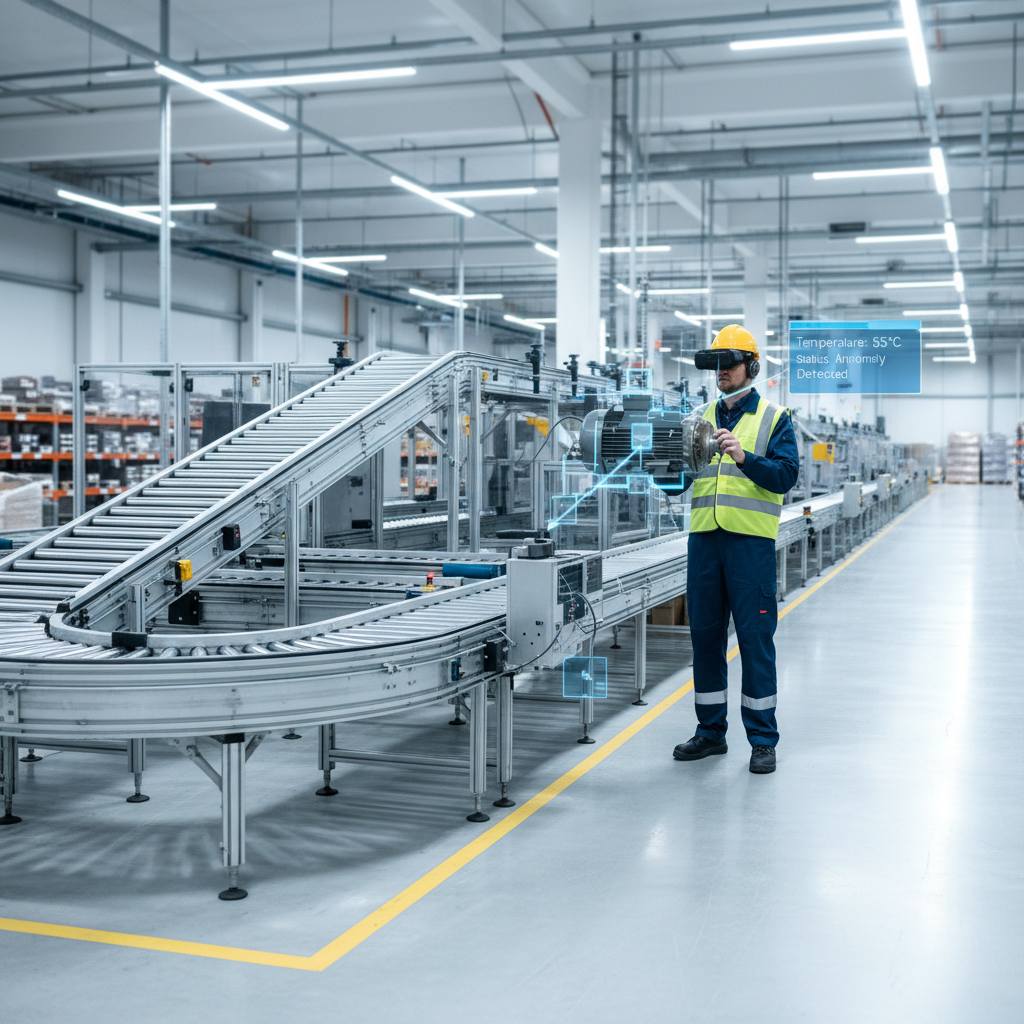
Predictive Maintenance for Conveyors: AI for 99.9% Uptime
Leverage the power of AI and Big Data for predictive maintenance on your conveyor systems. This approach anticipates failures, increases uptime to over 99.9%, and can reduce overall maintenance expenditures by 15-25%, transforming your warehouse efficiency.

In the high-stakes world of logistics and e-commerce, conveyor system downtime is not just an inconvenience; it's a critical failure that can cost thousands of euros per minute. Traditional maintenance strategies—reacting to breakdowns or replacing parts on a fixed schedule—are no longer sufficient. This article explores Predictive Maintenance (PdM), a data-driven approach using Big Data and Artificial Intelligence (AI) to achieve maximum uptime and operational excellence in European warehouses.
Definition
Predictive Maintenance (PdM) for conveyor systems is an advanced maintenance strategy that uses data analysis tools and techniques to detect anomalies in operation and predict potential equipment failures. By monitoring components like motors, bearings, and belts in real-time, PdM allows maintenance to be scheduled precisely when needed, preventing unplanned downtime and optimizing resource allocation.
Key Numbers
| Metric | Typical Range (EU 2026) | Notes |
|---|---|---|
| Unplanned Downtime Reduction | 20% - 35% | Compared to a purely reactive maintenance model. |
| Maintenance Cost Savings | 15% - 25% | Includes reduced labor for inspections and fewer premature part replacements. |
| Initial Investment (per system) | €15,000 - €40,000 | For a mid-sized conveyor line (50-100m), including sensors and software setup. |
| Return on Investment (ROI) | 18 - 24 months | Highly dependent on the cost of downtime at the specific facility. |
| Energy Savings | 3% - 7% | Resulting from optimally performing motors and reduced friction. |
From Reactive to Predictive: The Evolution of Maintenance
The journey to operational excellence involves a clear evolution in maintenance philosophy. Many operations still rely on a "if it ain't broke, don't fix it" model, also known as reactive maintenance. This approach is costly, leading to extensive, unplanned downtime. The next step is preventive maintenance, where parts are replaced on a fixed schedule, regardless of their actual condition. This is better, but often leads to discarding perfectly good components or, conversely, failing before the scheduled replacement.
Predictive maintenance represents the pinnacle of this evolution. It abandons fixed schedules in favor of data-driven, just-in-time interventions. By understanding the actual condition of every component, you can maximize its lifespan without risking catastrophic failure.
Core Technologies: The Sensory System of Your Conveyor
A successful PdM strategy is built on a foundation of diverse and reliable sensors—the Industrial Internet of Things (IIoT)—that act as the nervous system for your material handling equipment. These devices continuously monitor the health of your conveyors.
Key Sensory Inputs
- Vibration Analysis: Tiny, high-frequency vibrations are often the earliest signs of wear in motors, gearboxes, and bearings. Sensors can detect these minute changes long before they are perceptible to humans.
- Thermal Imaging: Overheating is a clear indicator of distress in electrical components and areas with high friction. Continuous thermal monitoring of drive motors and control panels can prevent fires and motor burnouts.
- Acoustic Analysis: Similar to vibration analysis, changes in the sound profile of a running belt conveyor can indicate issues like belt slippage, misalignment, or deteriorating rollers.
- Power Consumption Monitoring: A motor that is drawing more current than its baseline is working harder than it should be, often due to increased friction or a load imbalance. This data provides a direct look at operational efficiency.
The Brains: Big Data & AI Algorithms
Sensors generate a massive volume of data—Big Data. On their own, these data streams are just noise. The value is unlocked when Artificial Intelligence (AI) and machine learning algorithms process this information to find meaningful patterns. The system starts by establishing a "baseline" of normal operation, collecting data over hundreds of hours from a healthy conveyor.
Once this baseline is established, the AI model, often running on an edge device or in the cloud, monitors for deviations. This isn't simple threshold alerting; it's complex pattern recognition. The AI can learn, for instance, that a specific vibration frequency combined with a 2°C temperature increase in a particular motor is a 95% accurate predictor of bearing failure within the next 150 operating hours. This allows the system to send an alert not just that there is a problem, but what the problem likely is and how long you have to address it. Data from the machine's PLC is often combined with sensor data to add operational context.
Implementing a Predictive Maintenance Strategy
Transitioning to PdM is a strategic project that requires careful planning and execution.
Phase 1: Asset Audit & Criticality Assessment
Begin by mapping all conveyor assets. Not all components are created equal. Identify the most critical points of failure—those that would cause the most significant disruption. This often includes main drive units, sorter junctions, and incline sections. Focus your initial investment here.
Phase 2: Sensor Selection & IIoT Integration
Based on the criticality assessment, select and install the appropriate sensors. Ensure they are compatible with your existing infrastructure and can communicate reliably via a robust network (e.g., using OPC UA standards) to a central data aggregation point.
Phase 3: Data Collection, Model Training & Integration
This is where the machine learning happens. Allow the system to collect data for a "learning period" (typically 2-4 weeks) to build its baseline model of normal operation. Once the model is active, it must be integrated into your workflow. An alert should automatically create a work order in your CMMS (Computerized Maintenance Management System) and notify the relevant personnel. For advanced integration with your overall warehouse operation, you may need a robust middleware solution. To learn more about how different software systems connect, read our guide on WMS, WCS, and WES integration.
Comparing Maintenance Strategies
The advantages of a predictive approach become clear when compared directly with traditional methods.
| Aspect | Reactive Maintenance | Preventive Maintenance | Predictive Maintenance |
|---|---|---|---|
| Timing | After failure occurs | Fixed schedule (time/usage) | Just-in-time, based on condition |
| Downtime | High, unplanned | Scheduled, but failure can still occur | Minimal, planned |
| Component Lifecycle | Run to failure | Often replaced prematurely | Maximized to full potential |
| Maintenance Costs | High (overtime, express parts) | Moderate (unnecessary replacements) | Optimized (15-25% lower) |
| Data Requirement | None | Basic usage data | Extensive, real-time sensor data |
Challenges and Considerations in the EU
While the benefits are compelling, implementing a PdM system has challenges. Data security and privacy are paramount, especially under GDPR. Ensure your chosen partner has a robust data handling policy and, where possible, process data on-premise. Furthermore, there is the challenge of an aging workforce. As one recent Easy Systems article notes, companies grow but their processes don't always keep up. Successfully implementing PdM requires investing in training your maintenance teams to trust the data and work with the new AI-driven systems. It represents a a cultural shift from a mechanical to a data-first mindset.
Easy Systems: Your Partner in Intelligent Conveyor Uptime
Achieving a state of near-perfect uptime through predictive maintenance is not about buying sensors; it's about implementing an integrated strategy. It requires a deep understanding of both material handling equipment and the data science that brings it to life. At Easy Systems, we design and build robust, modular conveyor systems that are "PdM-ready." Our engineering philosophy focuses on reliability, serviceability, and data visibility from the ground up. We provide solutions that integrate seamlessly with modern supervision a WCS (Warehouse Control System), ensuring that the data from your conveyor becomes actionable intelligence. By partnering with us, you are not just installing a conveyor; you are building a resilient, future-proof logistics backbone designed for the data-driven era. Let us help you transition from reacting to failures to predicting success.
Frequently asked questions
What is the typical ROI of predictive maintenance for conveyor systems?+
The return on investment (ROI) for predictive maintenance on conveyors is typically seen within 18 to 24 months. For facilities with high downtime costs, often exceeding €5,000 per hour, the ROI can be achieved in less than a year due to significant savings from avoiding unplanned stops.
How much does it cost to implement predictive maintenance?+
For a medium-sized conveyor system (50-100 meters), an initial predictive maintenance setup can cost between €15,000 and €40,000. This includes sensors, mounting hardware, data acquisition software, and initial model configuration. The final cost depends on the number of critical points monitored.
What's the main difference between predictive and preventive maintenance?+
Preventive maintenance involves replacing parts on a fixed schedule, like changing your car's oil every 10,000 km. Predictive maintenance is condition-based; it analyzes real-time data to predict a failure and tells you to perform maintenance only when needed, potentially extending that oil change to 13,500 km safely.
What kind of data is needed for AI-based conveyor maintenance?+
The primary data types are high-frequency vibration data, temperature readings from motors and bearings, acoustic signatures, and electrical current draw from motors. This sensor data is often combined with operational data from the PLC, such as belt speed and load, to build an accurate predictive model.
Can predictive maintenance be retrofitted onto older conveyor systems?+
Yes, absolutely. Most predictive maintenance solutions are designed to be retrofitted. Wireless sensors for vibration and temperature can be easily mounted on older motors and gearboxes, making it a viable and cost-effective upgrade for existing material handling infrastructure, with an average installation time of 2-3 days.
How does predictive maintenance help reduce energy consumption?+
PdM can reduce conveyor energy consumption by 3-7%. It identifies issues like bearing friction, belt misalignment, or motor strain that cause the system to draw more power. By fixing these issues proactively, the equipment runs closer to its optimal efficiency, lowering electricity costs.

The Easy Systems engineering team designs, integrates and commissions conveyor systems and warehouse automation across Belgium, the Netherlands and Luxembourg. Combined experience covers roller and belt conveyors, sorters, AGV/AMR fleets, AutoStore, shuttle AS/RS and WMS/WCS integration for distribution centers and e-commerce fulfillment operations.
- Conveyor design (roller, belt, modular plastic)
- Sortation & merge logic
- AGV / AMR fleet integration
- AutoStore & shuttle AS/RS
- WMS / WCS integration