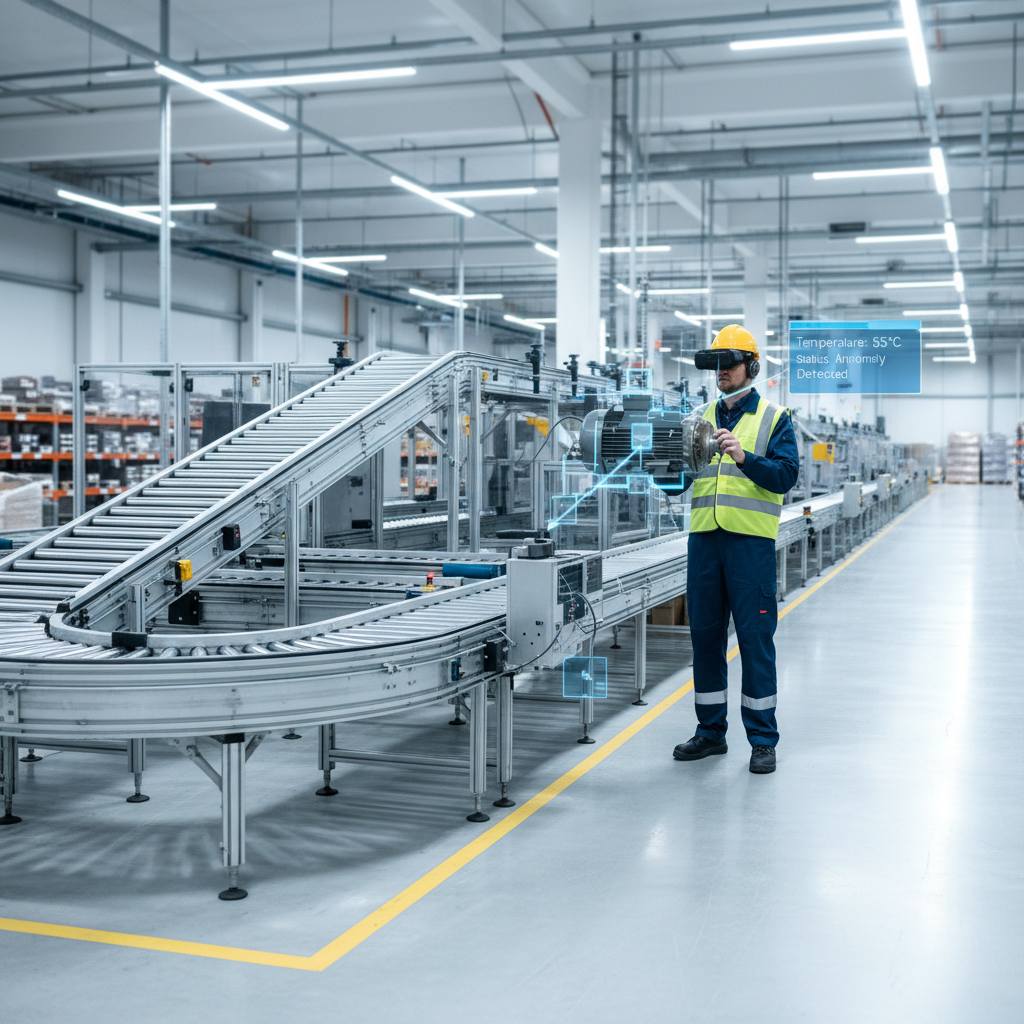
Predictive Maintenance for Conveyors: A Practical Guide
Discover how implementing a predictive maintenance strategy for your conveyor systems can drastically reduce unexpected failures and costly downtime. This guide covers the essential technologies, data points, and steps for maximizing your operational efficiency and ROI.

In any modern distribution center or manufacturing facility, conveyor system downtime is more than an inconvenience; it's a direct hit to the bottom line. Every minute a conveyor stands still, orders are delayed, production halts, and costs accumulate. While traditional maintenance strategies have aimed to mitigate this, they often fall short. The future of efficient and reliable material handling lies in a more intelligent, data-driven approach: predictive maintenance (PdM).
Definition
Predictive Maintenance (PdM) is a proactive maintenance strategy that utilizes condition-monitoring sensors and data analysis to detect early signs of equipment degradation. By forecasting potential failures, maintenance can be scheduled precisely when needed—before a catastrophic breakdown occurs—thereby minimizing disruption and maximizing asset lifespan.
Key Numbers
| Metric | Typical range (EU 2026) | Notes |
|---|---|---|
| Downtime Reduction | 30% - 50% | Compared to a purely reactive maintenance model. |
| Maintenance Cost Reduction | 25% - 30% | Fewer unnecessary part replacements and less overtime for emergency repairs. |
| Return on Investment (ROI) | 1.5 - 2 years | For a medium-sized logistics operation investing in a comprehensive PdM program. |
| Initial Investment Cost | €5,000 - €15,000 per 100m | Includes sensors, software integration, and initial setup. Highly variable. |
| Energy Savings | 5% - 10% | Resulting from optimally performing equipment (e.g., correct belt tension, efficient motors). |
| Asset Lifespan Increase | 20% - 40% | By addressing issues proactively before they cause cascading damage. |
| False-Positive Alert Rate | < 5% | With a well-tuned AI model after the initial learning phase. |
From Reactive to Predictive: A Necessary Evolution
For decades, maintenance in warehouses has fallen into two camps: reactive ("fix it when it breaks") and preventive ("fix it every X months"). While preventive maintenance was a step up, it often leads to unnecessary work and expense, replacing parts that are still perfectly functional. Predictive maintenance represents the next logical leap, leveraging the Industrial Internet of Things (IIoT) to create a truly efficient system.
| Attribute | Reactive Maintenance | Preventive Maintenance | Predictive Maintenance |
|---|---|---|---|
| Trigger | Equipment failure | Fixed schedule (time/usage) | Real-time condition data |
| Downtime | High, unplanned | Medium, planned | Minimal, planned |
| Maintenance Costs | Very High (overtime, expedited parts) | Medium (can include unnecessary work) | Low (only necessary work) |
| Asset Utilization | Low | Good | Optimal |
| Typical Scenario | A critical motor fails during peak season. | All bearings are replaced every 12 months. | An alert flags a bearing with a 95% failure probability in the next 72 hours. |
Core Technologies in Conveyor Predictive Maintenance
A successful PdM program is built on a foundation of robust sensor technology. These devices are the eyes and ears of the system, constantly monitoring the health of your conveyors.
Vibration Analysis
This is the cornerstone of PdM for rotating equipment. Small, wireless sensors attached to motor housings, bearings, and gearboxes measure vibration frequencies. Advanced algorithms can distinguish between normal operational vibrations and the unique signatures of impending failures like bearing wear, misalignment, or imbalance. An increase in a specific frequency band can indicate, with high precision, that a bearing will fail within a calculable timeframe (e.g., 100 operating hours).
Thermal Imaging (Thermography)
Infrared cameras, either mounted permanently or used during inspection rounds, detect abnormal heat signatures. Overheating is a primary indicator of problems in electrical components (like PLC cabinets and motor controls) and mechanical systems (e.g., excessive friction in a gearbox or a slipping belt). An otherwise healthy motor running 15°C above its normal baseline might signal an imminent winding failure.
Acoustic Analysis
Just as a car engine sounds different when it has a problem, so does a conveyor system. Ultrasonic sensors can "hear" high-frequency sounds that are inaudible to the human ear. These can pinpoint issues like compressed air leaks (in pneumatic systems), electrical arcing, and the very early stages of bearing fatigue, often detectable even before vibration analysis picks them up.
Integrating PdM with Your Warehouse Ecosystem
Collecting sensor data is only half the battle. The true power of PdM is unlocked when this data is integrated into your broader warehouse software stack. This is a key focus of modern logistics architecture, as detailed in our guide to WMS, WCS, and WES systems.
Ideally, alerts and data streams from PdM sensors feed directly into a Warehouse Control System (WCS) or a specialized Computerized Maintenance Management System (CMMS). This integration automates the maintenance workflow:
- An AI model flags an anomaly (e.g., motor vibration exceeds threshold).
- The system automatically generates a work order in the CMMS.
- The order includes the specific component, location, and the nature of the predicted failure.
- A technician is dispatched with the correct part before the failure ever occurs.
This level of integration transforms maintenance from a reactive firefight into a calm, controlled, and data-driven process.
Implementing a Predictive Maintenance Program: A 4-Step Approach
Deploying a PdM strategy can seem daunting, but it can be broken down into manageable phases.
- Baseline Assessment & Criticality Analysis: Not all components need advanced monitoring. Start by identifying the most critical points of failure in your conveyor network. Which breakdowns cause the most significant disruption? Focus your initial investment there. Measure baseline performance (vibration, temperature) on healthy equipment.
- Sensor Selection & Installation: Based on the failure modes identified, select the appropriate sensors. Vibration sensors for motors and bearings, thermal cameras for control panels, and perhaps motor-circuit analysis for key drives on a roller conveyor system.
- Data Integration & Model Training: Pipe the sensor data into a central platform. In the initial phase, the AI/machine learning model learns the "normal" operating signature of your system. This training period is crucial for minimizing false positives later on.
- Workflow Automation & Alerting: Define the rules for action. What happens when an alert is triggered? Who is notified? How is the work order generated? Start with simple email or SMS alerts and gradually build towards full CMMS/WCS integration.
The Financial Case: Calculating the ROI
The business case for PdM is compelling. The initial investment in sensors and software (from €5,000 to €15,000 per 100m of conveyor) is often recouped within 18-24 months. The ROI is driven by several factors:
- Drastic Reduction in Unplanned Downtime: The single largest cost saver. A single hour of downtime in a large DC can cost upwards of €10,000.
- Optimized MRO Inventory: No need to stock excessive "just-in-case" spare parts. You order what you need, when you need it.
- Reduced Maintenance Labor: Technicians spend their time on targeted, value-add tasks, not on routine inspections or emergency repairs at 2 a.m.
- Increased Safety: Proactively replacing components before they fail catastrophically reduces the risk of workplace accidents.
As many fast-growing European companies find, scaling operations requires processes that can keep pace. A breakdown in logistics can halt that growth instantly. Predictive maintenance is a key enabler of sustainable, scalable operations.
Easy Systems: Your Partner in Proactive Conveyor Management
At Easy Systems, we design and build modular conveyor solutions with modern maintenance needs in mind. Our systems are engineered for reliability and ease of access, providing the perfect foundation for a state-of-the-art predictive maintenance program. We use high-quality components and an open-architecture approach, allowing for straightforward integration of third-party sensors and monitoring systems. By partnering with us, you're not just investing in a conveyor; you're investing in a future-proof material handling backbone that minimizes downtime and maximizes your return on investment for years to come.
Frequently asked questions
What is the main benefit of predictive maintenance for conveyors?+
The primary benefit is a drastic reduction in unplanned downtime, often by as much as 50%. By forecasting failures, maintenance can be scheduled during non-peak hours, transforming costly emergencies into controlled, efficient repairs and boosting overall plant productivity significantly.
How much does it cost to implement predictive maintenance?+
Initial implementation costs can range from €5,000 to €15,000 per 100 meters of conveyor, depending on system complexity and the number of sensors. While this is a significant upfront investment, the ROI is typically realized within 18 to 24 months due to savings on downtime and repairs.
What's the difference between predictive and preventive maintenance?+
Preventive maintenance is time-based (e.g.,
Which conveyor parts benefit most from PdM?+
The components that benefit most are high-failure-rate rotating parts. This includes electric motors, gearboxes, and especially bearings within rollers and drive units. Monitoring these parts with vibration and thermal sensors provides the highest and most immediate return on investment.
How long does it take to see ROI from a PdM system?+
For a typical medium-to-large European warehouse, the return on investment for a comprehensive predictive maintenance program is usually seen within 1.5 to 2 years. This timeframe can be even shorter if the system prevents just one major, multi-day shutdown during a peak period.
Can predictive maintenance be added to older conveyor systems?+
Yes, retrofitting is one of the great advantages of modern PdM solutions. Wireless, battery-powered sensors can be easily attached to legacy equipment without extensive rewiring. This allows warehouses to bring the benefits of Industry 4.0 to their existing infrastructure for a fraction of the cost of a full replacement.

The Easy Systems editorial desk reviews and fact-checks every Conveyor-Design article against Benelux project experience. Editors translate engineering decisions — throughput, peak factors, layout, integration — into plain-language guides for operations managers, project leads and decision-makers.
- Warehouse layout & slotting
- Order-profile analysis
- Vendor-neutral comparison
- Benelux logistics market