Optimizing Conveyor Performance with Fleet Management Software: A Practical Approach for Benelux Warehouses
Fleet management software offers a centralized solution for monitoring, analyzing, and optimizing conveyor systems. This approach moves beyond basic control to unlock significant gains in throughput, uptime, and efficiency for modern Benelux warehouses.
In the high-density, fast-paced logistics landscape of the Benelux, where every square meter and every minute counts, the performance of your conveyor systems is non-negotiable. While traditional systems move boxes, modern warehouse operations require a more intelligent approach. This is where fleet management software for conveyors comes in, offering a data-driven strategy to maximize uptime, throughput, and overall equipment effectiveness (OEE) that goes far beyond simple on/off controls.
Definition
Conveyor fleet management software is a specialized platform that centralizes the monitoring, control, and performance analysis of an entire fleet of material handling equipment, specifically conveyor lines. It aggregates data from sensors, motors, and controllers to provide a holistic, real-time view of the system's health and efficiency, enabling predictive maintenance and data-driven optimization.
Why Traditional Conveyor Control Is No Longer Enough
For decades, conveyor systems have been the reliable workhorses of the warehouse, often controlled by isolated PLC (Programmable Logic Controller) units. This decentralized approach, while functional for simple A-to-B transport, presents significant challenges in today's complex fulfillment centers, particularly in the competitive Benelux market.
The Limitations of Siloed Operations
A typical warehouse might have dozens of conveyor segments—inclines, curves, merges, and sorters—each operating with its own localized logic. This creates data silos. A problem in one zone might cause a cascade of delays upstream, but without a centralized overview, diagnosing the root cause is slow and reactive. Maintenance is often calendar-based or, worse, reactive, leading to unexpected and costly downtime during peak operating hours. In a region where labor costs are high (€35-€45 per hour for a warehouse operator), every minute of non-productive time has a significant financial impact.
The Demands of Modern E-commerce
The pressure from e-commerce—with its demands for higher SKU counts, smaller order sizes, and shorter delivery windows—means that conveyor systems must be more than just "on." They need to be adaptable, efficient, and resilient. A simple PLC can't tell you which motor is showing early signs of wear or which line is consistently underperforming its design capacity by 10%. To achieve this level of insight, a higher level of intelligence is required, one that integrates seamlessly with a WMS/WCS/WES ecosystem.
Core Capabilities of Modern Fleet Management Software
Fleet management platforms transform conveyors from passive hardware into active, intelligent assets. They do this through a set of powerful, integrated capabilities.
Centralized Monitoring & Real-time Visualization
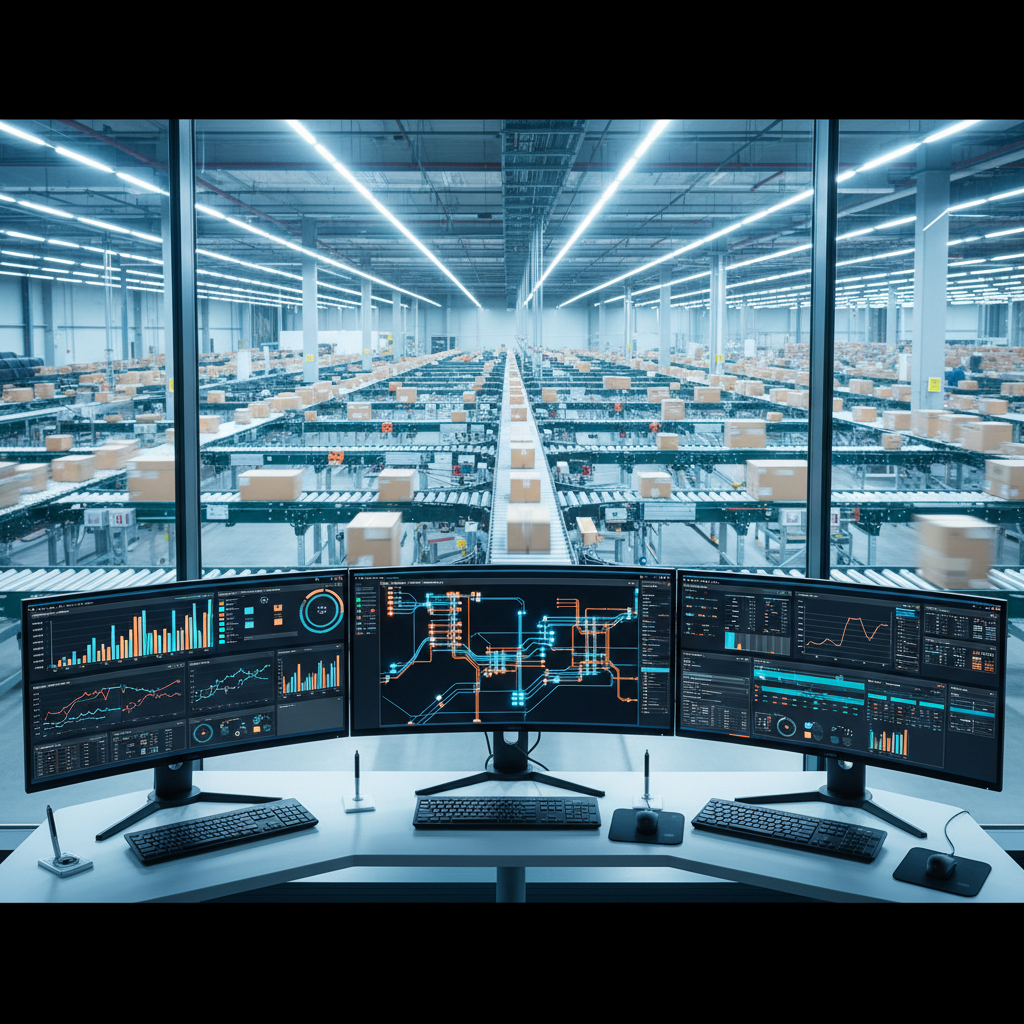
Imagine a single dashboard showing the status of every conveyor in your facility, from a small accumulation line in packing to the main sorting artery. This "digital twin" of your conveyor network provides a live, graphical representation of your operations. Operators can see motor speeds (in m/s), load weights (in kg), and throughput rates in real-time. An alarm on a motor drawing too much current can be pinpointed on the map instantly, long before it overheats and fails.
Predictive Maintenance & Anomaly Detection
This is arguably the most valuable feature. By continuously analyzing data from sensors (vibration, temperature, power consumption), the software uses machine learning algorithms to detect anomalies that signal potential failures.
- An increase in a motor's temperature by 5°C over its 30-day average might trigger a low-level alert.
- Slightly increased vibration on a roller bearing can be flagged for inspection during the next planned maintenance window.
- A gradual drop in the speed of a specific belt conveyor section could indicate belt slippage or tension issues.
Performance Analytics & KPI Tracking
Fleet management software is a powerful business intelligence tool. It tracks key performance indicators (KPIs) crucial for logistics managers:
- Throughput: Cases Per Hour (CPH) for each line, compared against design capacity.
- Uptime: Percentage of scheduled time the system is operational.
- Mean Time Between Failures (MTBF): Tracks reliability over time.
- Mean Time To Repair (MTTR): Measures the efficiency of the maintenance response.
Fleet Management Software vs. Traditional WCS/WES
It's crucial to understand how fleet management software complements, rather than replaces, a Warehouse Control System (WCS) or a Warehouse Execution System (WES). A WES is focused on the *flow of goods*—directing products and orders. Fleet management software is focused on the *health and performance of the hardware* that moves those goods.
| Aspect | Traditional WCS/WES | Conveyor Fleet Management Software |
|---|---|---|
| Primary Focus | Flow of goods, order routing, task allocation. | Health, performance, and maintenance of conveyor hardware. |
| Core Question | "Where should this parcel go next?" | "Is this motor about to fail? Is this line running at optimal speed?" |
| Key Data Inputs | WMS data (orders, inventory), scanner inputs. | Sensor data (vibration, temperature, current), motor speeds, PLC error codes. |
| Main Benefit | Optimized order fulfillment and logistics flow. | Maximized uptime, reduced maintenance costs, and asset longevity. |
| Typical User | Operations Manager, Shift Supervisor. | Maintenance Manager, Engineering Team. |
Tangible Benefits for Benelux Distribution Centers
Implementing a fleet management strategy for you conveyor systems yields concrete, measurable results that directly address the challenges of the Benelux market.
Increased Throughput and CPH
By optimizing line speeds, minimizing micro-stoppages, and ensuring smooth merges, warehouses can often achieve a 10-15% increase in overall throughput without any major physical changes to the conveyor hardware. For a DC in Utrecht processing 5,000 parcels per hour, this translates to an additional 500-750 parcels hourly, significantly boosting capacity during peak seasons.
Reduced Downtime & Maintenance Costs
Predictive maintenance is a game-changer. By replacing a €500 motor during a planned overnight shift instead of having it fail during the morning peak, you avoid not just the repair cost but thousands of euros in lost productivity and potential SLA penalties. The software enables a maintenance budget that is planned and efficient, not chaotic and expensive.
Improved Energy Efficiency
Modern fleet management systems can implement intelligent control strategies, such as running conveyors at a slightly lower speed during off-peak hours or putting entire sections to sleep when no product is present for a set period (a feature especially effective with Motorized Drive Roller systems). This can lead to energy savings of 15-20%, a significant number given the high energy prices in Europe.
Implementing Fleet Management: A Phased Approach
Adopting this technology is a structured process, not an overnight flip of a switch. It typically involves three phases.
- Assessment & Hardware Integration: This phase involves auditing your existing conveyor network. Are your PLCs capable of providing data? Do you need to add additional sensors (e.g., vibration, temperature)? This is the foundational step of connecting the physical hardware to the digital world.
- Software Deployment & Integration: The fleet management software is installed, typically on a central server. It's then configured to communicate with the PLCs and sensors. Crucially, it is integrated with your WES/WCS to contextualize the hardware data with operational flow.
- Training, Go-live & Continuous Optimization: Maintenance and operations teams are trained on how to use the dashboards and interpret the alerts. As many Dutch business leaders have experienced, growth happens when processes evolve. As noted in a recent analysis, companies grow, but their processes don't always keep up; this software provides the data needed for that continuous process evolution. Your system isn't just "live"—it's now a source of insight for ongoing improvement.
Partner with Easy Systems for Intelligent Automation
In the dynamic European market, especially within the logistics triangle of the Benelux, leveraging advanced technology is not just an option—it's essential for survival and growth. Adopting a fleet management approach to your conveyor systems is a critical step towards building a more resilient, efficient, and data-driven warehouse operation.
At Easy Systems, we specialize in designing, manufacturing, and integrating modular conveyor systems that are built for the future. Our solutions, from simple roller conveyors to complex sorting systems, are designed to be easily integrated with intelligent software layers. We understand the specific pressures of the Benelux market and partner with our clients to deliver robust, scalable, and cost-effective automation solutions that provide a tangible return on investment. Let us help you turn your conveyor system from a simple mover of boxes into a strategic asset for your business.
Frequently asked questions
Can fleet management software be retrofitted to older conveyor systems?+
Yes, in many cases it can. The feasibility depends on the existing PLCs and control systems. It may require adding modern sensors and communication gateways to extract the necessary data, but it's often more cost-effective than a full system replacement.
Is this type of software only for large distribution centers?+
While large DCs with extensive conveyor networks see the biggest benefits, the principles are scalable. A smaller facility in Belgium or Luxembourg can still benefit from centralized monitoring and predictive maintenance to maximize the uptime of their critical sorting lines.
What is the typical ROI for implementing conveyor fleet management software?+
The Return on Investment (ROI) typically ranges from 12 to 24 months. It's driven by cost savings from reduced unplanned downtime, lower maintenance labor costs, extended equipment lifespan, and increased throughput capacity.
How does this differ from the software that controls an AGV or AMR fleet?+
The principle is similar—managing a fleet of assets—but the application is different. AGV/AMR fleet managers focus on traffic control, routing, and battery management for mobile units. Conveyor fleet management focuses on the health and performance of fixed assets: motors, belts, rollers, and drives.

The Easy Systems engineering team designs, integrates and commissions conveyor systems and warehouse automation across Belgium, the Netherlands and Luxembourg. Combined experience covers roller and belt conveyors, sorters, AGV/AMR fleets, AutoStore, shuttle AS/RS and WMS/WCS integration for distribution centers and e-commerce fulfillment operations.
- Conveyor design (roller, belt, modular plastic)
- Sortation & merge logic
- AGV / AMR fleet integration
- AutoStore & shuttle AS/RS
- WMS / WCS integration