Micro-Fulfillment in the Benelux: The Role of Compact Conveyors
Micro-Fulfillment Centers (MFCs) are transforming urban logistics in the Benelux. This article explores their critical role and how compact, modular conveyor systems are essential for achieving the speed and efficiency required for last-mile delivery.
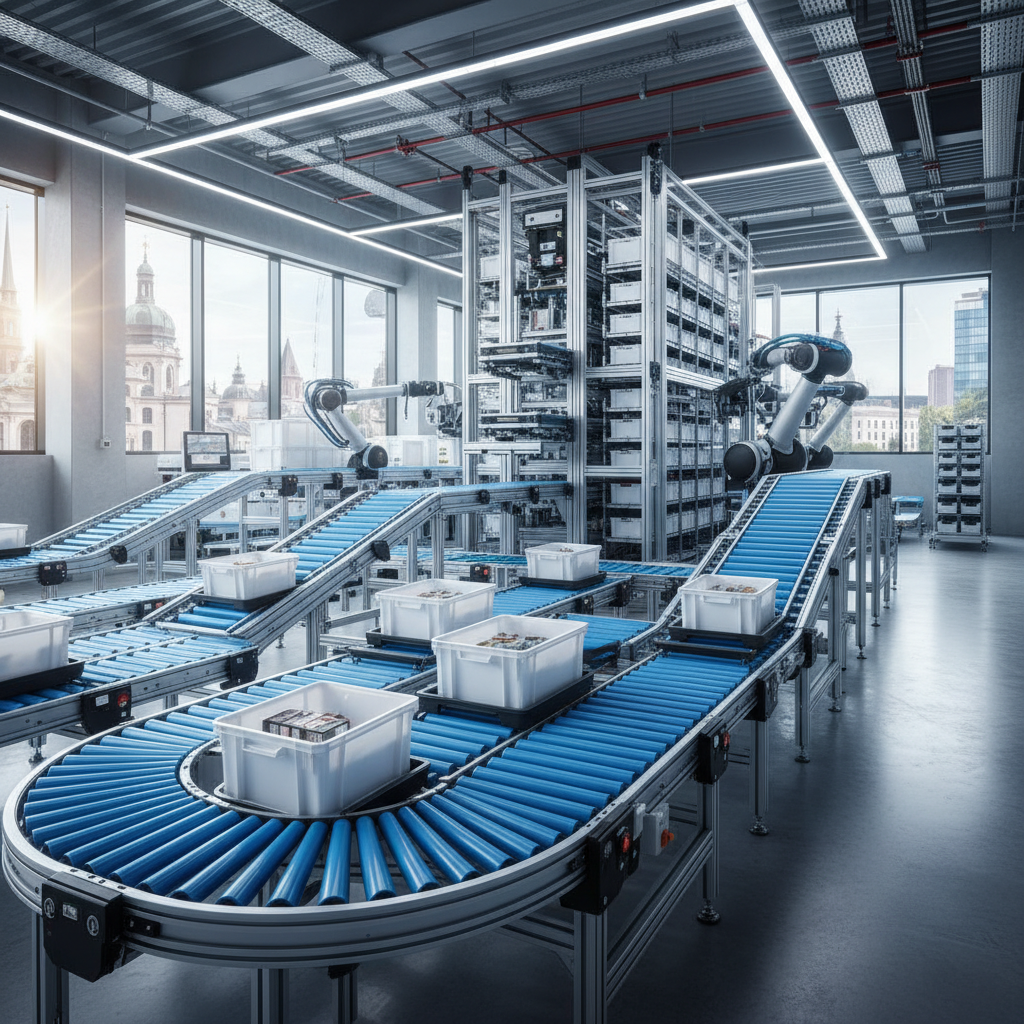
The explosive growth of e-commerce and rising consumer expectations for instant delivery have reshaped the urban landscape of the Benelux. Retailers are racing to solve the last-mile puzzle, and a powerful solution has emerged: the Micro-Fulfillment Center (MFC). These compact, strategically located facilities are bringing goods closer to the customer, making same-day or even same-hour delivery a reality. At the heart of these operations are compact, intelligent conveyor systems, the unsung heroes enabling the speed and precision required in dense urban environments.
Definition
A Micro-Fulfillment Center (MFC) is a small-scale, highly automated warehouse facility located within a densely populated urban area to facilitate ultra-fast e-commerce order fulfillment and last-mile delivery. Unlike traditional large distribution centers on the outskirts of cities, MFCs prioritize speed and proximity over vast storage capacity, often utilizing advanced robotics and compact material handling equipment.
Key Numbers
| Metric | Typical Range (Benelux 2026) | Notes |
|---|---|---|
| Footprint | 500 - 2,000 m² | Often retrofitted into existing urban spaces like retail backrooms or parking garages. |
| Order Processing Time | 10 - 30 minutes | From order receipt to ready-for-dispatch. Key for rapid delivery. |
| Conveyor System Speed | 0.5 - 1.5 m/s | Optimized for short distances and careful handling of mixed items. |
| Throughput (Conveyor) | 500 - 1,500 CPH | Units (totes, parcels) per hour, depending on system complexity. |
| Total System Investment | €500,000 - €5,000,000 | Includes automation (e.g., AS/RS), conveyors, software, and installation. |
| Conveyor Investment | €50,000 - €300,000 | Represents a fraction of the total MFC cost but is critical for workflow. |
| Return on Investment (ROI) | 2 - 4 years | Driven by reduced last-mile costs and increased customer retention. |
Why MFCs are Dominating Urban Logistics in the Benelux
The Benelux region, with its high population density, affluent consumers, and significant traffic congestion, presents a unique challenge for logistics. Traditional, large-scale distribution centers located far from city centers struggle to meet the demand for "q-commerce" (quick commerce). MFCs address this by design.
- Proximity to the Customer: Located in or near cities like Amsterdam, Brussels, and Luxembourg, MFCs drastically reduce the distance for last-mile delivery. This translates to lower fuel costs, reduced emissions, and critically, faster delivery times.
- Meeting Consumer Expectations: The modern consumer expects their order *now*. A 2-hour delivery window is quickly becoming the standard in major Benelux cities for groceries and other convenience items. MFCs are the only way to meet this demand consistently.
- Overcoming Urban Constraints: Building large warehouses in city centers is impossible. MFCs are designed to be retrofitted into the back of a supermarket, a small industrial unit, or even an underground car park, making creative use of expensive urban real estate.
The Central Role of Compact Conveyor Systems
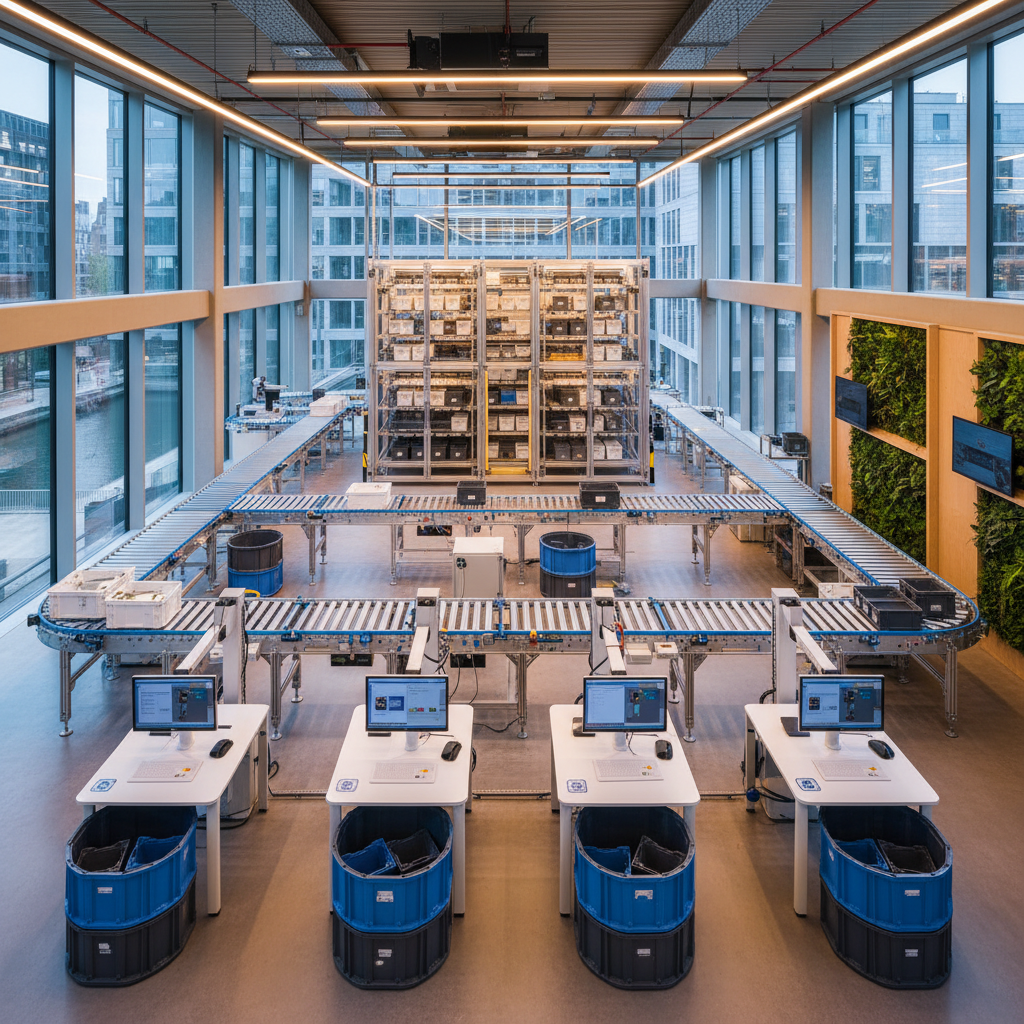
Space is the ultimate luxury in an MFC. Every square meter is meticulously planned. This is where compact, modular conveyor systems become indispensable. They are the circulatory system that connects different functional areas, moving items from storage to picking stations and finally to dispatch without wasting valuable floor space.
Key Conveyor Technologies for MFCs
Not all conveyors are created equal. MFCs demand specific features: modularity, low profiles, and intelligent control. A one-size-fits-all approach fails in such a constrained environment. For a deeper understanding of the core technology, our Roller Conveyor Guide provides essential background.
| Conveyor Type | Key Advantage for MFCs | Typical Use Case | Cost Indicator |
|---|---|---|---|
| Modular Roller Conveyor (MDR) | Zero-pressure accumulation & energy efficiency | Transporting totes between Goods-to-Person stations and packing. | €€ |
| Modular Plastic Belt Conveyor | Handles diverse item shapes/sizes directly | Infeed/outfeed for sorters or direct transport of irregularly shaped items. | €€€ |
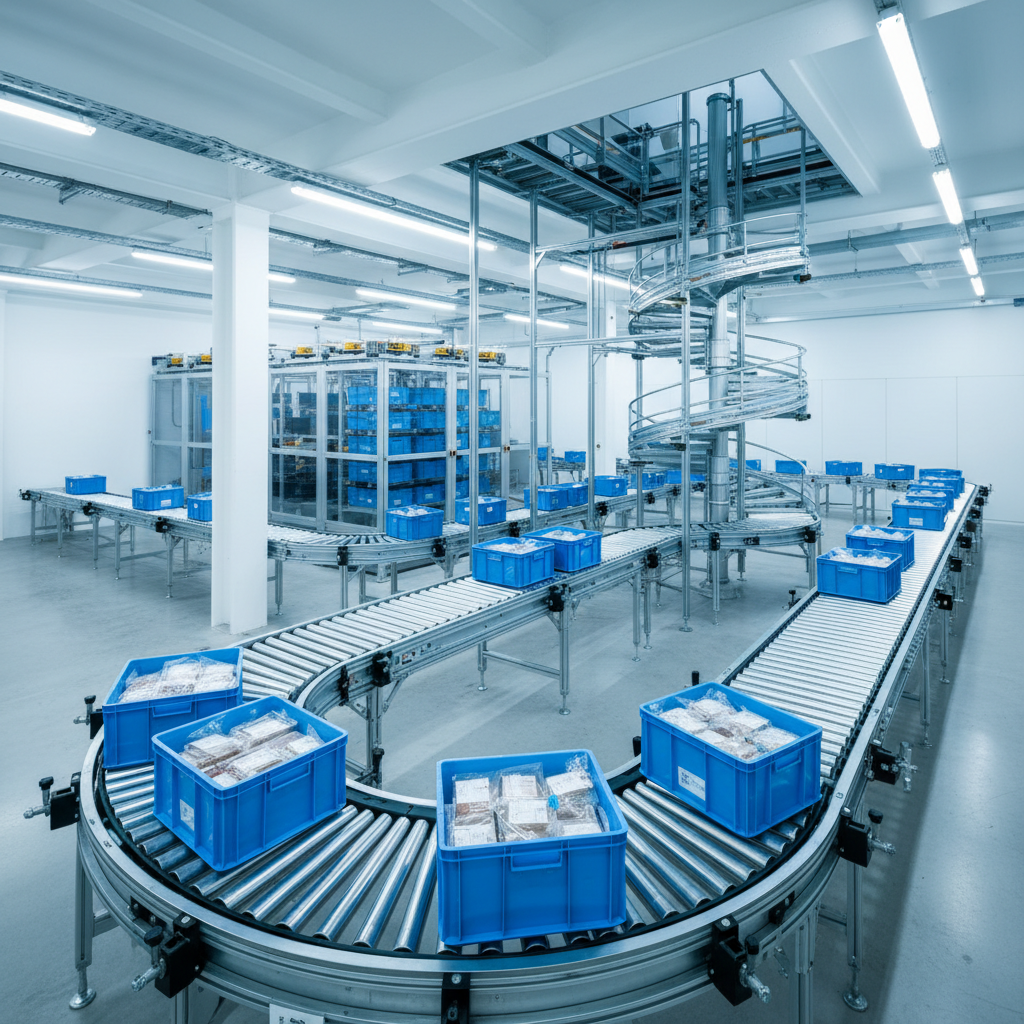
| Spiral Conveyor | Vertical space utilization | Moving goods between different floor levels or mezzanines. | €€€€ |
| Gravity Roller Conveyor | Cost-effective simplicity | Manual packing stations or as a buffer at the end of a line. | € |
| Belt Conveyor | Smooth transport for delicate items | Incline/decline sections or moving loose items before bagging. | €€ |
System Integration: The Brains of the Operation
A conveyor system in an MFC is more than just hardware; it's an integrated part of a larger automation ecosystem. The entire process is orchestrated by a hierarchy of software:
- Warehouse Management System (WMS): Manages inventory and order data.
- Warehouse Execution System (WES): The real-time "brain" that directs the automation. It tells the AS/RS which tote to retrieve and instructs the Warehouse Control System (WCS) on how to route it.
- Warehouse Control System (WCS): Directly manages the material handling equipment, activating specific conveyor zones, diverters, and sorters.
This seamless integration is critical. As noted in a recent analysis, many companies find that while their business grows, their internal processes fail to scale accordingly. In an MFC, a robust WES/WCS is non-negotiable for achieving the required speed and accuracy.
Designing a Conveyor Layout for a Benelux MFC
Designing a conveyor system for an MFC is a game of millimeters. The goal is to create a fluid, non-stop flow in a highly restricted space.
Core Principles of MFC Conveyor Design
- Maximize Vertical Space: Use spiral conveyors or multi-level mezzanines to move goods up and down, freeing up the ground floor for high-value activities like picking and packing.
- Embrace Modularity: The needs of an MFC can change. Modular roller conveyors, like those using Motorized Drive Roller (MDR) technology, allow for easy reconfiguration and expansion without requiring a complete system overhaul.
- Prioritize Zero-Pressure Accumulation: To prevent damage to products and totes, and to create a smooth, efficient flow, zero-pressure accumulation zones are essential. This allows totes to buffer without contact before proceeding to the next step.
- Integrate Smart Diverters: High-speed diverters and transfers are used to route totes to specific picking stations or dispatch lanes with millisecond precision, directed by the WCS.
The Future: AI, Robotics, and Hyper-Local Fulfillment
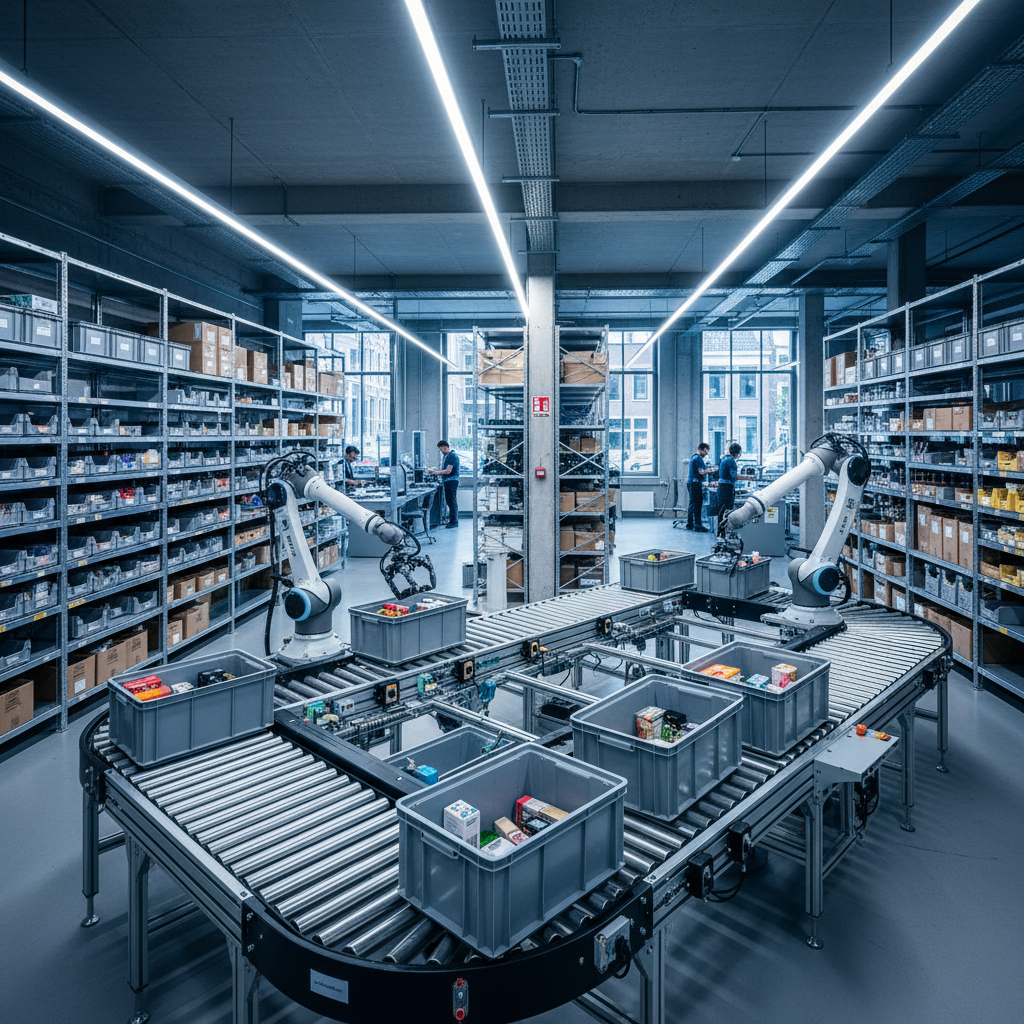
The evolution of the MFC is far from over. The next wave of innovation in the Benelux will focus on even greater automation and intelligence. We are seeing a rise in Autonomous Mobile Robots (AMRs) working alongside conveyors to provide flexible transport to and from packing stations. AI-powered vision systems will enhance quality control and picking accuracy, while predictive analytics will optimize inventory placement and order batching based on real-time local demand. The end goal is a fully autonomous, "lights-out" micro-facility that can fulfill an order within 5-10 minutes, 24/7.
Easy Systems: Your Partner for Compact Fulfillment Solutions
In the high-stakes world of micro-fulfillment, there is no room for error. The efficiency of your entire operation depends on the reliability and intelligence of your material handling systems. At Easy Systems, we specialize in designing and delivering compact, modular conveyor solutions specifically for the unique challenges of urban fulfillment centers in the Benelux and across Europe.
Our deep expertise in modular roller conveyors, belt systems, and WCS integration allows us to create custom-fit solutions that maximize throughput in minimal space. We understand that an MFC is a complex, integrated system. We partner with you, your WMS provider, and your automation partners to deliver a conveyor solution that is not just a piece of equipment, but a critical enabler of your last-mile strategy. Trust Easy Systems to build the fast, reliable, and scalable transport backbone your MFC needs to win in the competitive world of q-commerce.
Frequently asked questions
What is the main advantage of a Micro-Fulfillment Center in the Benelux?+
The main advantage is speed. By being located in dense urban areas like Amsterdam or Brussels, MFCs cut last-mile delivery times dramatically, enabling order fulfillment in under 2 hours. This proximity to the customer is crucial for meeting the growing demand for quick commerce.
How much does a conveyor system for an MFC cost?+
The conveyor system itself typically costs between €50,000 and €300,000 for a Benelux MFC. This is part of a larger total automation investment of €500k to €5M. The cost depends on complexity, length, and technology like MDR or spiral conveyors.
What kind of conveyors are used in a micro-fulfillment center?+
MFCs primarily use compact, modular conveyor systems. Motorized Drive Roller (MDR) conveyors are popular for their zero-pressure accumulation and energy efficiency. Modular plastic belts handle diverse items, and spiral conveyors are used to save space by moving goods vertically.
What is the typical size of a micro-fulfillment center?+
A typical MFC in Europe ranges from 500 to 2,000 square meters. They are designed to be compact enough to fit into existing urban structures, such as the backroom of a retail store, a small warehouse, or even a converted parking garage.
How fast can an MFC process an order?+
A highly automated MFC can process a customer order—from digital receipt to being packed and ready for dispatch—in as little as 10 to 30 minutes. This high speed is achieved through a combination of robotics like AS/RS and efficient, integrated conveyor systems.

The Easy Systems editorial desk reviews and fact-checks every Conveyor-Design article against Benelux project experience. Editors translate engineering decisions — throughput, peak factors, layout, integration — into plain-language guides for operations managers, project leads and decision-makers.
- Warehouse layout & slotting
- Order-profile analysis
- Vendor-neutral comparison
- Benelux logistics market