Micro-Fulfillment in Benelux: The Role of Compact Conveyors
Micro-Fulfillment Centers (MFCs) are transforming e-commerce logistics in the Benelux by bringing automation to urban locations. Compact conveyor systems are crucial for optimizing these small-footprint warehouses for fast, efficient last-mile delivery.
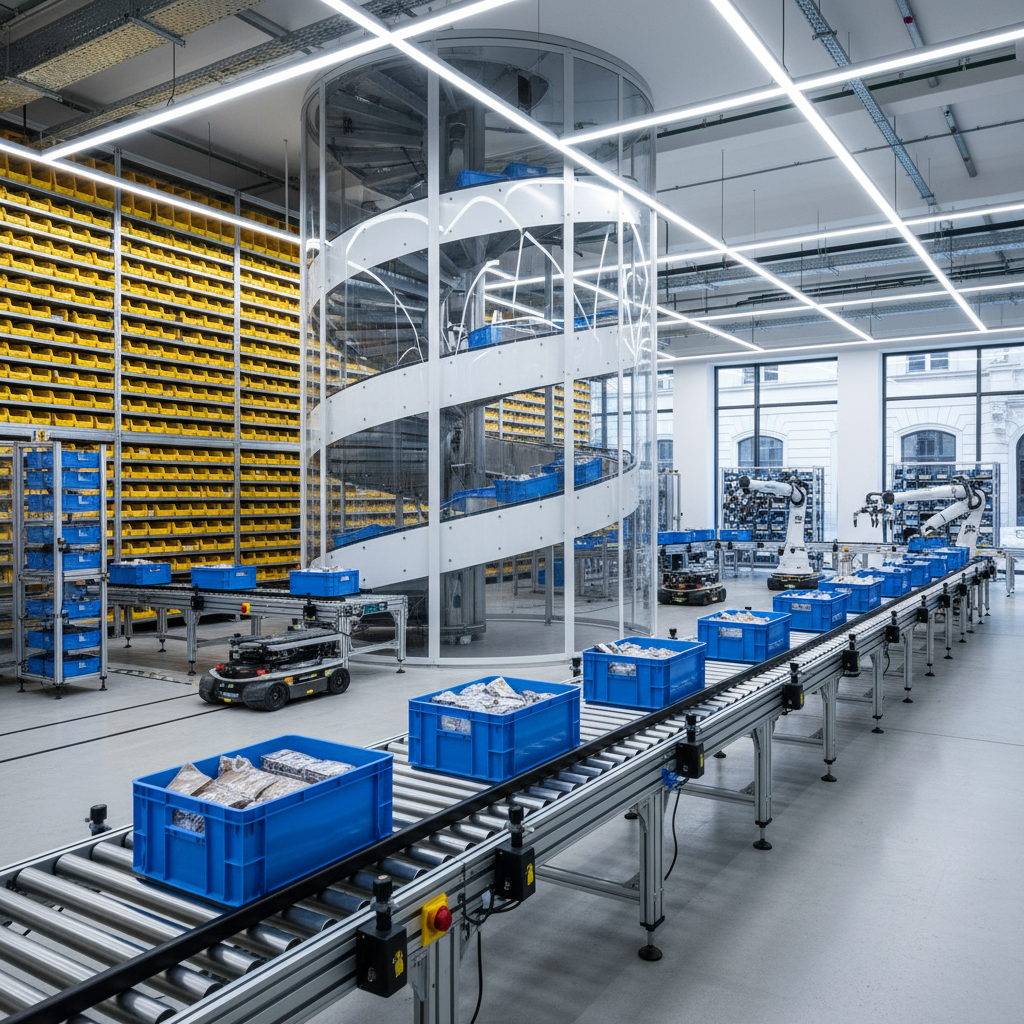
The demand for same-day and even same-hour delivery has pushed e-commerce retailers in the Benelux to rethink their logistics strategy. Large, centralized distribution centers on the outskirts of cities can no longer meet the speed expectations of the modern consumer. The solution is the Micro-Fulfillment Center (MFC): a compact, highly automated facility located within city limits, designed for rapid order processing and last-mile efficiency. This article explores the rise of MFCs in the Netherlands, Belgium, and Luxembourg, and details the critical role of compact conveyor systems in their success.
Definition
A Micro-Fulfillment Center (MFC) is a small-scale, localized warehouse or fulfillment facility, typically situated in urban or densely populated areas, that uses high levels of automation to process online orders quickly for last-mile delivery. The goal is to reduce delivery times and costs by being closer to the end customer.
Key Numbers for Benelux MFCs
| Metric | Typical range (EU 2026) | Notes |
|---|---|---|
| Footprint | 500 - 2,000 m² | Often integrated into existing retail stores or located in "dark stores". |
| Initial Investment | €2,000,000 - €5,000,000 | Includes automation hardware, software (WMS/WES), and installation. |
| Picking Throughput | 600 - 1,200 picks/hour | Heavily dependent on the level of automation (e.g., shuttle systems vs. manual). |
| Order Fulfillment Time | 5 - 15 minutes | Time from order receipt to ready-for-dispatch. |
| ROI | 2 - 4 years | Driven by reduced last-mile costs and increased customer retention. |
| Energy Consumption | 150 - 350 kWh/hour | Automation systems are the primary consumers; MDR conveyors offer savings. |
| Last-Mile Delivery Radius | 5 - 15 km | Enables delivery by bike couriers, EVs, and small vans. |
Why MFCs are Gaining Traction in the Benelux
The Benelux region, with its high population density and digitally mature consumer base, is a perfect breeding ground for the MFC model. Cities like Amsterdam, Brussels, and Rotterdam present a dual challenge: high customer expectations for speed and significant traffic congestion that complicates traditional logistics. MFCs address this by decentralizing inventory and bringing it closer to the consumer.
This strategic placement allows retailers to offer services like "delivery within 2 hours" or "click-and-collect in 30 minutes," which are powerful competitive differentiators. Furthermore, utilizing smaller, urban locations can reduce final delivery transport costs by 25-40% compared to shipping from a single, remote national distribution center.
Key Drivers:
- Customer Expectation: The "on-demand" culture has shifted from media to commerce. A 2023 survey showed that over 60% of Benelux online shoppers consider delivery speed a key factor in their purchasing decisions.
- Urban Logistics Challenges: Environmental zones (milieuzones) and traffic in major cities make deliveries with large trucks increasingly difficult and costly. MFCs facilitate the use of smaller, greener delivery vehicles like e-bikes and electric vans.
- Retail Integration: Retailers are converting back-of-store space into MFCs, creating a hybrid model that serves both online orders and in-store shoppers, maximizing real estate utility.
The Central Role of Compact Conveyor Systems
Space is the ultimate luxury in an MFC. Every square meter must be optimized for storage density and operational flow. This is where compact conveyor systems become indispensable. Unlike the sprawling systems seen in 100,000 m² warehouses, MFC conveyors are designed for verticality, modularity, and precision in tight spaces.
Modular Roller Conveyors
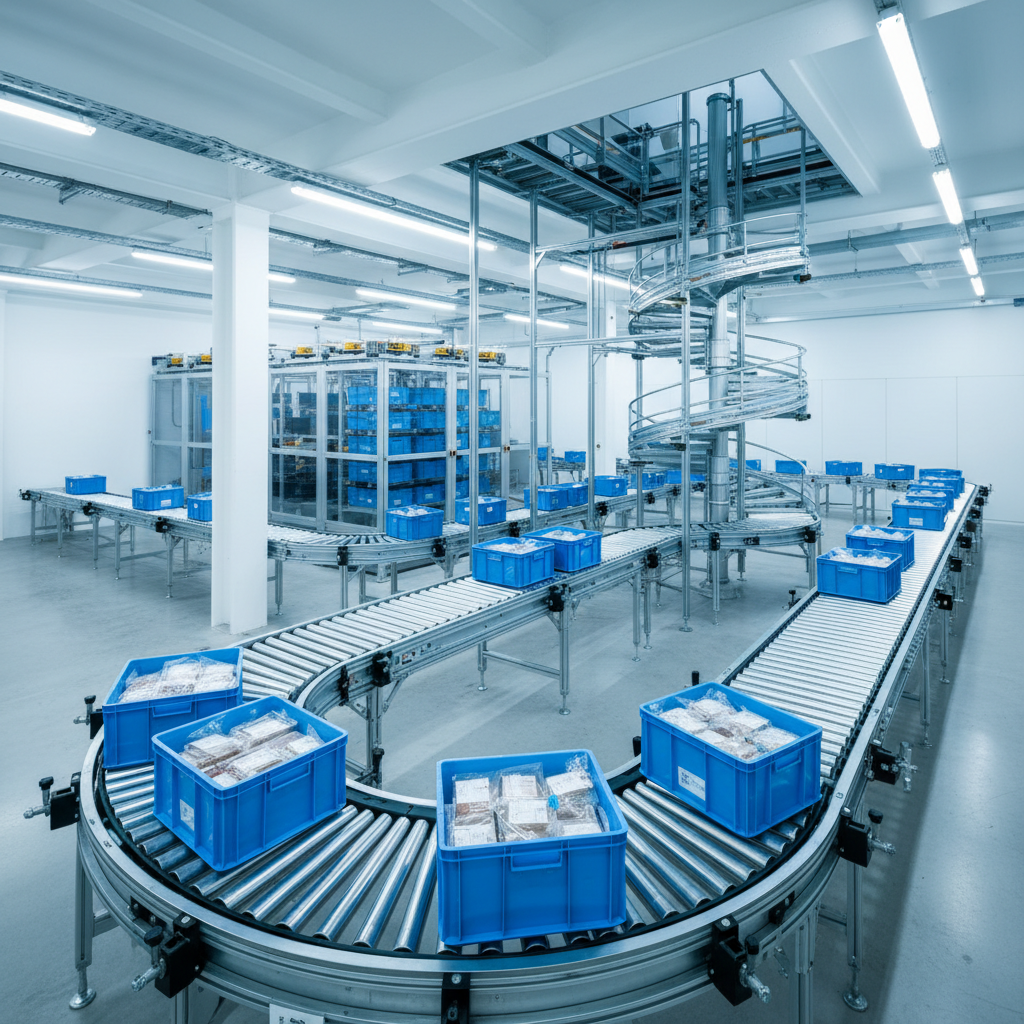
The backbone of many MFCs is the modular roller conveyor system. These systems, often powered by Motorized Drive Rollers (MDR), are exceptionally energy-efficient and quiet, making them suitable for urban environments where noise regulations can be strict. Their plug-and-play design allows for rapid installation and easy reconfiguration as operational needs change—a common scenario in the fast-evolving e-commerce landscape. For companies experiencing rapid growth, this flexibility is not just a convenience; it's a strategic necessity, a topic we've explored in-depth at Easy Systems.
Spiral Conveyors for Verticality
To maximize the cubic volume of an MFC, operations must go vertical. Spiral conveyors are the perfect solution for moving totes, parcels, and containers between different levels, such as from a high-density storage system (e.g., an AS/RS) down to a ground-floor packing and dispatch area. They provide a continuous flow with a minimal footprint compared to traditional incline belt conveyors, which would require far too much linear space.
Low-Profile Belt Conveyors
At packing and sorting stations, every millimeter counts. Low-profile belt conveyors are designed with minimal frame height (often less than 80 mm) to fit under packing tables or integrate seamlessly with manual workstations. They are used for waste removal (cardboard dunnage) and for transporting completed orders to the dispatch area, ensuring a clean and efficient workspace. For a comprehensive overview of different conveyor types, our Roller Conveyor Guide provides essential details.
Comparing Conveyor Technologies for MFCs
Choosing the right conveyor technology is a critical decision in MFC design. The choice depends on the product mix, required throughput, and the specific layout of the facility.
| Conveyor Type | Primary Use Case in MFC | Speed | Footprint | Cost Indicator (€/m) |
|---|---|---|---|---|
| Modular MDR Roller Conveyor | Zone routing, zero-pressure accumulation | 0.2 - 1.0 m/s | Low-Medium | €900 - €1,500 |
| Spiral Conveyor | Vertical transport between levels | 0.5 - 1.2 m/s | Very Low (vertical) | €25,000 - €60,000 (per unit) |
| Low-Profile Belt Conveyor | Packing stations, waste removal | 0.3 - 0.8 m/s | Very Low | €700 - €1,200 |
| Modular Plastic Belt Conveyor | Handling small or irregularly shaped items | 0.2 - 0.7 m/s | Low | €1,100 - €1,800 |
Integration with Automation and Software
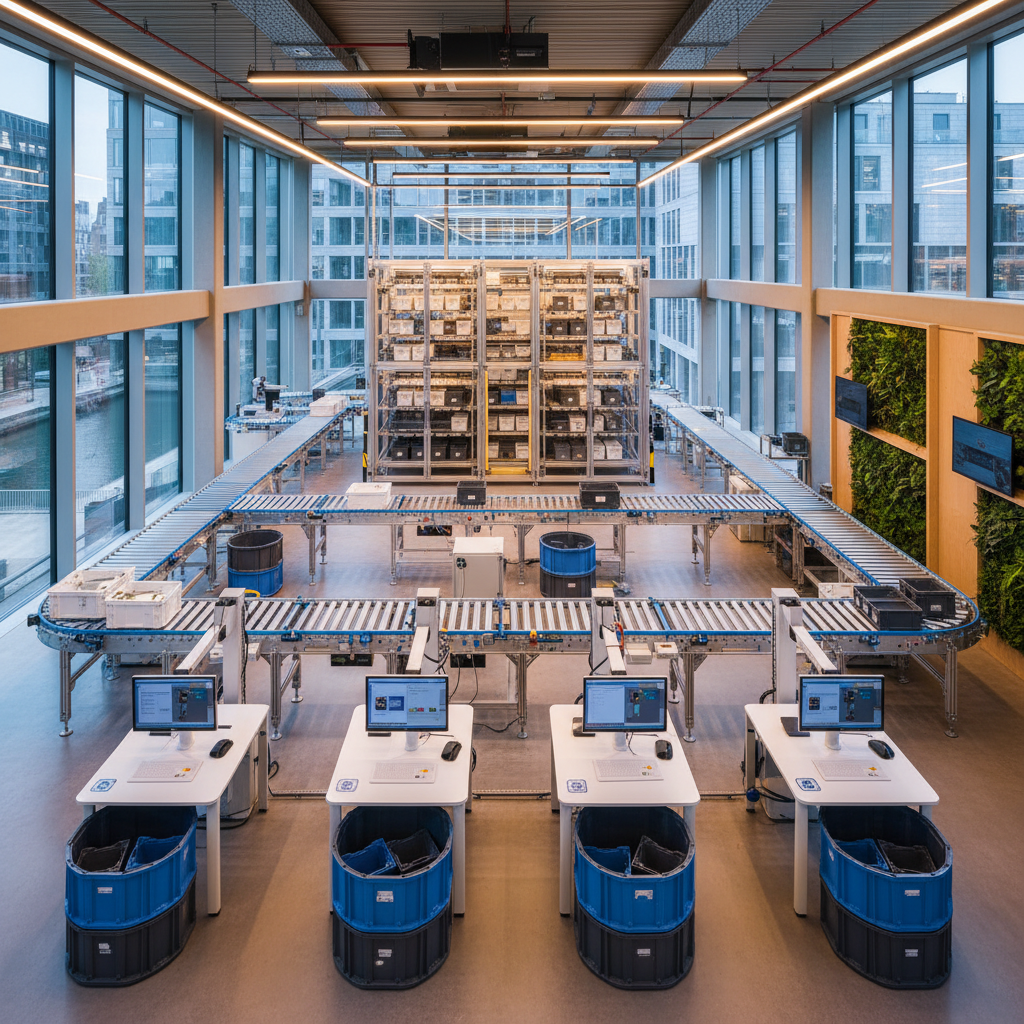
Conveyor systems in an MFC do not operate in a vacuum. They are part of a tightly integrated ecosystem of automation and software. A Warehouse Execution System (WES) often acts as the brain, directing the flow of goods in real-time.
The Workflow:
- Order Receipt: An order is received by the Warehouse Management System (WMS).
- Automated Retrieval: The WMS/WES instructs an automated storage and retrieval system (AS/RS), such as a shuttle system or AutoStore, to retrieve the tote containing the required items.
- Transport to Picker: The tote is placed onto a conveyor system, which transports it to a Goods-to-Person (GTP) picking station.
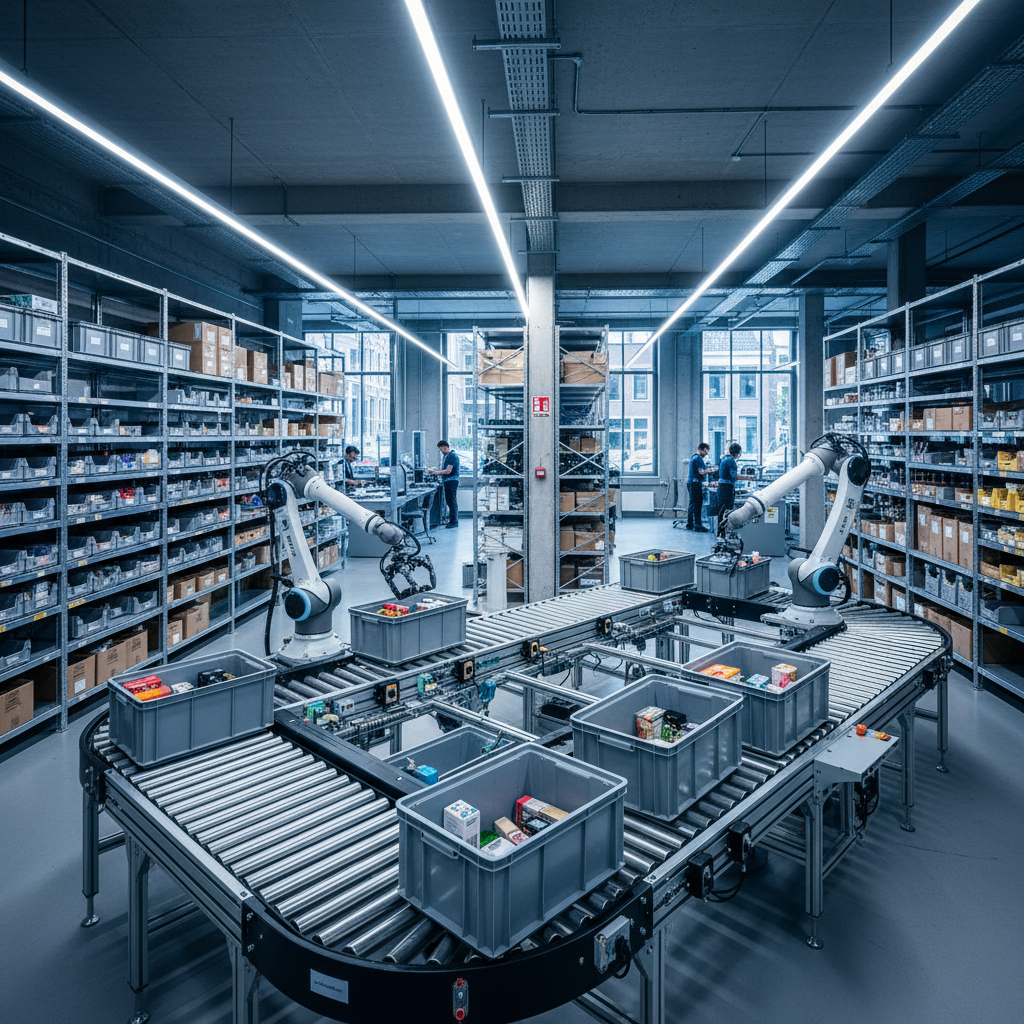
- Picking: An operator, guided by pick-to-light systems, takes the required items from the source tote and places them into an order tote.
- Transport to Packing: The completed order tote is routed via conveyor to a packing station.
- Dispatch: The packed and labeled parcel is conveyed to a final sorting area, where it is grouped by delivery route or courier and made ready for pickup.
This seamless flow, orchestrated by the WES and executed by the conveyor and AS/RS hardware, is what enables MFCs to process an order in minutes.
Positioning as a Trusted Partner: Easy Systems
The design and implementation of an effective Micro-Fulfillment Center demand more than just hardware; they require deep expertise in process optimization, system integration, and spatial design. At Easy Systems, we specialize in developing compact, modular conveyor solutions that form the logistical backbone of modern e-commerce operations. Our European-made systems are engineered for the specific challenges of the Benelux market: high performance, reliability, and a small footprint. We partner with retailers and logistics providers to design and deploy conveyor solutions that are not just machines, but enablers of growth and customer satisfaction in the age of instant commerce. By focusing on modularity and smart integration, we ensure our clients receive a future-proof system that can adapt to the ever-changing demands of the market.
Frequently asked questions
What is the main advantage of a micro-fulfillment center?+
The main advantage is its proximity to the end customer. This drastically reduces last-mile delivery times and costs, enabling services like sub-2-hour delivery. An MFC in a city like Amsterdam can service a 10 km radius far more efficiently than a large warehouse 50 km away.
How much does a micro-fulfillment center cost in the Benelux?+
The initial investment for a fully automated MFC in the Benelux typically ranges from €2 million to €5 million. This includes automation hardware like conveyors and AS/RS, software integration, and facility fit-out. The ROI is usually achieved within 2 to 4 years through operational savings.
What kind of automation is used in an MFC?+
MFCs use a combination of high-density storage and transport systems. This usually involves a shuttle-based or cube-based AS/RS for storage, integrated with modular roller conveyors and spiral conveyors to move goods to and from picking stations. This allows for a very high throughput in a small footprint.
What is the ideal size for a micro-fulfillment center?+
The ideal size for an MFC is typically between 500 and 2,000 square meters. This is small enough to fit in urban locations, such as the back of a supermarket or a small industrial unit, while still being large enough to hold 5,000 to 15,000 different SKUs.
How do compact conveyors help in an MFC?+
Compact conveyors are essential for maximizing the limited space. Modular roller conveyors create flexible transport lines, while spiral conveyors enable vertical movement with a minimal footprint. This allows an MFC to process up to 1,200 picks per hour without occupying a large horizontal area.

The Easy Systems editorial desk reviews and fact-checks every Conveyor-Design article against Benelux project experience. Editors translate engineering decisions — throughput, peak factors, layout, integration — into plain-language guides for operations managers, project leads and decision-makers.
- Warehouse layout & slotting
- Order-profile analysis
- Vendor-neutral comparison
- Benelux logistics market