Low-Code/No-Code in Conveyor Automation: A Game-Changer
Low-code/no-code platforms are revolutionizing conveyor automation by enabling faster, more flexible, and cost-effective deployments. These visual interfaces allow on-site teams to configure, adapt, and scale systems with minimal specialized coding, drastically reducing project timelines.
In the fast-paced European logistics landscape, speed and adaptability are paramount. The traditional approach to conveyor automation, heavily reliant on specialized PLC programmers, often creates bottlenecks. Low-code and no-code platforms are emerging as a transformative solution, democratizing automation and enabling warehouses to deploy and modify sophisticated conveyor systems with unprecedented speed and agility.
Definition
Low-code/no-code platforms are visual software development environments that allow users to create and configure applications, including conveyor control logic, through graphical user interfaces and drag-and-drop components instead of traditional, hand-written computer programming. This approach empowers engineers and technicians with deep process knowledge to build and modify systems without needing extensive coding expertise.
Key Numbers
| Metric | Typical range (EU 2026) | Notes |
|---|---|---|
| Implementation Time Reduction | 30% - 70% | Compared to traditional PLC programming from scratch. |
| Software Development Cost Saving | €15,000 - €50,000 per project | Dependent on complexity; avoids hiring specialized programmers. |
| Time to Modify Logic (e.g., new zone) | 1 - 4 hours | vs. 2-3 days for traditional PLC reprogramming and testing. |
| Training Time for On-site Staff | 8 - 20 hours | To achieve proficiency in basic configuration and troubleshooting. |
| Typical Application | MDR Conveyor Systems | Ideal for controlling logic for zero-pressure accumulation zones. |
| Integration with WCS/WES | API-driven, hours to days | Dramatically faster than custom-coded integrations. |
The Shift from Traditional PLC Programming to Low-Code
For decades, the brain of any automated conveyor system has been the Programmable Logic Controller (PLC). These industrial computers are robust and reliable, but programming them requires a niche, often expensive, skillset using languages like Ladder Logic or Structured Text. This dependency has several drawbacks:
- High Costs: Specialized PLC programmers command high salaries, and their availability can be limited.
- Long Lead Times: Writing, testing, and debugging custom PLC code is a time-consuming process that can delay project commissioning by weeks or months.
- Inflexibility: Once a system is programmed, even minor changes—like altering the logic for a divert or a merge—require a programmer to go on-site, make code changes, and conduct extensive testing. This hampers a facility's ability to adapt to changing operational needs.
Low-code platforms fundamentally change this dynamic. They abstract away the complexity of the underlying code, presenting the logic in a visual, intuitive format. This is not about replacing engineers, but empowering them to work faster and more efficiently.
How Low-Code Works in a Conveyor Context
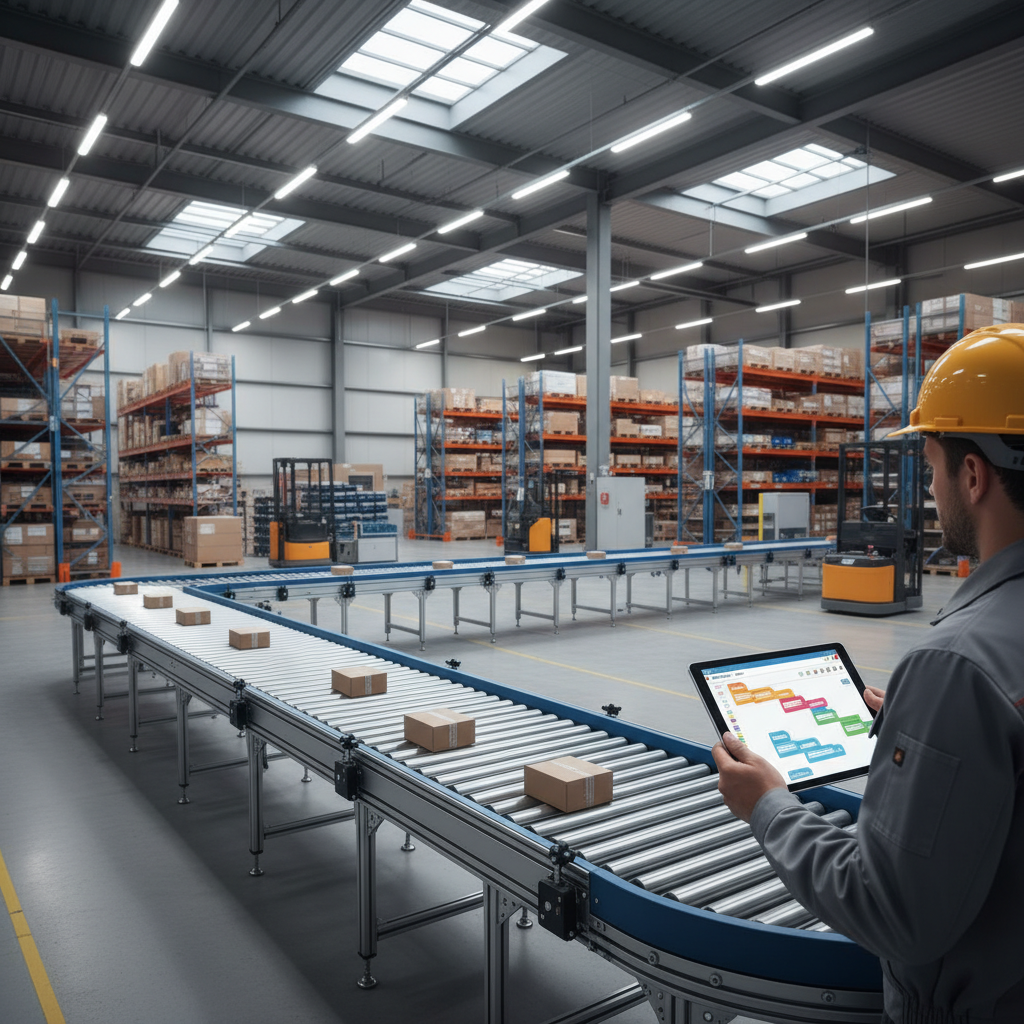
Instead of writing lines of code, an engineer or technician uses a graphical interface. They might drag a "conveyor zone" block onto a canvas, connect it to a "merge" block, and then define the rules for that merge (e.g., "left lane has priority") using simple dropdown menus and checkboxes. This visual workflow directly translates into the control commands sent to the conveyor hardware, such as Motorized Drive Rollers (MDRs).
This approach aligns perfectly with modern conveyor technology. Systems built with modular components, like plug-and-play MDR modules, are inherently suited for the flexible control that low-code platforms offer. A company can reconfigure its physical layout and then quickly remap the control logic in the software to match, without a single line of custom code being written. To learn more about the integration of control systems, our guide on WMS, WCS, and WES provides deeper insights.
Comparing Control Philosophies: Traditional vs. Low-Code
| Aspect | Traditional PLC Programming | Low-Code/No-Code Platform |
|---|---|---|
| Primary User | Specialized PLC Programmer | Process Engineer, Maintenance Technician |
| Development Time | Weeks to months | Days to weeks |
| Cost of Changes | High (programmer call-out, downtime) | Low (on-site staff can perform changes) |
| Flexibility | Low; changes are complex | High; drag-and-drop modifications |
| Example Task: Add a new sortation lane | Requires code rewrite, I/O mapping, extensive testing. (Est: 3-5 days) | Add new logic blocks, configure rules via GUI. (Est: 2-4 hours) |
| Initial Investment | High for custom software development | Often license-based (SaaS or perpetual), lower initial barrier |
Key Benefits of Low-Code in Warehouse Automation
1. Speed of Deployment
The most significant advantage is the dramatic reduction in time-to-market. Pre-built, tested logic blocks for common conveyor functions (accumulation, merging, diverting, sorting) mean that 80% of the control software is ready "out of the box." The implementation phase shifts from ground-up development to configuration, slashing project timelines by weeks.
2. Increased Agility and Flexibility
Market demands change. A warehouse might need to handle a different product mix, increase throughput in a specific area, or change sortation patterns for a new carrier. With a low-code platform, an on-site manager or lead technician can make these adjustments in hours, not weeks. This agility is a powerful competitive advantage, as discussed in how business processes must evolve with growth.
3. Lower Total Cost of Ownership (TCO)
While there's a licensing cost for the platform, the TCO is often lower. Savings come from reduced dependency on expensive programming specialists, shorter project commissioning times (less labor cost), and minimized downtime when changes are needed. The ability to empower in-house staff to manage the system reduces long-term operational expenditure.
4. Democratization of Automation
Low-code lowers the technical barrier to implementing automation. Small and medium-sized enterprises (SMEs) in Europe, which may not have the budget for a full team of automation programmers, can now access sophisticated control systems. It allows the people who know the physical process best—the operations staff—to have direct input and control over how the automation behaves.
Easy Systems: Your Partner for Agile Conveyor Automation
At Easy Systems, we are at the forefront of integrating intelligent and flexible control solutions with our robust conveyor hardware. We understand that modern logistics is not just about moving boxes; it's about creating adaptable, data-driven ecosystems. Our philosophy aligns perfectly with the principles of low-code: providing modular, scalable hardware that is easy to control and reconfigure.
We leverage pre-configured and pre-tested control software that dramatically shortens the path from design to a fully operational system. Our approach empowers our clients by providing them with systems that are not only efficient on day one but are also simple to adapt for the challenges of tomorrow. By combining our high-quality European-made conveyors with smart, accessible control platforms, we deliver automation that is both powerful and future-proof, ensuring you achieve the lowest Total Cost of Ownership and the highest operational agility.
Frequently asked questions
What is the main advantage of low-code for conveyor systems?+
The main advantage is speed. Low-code platforms can reduce the software implementation and commissioning time for a new conveyor line by 30-70%, allowing a warehouse to become operational much faster than with traditional PLC programming, which can take weeks or months.
Can a warehouse technician really use a low-code platform?+
Yes. These platforms are designed with a visual, drag-and-drop interface. A technician with good process knowledge can be trained in as little as 8-20 hours to configure, troubleshoot, and modify basic conveyor logic, a task previously reserved for specialized engineers.
Is low-code reliable enough for industrial automation?+
Absolutely. The low-code environment is a user-friendly layer on top of a robust, pre-tested industrial control engine. The core logic for motor control and safety is highly reliable. The platform simply makes it easier to orchestrate these proven functions, ensuring industrial-grade performance.
How does low-code integrate with a Warehouse Management System (WMS)?+
Low-code platforms are typically designed with open APIs (Application Programming Interfaces). This allows for rapid, standardized integration with a WMS or WES. Instead of custom coding a connection, you can often configure the data exchange in a matter of hours, linking high-level orders to the physical movement on the conveyor.
What type of conveyor is best suited for low-code controls?+
Motorized Drive Roller (MDR) conveyor systems are exceptionally well-suited. The modular nature of MDRs and their decentralized control (each roller has its own motor and logic card) pairs perfectly with the zone-based, visual logic building blocks of a low-code platform, especially for zero-pressure accumulation.

The Easy Systems editorial desk reviews and fact-checks every Conveyor-Design article against Benelux project experience. Editors translate engineering decisions — throughput, peak factors, layout, integration — into plain-language guides for operations managers, project leads and decision-makers.
- Warehouse layout & slotting
- Order-profile analysis
- Vendor-neutral comparison
- Benelux logistics market