Low-Code/No-Code for Complex Conveyor Systems in the Benelux
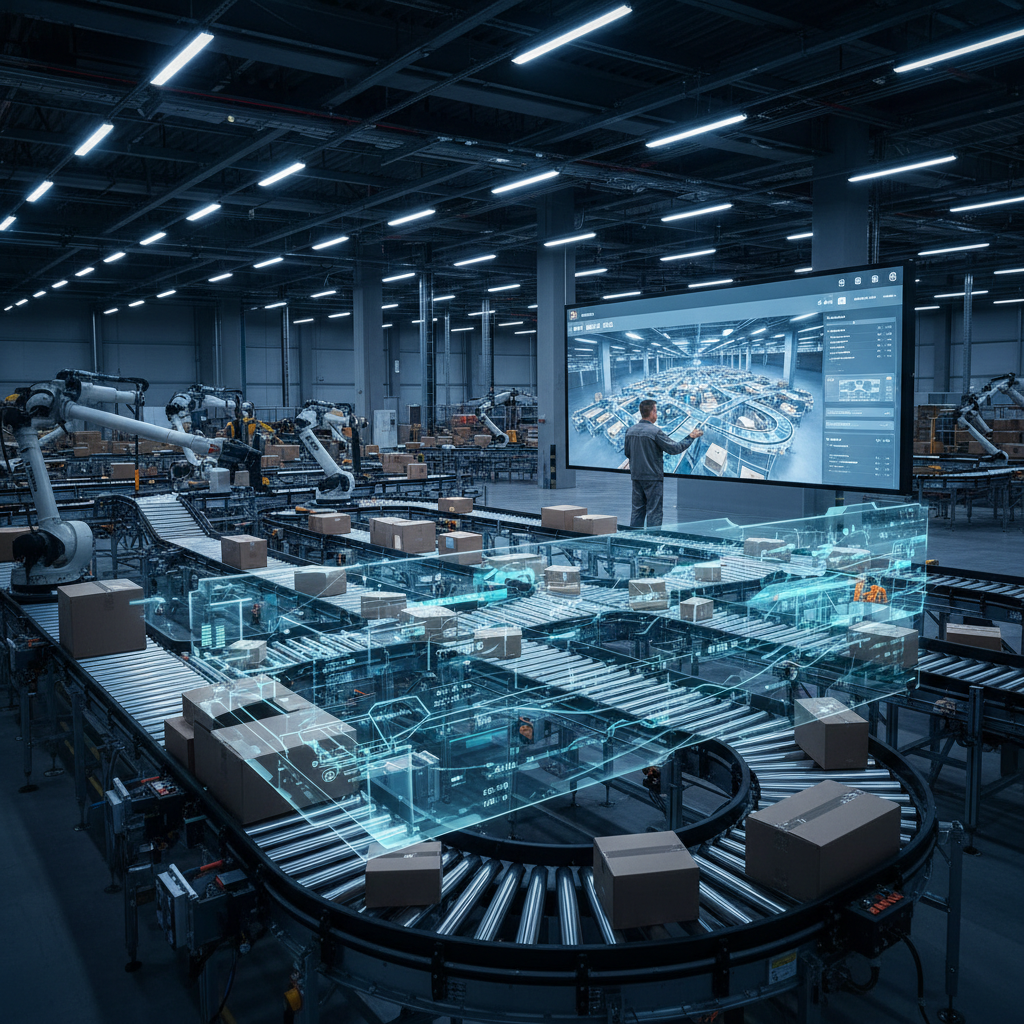
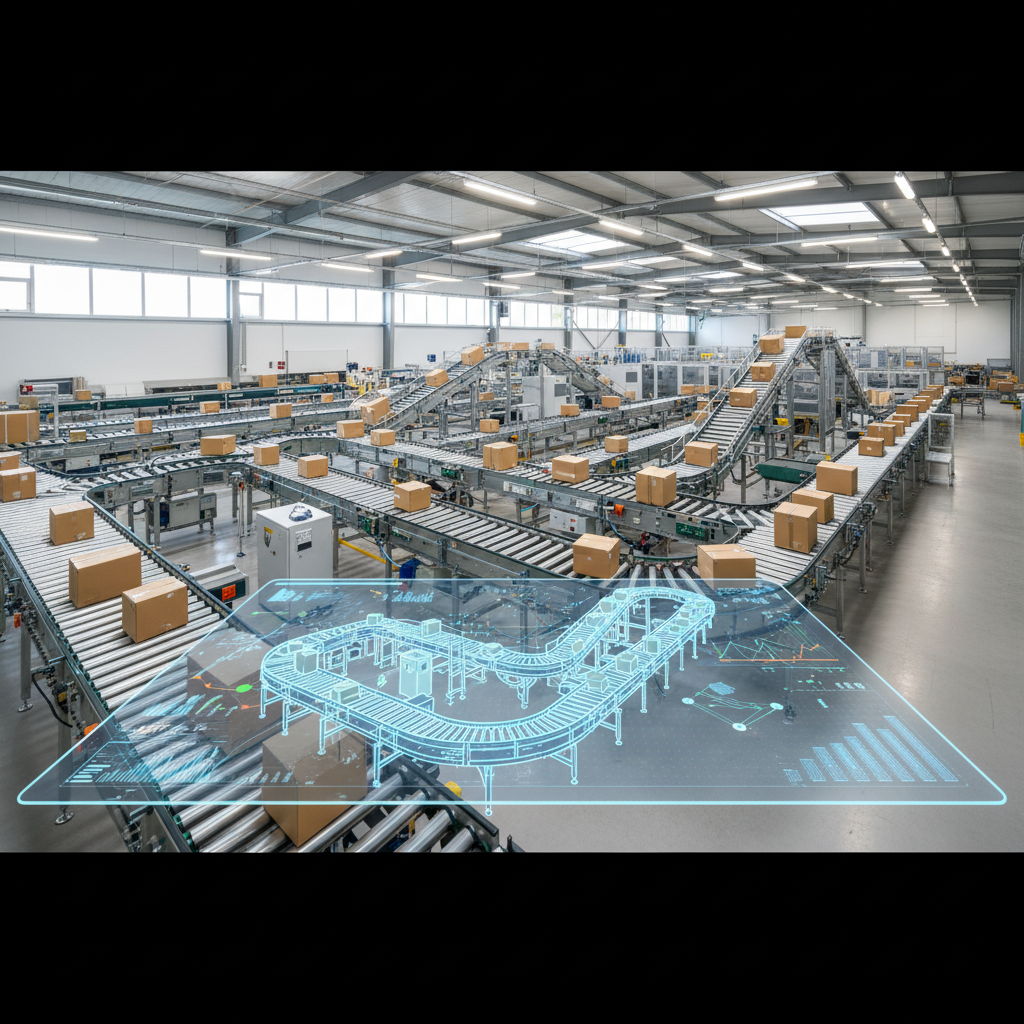
Low-code/no-code platforms are transforming conveyor system management in the Benelux, enabling rapid deployment and flexible control without deep PLC programming knowledge. This approach significantly cuts implementation time and costs, offering greater operational agility.
In the fast-paced logistics landscape of the Benelux, speed and adaptability are paramount. Traditional conveyor system implementation, heavily reliant on specialized PLC programmers, often creates bottlenecks. The emergence of low-code and no-code platforms for warehouse control offers a paradigm shift, democratizing the ability to design, deploy, and manage complex material handling flows. This article explores the strategic advantages of this approach for warehouses in Belgium, the Netherlands, and Luxembourg.
Definition
Low-Code/No-Code for Conveyor Systems refers to a software development approach that allows users to create, configure, and manage the control logic for conveyor networks using graphical user interfaces and pre-built modules instead of traditional, text-based programming languages like Ladder Logic or C++.
Key Numbers
| Metric | Typical range (EU 2026) | Notes |
|---|---|---|
| Implementation Time Reduction | 30% - 50% | Compared to traditional PLC-based projects. |
| Initial Project Cost Savings | 15% - 25% | Primarily from reduced specialized programming hours. |
| Reconfiguration Time | < 1 hour | For common tasks like changing sortation rules or zone routing. |
| Training Time for Operators | 4 - 8 hours | Basic operational changes can be taught quickly. |
| Total Cost of Ownership (TCO) Reduction | 10% - 20% over 5 years | Includes lower costs for updates, maintenance, and modifications. |
| Integration API Calls | 50-200 pre-built | Connectors for standard WMS, ERP, and shipping carriers. |
The Shift from Traditional PLC Programming to Low-Code WCS
For decades, the brain of any conveyor system has been the Programmable Logic Controller (PLC). These ruggedized industrial computers are programmed using specialized languages (like Ladder Logic) by highly skilled, and often expensive, automation engineers. While robust, this model presents several challenges in today's agile warehousing environment:
- Dependency on Specialists: Any change, from a minor timing adjustment to rerouting a conveyor line, requires a PLC programmer. This creates a dependency that can slow down operations significantly.
- High Costs: The demand for skilled PLC programmers, especially in a competitive market like the Benelux, drives up project and maintenance costs.
- Lack of Flexibility: Adapting a hard-coded system to new products, seasonal peaks, or process improvements is a slow and expensive undertaking. This inflexibility can be a major disadvantage for e-commerce and 3PL providers.
Low-code Warehouse Control Systems (WCS) or Warehouse Execution Systems (WES) abstract this complexity away. They provide a visual layer on top of the hardware controllers, allowing logistics managers and on-site technicians to configure system behavior through intuitive interfaces. For more details on how these systems interact, see our guide on WMS, WCS, and WES integration.
Core Principles of a Low-Code Approach
A low-code platform for conveyor control is built on a few key ideas:
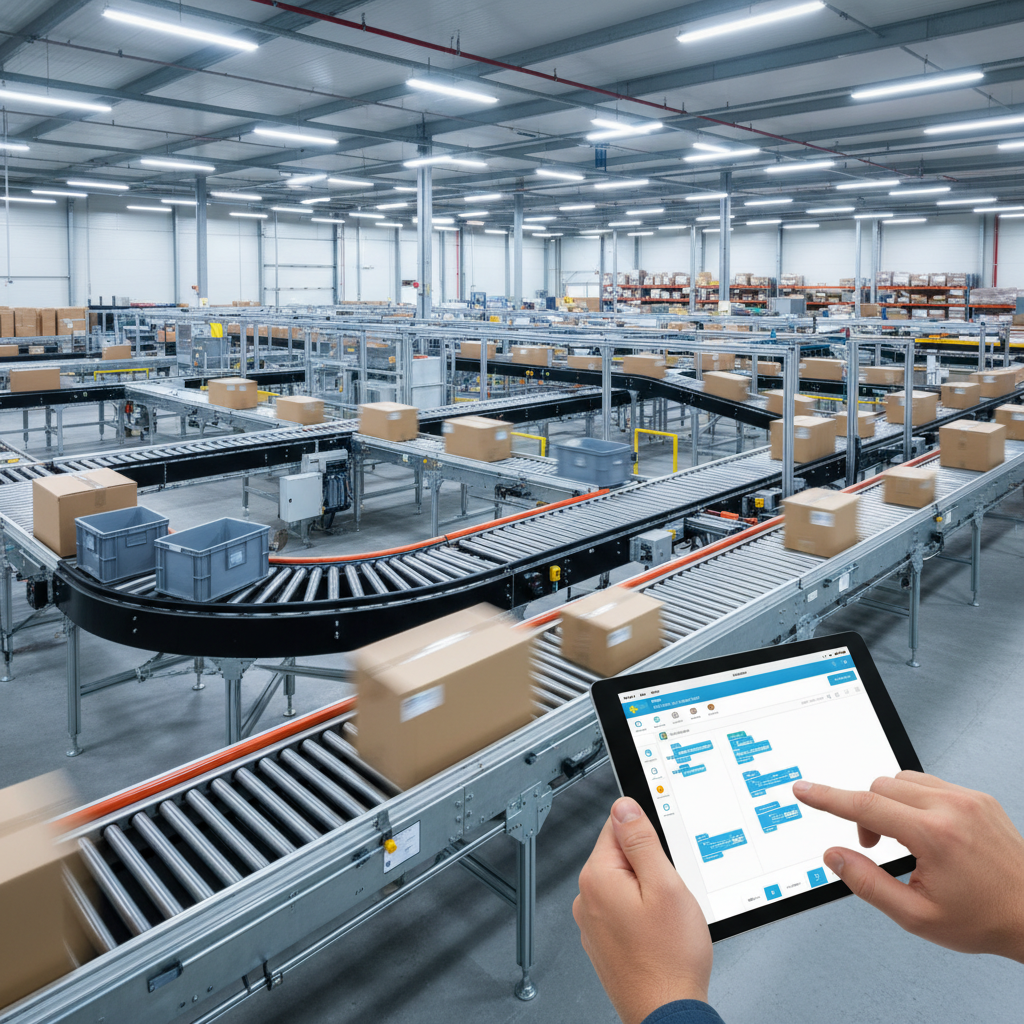
- Visual Workflow Design: Instead of writing code, users drag and drop functional blocks (e.g., "Read Barcode," "Divert Left," "Accumulate") and connect them to create logic flows.
- Pre-built Modules: The platform includes a library of standard functions for controlling motors, reading sensors, and communicating with other equipment like scanners or weigh scales.
- Simplified Integration: APIs and connectors to common Warehouse Management Systems (WMS), ERPs, and shipping carriers are often included, simplifying data exchange.
Comparing Traditional PLC vs. Low-Code WCS Implementation
The differences in project lifecycle are stark when comparing the two methodologies. A change that might take a week in a traditional environment can often be accomplished in an afternoon with a low-code platform.
| Stage | Traditional PLC Programming | Low-Code WCS Platform |
|---|---|---|
| Initial Design | Requires detailed functional specifications written for a programmer. High risk of misinterpretation. | Logic can be prototyped visually and collaboratively with the operations team. |
| Development | Weeks or months of specialized coding. Typically a single-threaded process. | Days or weeks of configuration using drag-and-drop. Can be done by trained on-site staff. |
| Testing & Debugging | Complex, requires on-site presence of the programmer. Emulation is possible but often limited. | Visual debugging shows the flow of goods in real-time on the screen, simplifying troubleshooting. |
| Modification | Requires a new project scope, coding, and extensive testing. Can cost thousands of euros for minor changes. | Simple changes (e.g., divert to a new packing station) can be done in minutes by a trained user for no extra cost. |
Practical Applications in Benelux Warehouses
The logistics hubs around Antwerp, Rotterdam, and Liège are prime examples of where low-code flexibility adds immense value. Consider a 3PL provider handling fulfillment for multiple e-commerce clients.
Case Study: E-commerce Fulfillment Center
A fulfillment center near Schiphol Airport needs to re-route packages from a specific brand to a new value-added services (VAS) area for custom labeling during a promotional campaign.
- With PLC: The process would involve submitting a change request to the automation vendor, waiting for a programmer to become available, scheduling downtime for the update, and on-site testing. This could take 1-2 weeks.
- With Low-Code WCS: The shift manager could log into the WCS, add a new rule to the sortation logic ("IF barcode prefix matches 'XYZ', THEN divert to Lane 12"), and deploy the change in under 30 minutes, with no system downtime.
This level of agility is crucial. Businesses grow and evolve, but often their internal processes fail to keep pace with that growth. Low-code systems provide the tooling to ensure the physical automation can adapt as quickly as business strategy does.
Integration with Other Systems
A key strength of modern low-code platforms is their ability to communicate seamlessly. For instance, a WCS can receive an order file from the WMS, direct the picking and transport via the conveyor system, and then send the final package weight and dimensions back to the WMS and the shipping carrier's system via an API call—all configured through a visual interface.
Challenges and Considerations
While powerful, low-code platforms are not a universal panacea.
When is Traditional PLC still a better fit?
- Extreme High-Speed or Safety-Critical Applications: For systems requiring microsecond-level response times or those involving critical safety functions (e.g., emergency stops on heavy pallet conveyors), the direct, low-level control of a PLC is often still preferred and mandated.
- Very Simple, Static Systems: For a simple, standalone belt conveyor that will never change its function, the overhead of a WCS might be unnecessary.
Vendor Lock-in
A significant consideration is that you are adopting a specific vendor's ecosystem. Migrating from one low-code platform to another is not a simple task. It's crucial to choose a partner with a strong track record, a clear development roadmap, and robust support, particularly within the EU.
Easy Systems: Your Partner for Flexible Automation
At Easy Systems, we bridge the gap between powerful hardware and user-friendly control. We understand that Benelux businesses need automation that is not just efficient on day one, but adaptable for years to come. Our approach integrates modular conveyor systems with flexible, transparent control software. We empower your on-site teams to take ownership of your automation, allowing them to make adjustments and improvements without costly external dependencies. By focusing on scalable solutions and intuitive controls, we ensure your investment delivers lasting value and provides the agility needed to thrive in a competitive market.
Frequently asked questions
What is the main benefit of using a low-code platform for a conveyor system?+
The primary benefit is speed and flexibility. Instead of weeks of complex PLC programming, a low-code WCS allows you to configure and modify conveyor logic in a matter of hours, reducing implementation time by up to 50% and enabling rapid response to operational needs.
Can I integrate a low-code conveyor system with my existing WMS?+
Yes, absolutely. Modern low-code platforms are designed for integration. They typically use standard APIs (like REST) and pre-built connectors to seamlessly communicate with most major WMS and ERP systems, often reducing integration costs by 20-30%.
Is a low-code system less reliable than a traditional PLC system?+
No. The underlying control is still handled by robust industrial hardware. The low-code platform acts as a user-friendly configuration layer. For standard warehouse operations, reliability is on par with PLC systems, with uptime typically exceeding 99.8%.
Do I need to be a programmer to manage a low-code conveyor system?+
No. While a technical aptitude is helpful, you do not need to be a programmer. Operations managers or on-site technicians can be trained in a few days (typically 8-16 hours) to handle most common configuration changes, like altering sortation rules.
Is low-code suitable for very high-speed sortation systems?+
It depends. For most e-commerce and logistics applications with throughput up to 10,000 cases per hour, low-code WCS is highly effective. For extremely high-speed applications or systems with complex safety requirements, a traditional, deeply embedded PLC solution might still be the preferred choice.

The Easy Systems editorial desk reviews and fact-checks every Conveyor-Design article against Benelux project experience. Editors translate engineering decisions — throughput, peak factors, layout, integration — into plain-language guides for operations managers, project leads and decision-makers.
- Warehouse layout & slotting
- Order-profile analysis
- Vendor-neutral comparison
- Benelux logistics market