Conveyor System Energy Efficiency: Reducing Costs in the Benelux
In a competitive Benelux market, reducing your warehouse's energy consumption is key. This article provides actionable strategies, from choosing the right components like motorized drive rollers to implementing smart control systems for significant long-term savings.
Key numbers
| Metric | Typical range (EU 2026) | Notes |
|---|---|---|
| Energy Savings (MDR vs. Traditional) | 50% – 70% | Comparing a 24V DC MDR system with a continuously-running AC lineshaft system. |
| Payback Period (MDR upgrade) | 2 – 4 years | Based on typical Benelux energy prices and 2-shift operation. |
| Commercial Electricity Price | €0.22 – €0.35 / kWh | Projected average for commercial users in the Benelux region. |
| Upfront Cost Delta (MDR vs. Traditional) | +15% – 25% | MDR systems have a higher initial hardware cost, offset by lower running costs. |
| Noise Level Reduction | 10 – 15 dB | Reduction from ~75 dB (traditional) to <60 dB (MDR), improving workplace safety. |
| Maintenance Cost Reduction | 15% – 25% | Fewer moving parts (belts, chains, gearboxes) in MDR systems reduce maintenance needs. |
In the high-stakes, fast-paced logistics landscape of the Benelux, operational costs are under constant scrutiny. While labour and real estate often get the most attention, energy consumption from material handling systems represents a significant and often overlooked expense. With European energy prices remaining volatile, optimising the energy efficiency of your conveyor systems is no longer a "nice-to-have" but a critical competitive advantage.
Definition
Conveyor system energy efficiency is the practice of designing, operating, and maintaining conveyor systems to perform their required material handling function with the lowest possible energy consumption. It involves optimising components, layout, and control systems to reduce waste and lower operational costs (OPEX).
The Hidden Cost: Why Energy Matters in Benelux Warehouses
Warehouses and distribution centers are energy-intensive operations. In a region like the Benelux—a major European logistics hub—the scale is immense. A typical distribution center can consume hundreds of thousands of kilowatt-hours (kWh) annually, with conveyor systems accounting for a substantial portion of that. With commercial electricity prices in countries like the Netherlands and Belgium averaging between €0.25 and €0.40 per kWh in recent years, this translates to a massive operational expense.
Beyond the direct financial impact, there's growing pressure from both regulations (EU Green Deal) and customers for more sustainable operations. An energy-efficient warehouse isn't just cheaper to run; it's also a powerful green credential that strengthens your brand reputation.
Component Selection: The Foundation of Efficiency
The single most important decision affecting your conveyor’s energy footprint is the choice of drive technology. For decades, the industry standard has been a single, large AC induction motor driving long sections of conveyor through a series of belts, chains, and lineshafts. While robust, this design is inherently inefficient.
Motors and Rollers: The Heart of the System
A traditional AC motor runs continuously, regardless of whether there are products on the conveyor. It’s like leaving a tap running all day just in case you need a glass of water. This constant operation, combined with mechanical losses from belts and chains, results in significant energy waste.
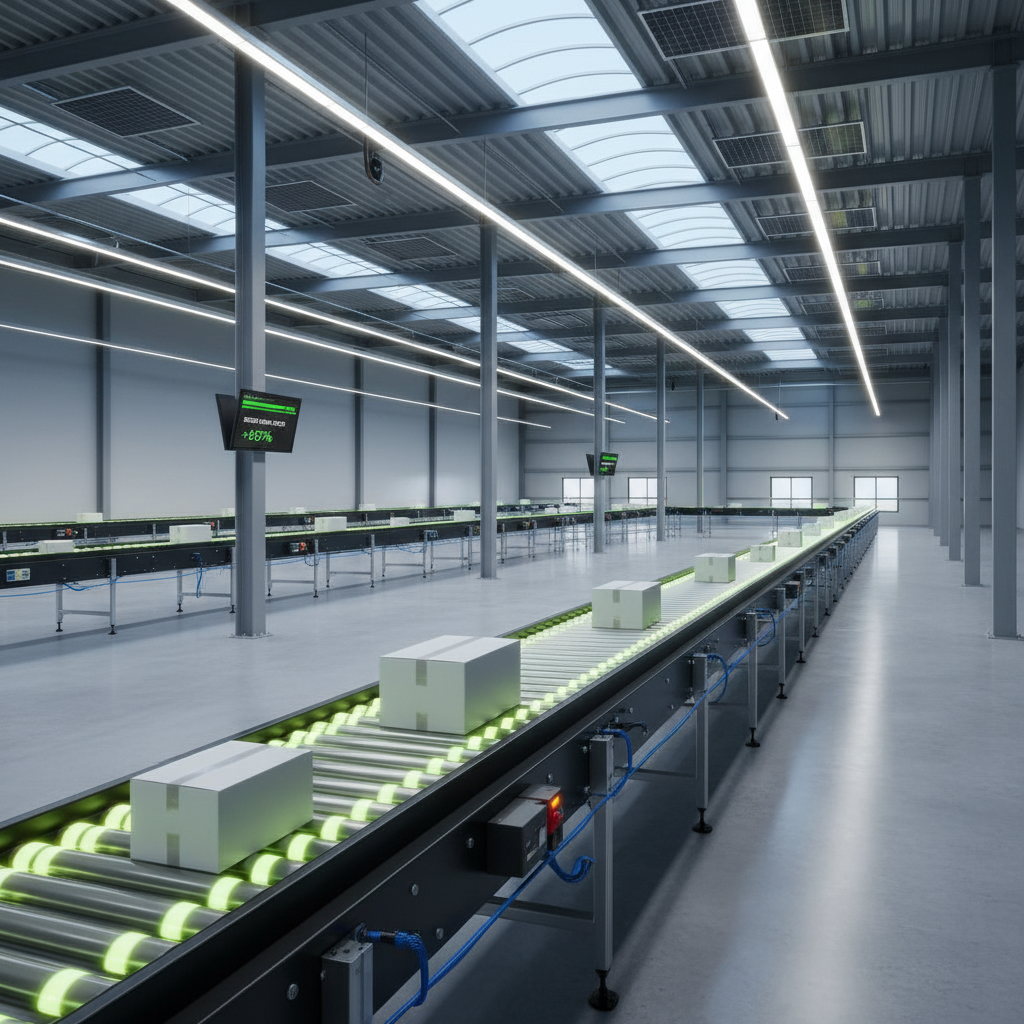
The modern alternative is Motorized Drive Roller (MDR) technology, also known as "run-on-demand." In an MDR system, standard rollers are replaced by rollers with integrated 24V DC motors. These rollers are connected in zones and controlled by smart logic. A zone only activates when a package is present and needs to move. Once the package has been passed to the next zone, the motor shuts off. This eliminates the constant energy draw of a large AC motor, leading to dramatic savings.
The table below compares these two fundamental technologies:
| Feature | Traditional AC Motor System | Motorized Drive Roller (MDR) System |
|---|---|---|
| Energy Consumption | High (runs continuously) | Low (runs on demand), 50-60% savings typical |
| Speed Control | Limited (often single speed) | Variable and zone-specific |
| Noise Level | High (motor, chains, belts) | Very Low (quiet DC motors) |
| Maintenance | Complex (belt tensioning, gearbox) | Simple (plug-and-play roller replacement) |
| Installation | Requires specialist alignment | Modular, plug-and-play wiring |
| Initial Cost | Lower for very simple, short lines | Higher initial investment, rapid ROI |
Intelligent Control: The Brains Behind the Savings
An efficient design isn't just about hardware; it’s about intelligent control. Modern conveyor systems must integrate seamlessly into the warehouse ecosystem. A sophisticated Warehouse Control System (WCS) is essential for managing product flow and, by extension, energy use.
The key concept here is running conveyors only when they are needed. This is achieved through:
- Zero-Pressure Accumulation (ZPA): This is a core function of MDR systems. ZPA logic allows products to be buffered along the conveyor line without physically touching, reducing product damage. Crucially, it means entire sections of the conveyor can remain powered down until the preceding zone clears, saving immense amounts of energy during accumulation.
- Sleep/Standby Modes: During periods of low activity or downtime (e.g., between shifts or during lunch breaks), the WCS can automatically put the entire conveyor system into a low-power "sleep" mode. A signal from the Warehouse Management System (WMS) can then wake the system up instantly when the next wave of orders begins. This simple feature can cut energy use by 10-15% on its own.
- Flow Optimisation: A smart WCS can optimize the routing of goods to use the most energy-efficient paths, consolidating orders to create denser product flow and reducing the total distance travelled. As we've noted before, growing companies often find their processes haven't kept pace with their growth, leading to inefficiencies that a modern WCS can resolve.
Design & Layout: Smarter Conveying, Less Energy
Energy efficiency starts on the drawing board. Simply throwing power at a problem is an outdated approach. A well-considered layout can drastically reduce your energy requirements from day one. When planning a new system or auditing an existing one, consider linking to our comprehensive Roller Conveyor guide for foundational knowledge.
Key design principles include:
- Right-Sizing: Avoid the temptation to over-specify. A system designed for 2,000 cases per hour (CPH) that only runs at 800 CPH is inefficient. Work with a qualified integrator to match the system capacity to your actual and projected throughput.
- Harnessing Gravity: Gravity is free. Incorporating gravity-fed roller or skate-wheel conveyor sections where there’s a natural decline in elevation is the single most effective way to move goods without power. This is ideal for descending from mezzanines or in manual packing areas.
- Minimizing Friction: A traditional belt conveyor has a much higher coefficient of friction than a roller conveyor, as the entire weight of the product is dragged across a static surface. For transporting stable, flat-bottomed items like boxes and totes, a roller conveyor is almost always the more energy-efficient choice.
Maintenance: A Proactive Approach to Energy Savings
A poorly maintained conveyor is an energy-hungry conveyor. Friction is the enemy of efficiency. A proactive maintenance schedule doesn't just prevent costly downtime; it directly impacts your electricity bill.
Key Maintenance Focus Areas:
- Lubrication: Ensure all bearings and chains (in older systems) are lubricated according to the manufacturer’s specifications. Dry components create friction, forcing the motors to work harder and draw more power.
- Belt Tension & Tracking: On belt conveyors, incorrect tension is a major cause of energy waste. A belt that is too tight puts a strain on the drive motor and bearings. A belt that is too loose can slip, causing inefficient power transfer.
- Component Inspection: Regularly inspect for and replace worn rollers, bearings, or belts. A single seized roller on a line can act like a brake, creating drag that places a significant additional load on the entire drive system. A thermal imaging camera can be a great tool for spotting "hot spots" caused by friction from failing components.
- Cleaning: Keep the system clean. Debris, dust, and shrink-wrap fragments can get caught in moving parts, increasing friction and strain on motors.
Implementing a Computerized Maintenance Management System (CMMS) to schedule and track these tasks ensures consistency and accountability, turning maintenance from a reactive chore into a proactive cost-saving strategy.
Easy Systems: Your Partner in Efficient Benelux Logistics
In a competitive market like the Benelux, controlling operational costs is paramount. Energy efficiency is no longer an afterthought but a cornerstone of modern, profitable logistics. At Easy Systems, we specialize in designing and implementing state-of-the-art conveyor and automation solutions tailored for the European market. From auditing your existing setup to designing a new, high-efficiency MDR-based system, our engineering team has the expertise to significantly lower your energy consumption. We combine cutting-edge technology with pragmatic, robust design to deliver systems that provide a rapid return on investment and a sustainable path for growth. Contact us to discover how much you could be saving.
Frequently asked questions
What is the biggest factor in a conveyor's energy consumption?+
The drive system is by far the biggest factor. Traditional systems using a single large AC motor that runs continuously are highly inefficient. Modern systems using Motorized Drive Rollers (MDR) that operate on-demand can reduce energy consumption by 50-70%, directly impacting your operational expenses.
How much can I realistically save by upgrading to an energy-efficient conveyor system?+
Savings depend on your operating hours, but a 50-60% reduction in conveyor-related electricity usage is a common result when moving from a traditional AC-powered system to a modern 24V DC MDR system. For a medium-sized Benelux DC, this can translate into savings of over €15,000 annually.
What is the typical payback period for an MDR upgrade in the Benelux?+
For a typical warehouse in the Netherlands or Belgium, upgrading to a Motorized Drive Roller (MDR) system has a projected payback period of 2 to 4 years. This calculation assumes 2026 energy prices of €0.22-€0.35/kWh and the system operating at least 2,000 hours per year. The high energy savings of 50-70% accelerate this return on investment.
Besides MDR, what else can improve efficiency?+
Beyond switching to MDR, regular preventive maintenance is crucial. Properly maintaining older systems can save 3-5% of energy. Implementing smart controls that enable sleep-modes during idle periods can further reduce energy waste by 10-15% across any system type. For AC motors, upgrading from IE2 to IE4 efficiency class can cut motor energy loss by nearly 20%.
Do energy-efficient conveyors improve the work environment?+
Yes, significantly. A modern MDR system is much quieter than a traditional lineshaft conveyor. By eliminating the constant noise from a large motor and transmission components, ambient noise levels can drop from a loud 75 decibels (dB) down to a much more comfortable 60 dB or less. This creates a safer and less stressful environment for warehouse staff.
How much more expensive is an MDR system compared to a traditional one?+
Initially, a 24V DC Motorized Drive Roller (MDR) system can have a 15-25% higher upfront capital cost than a comparable traditional AC-powered lineshaft system. However, this is offset by lower installation and commissioning costs, in addition to the massive energy savings. The lower total cost of ownership (TCO) is typically realized within 2-4 years in the Benelux region.

The Easy Systems editorial desk reviews and fact-checks every Conveyor-Design article against Benelux project experience. Editors translate engineering decisions — throughput, peak factors, layout, integration — into plain-language guides for operations managers, project leads and decision-makers.
- Warehouse layout & slotting
- Order-profile analysis
- Vendor-neutral comparison
- Benelux logistics market