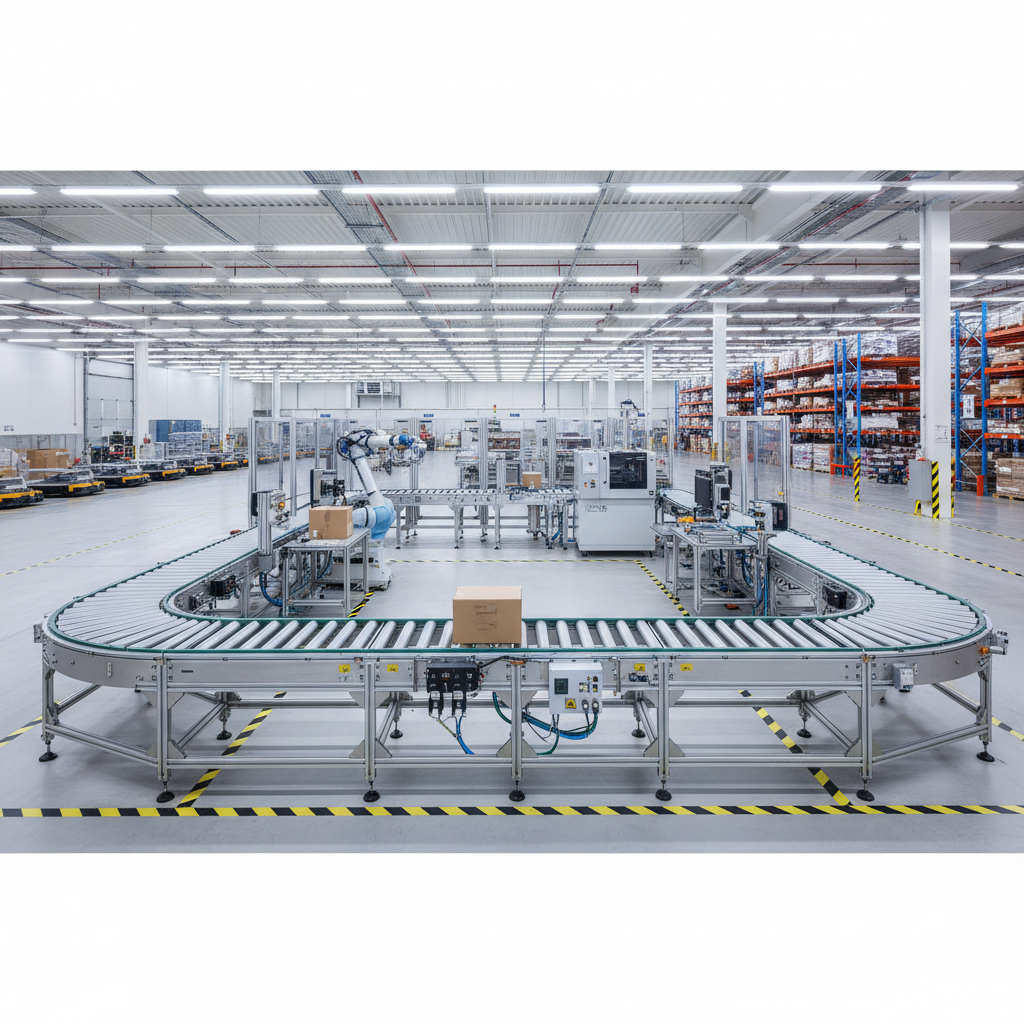
RFID on Conveyors: Real-Time Tracking for Benelux Warehouses
Integrating RFID readers with conveyor systems automates data capture, providing real-time inventory visibility and 99%+ accuracy. This is crucial for high-volume logistics hubs in the Benelux, streamlining operations from inbound to outbound.

In the fast-paced logistics landscape of the Benelux—a critical junction for European trade—inventory accuracy is not just an operational goal; it is the backbone of profitability. For distribution centers in strategic locations like Rotterdam, Antwerp, and Venlo, the constant flow of goods demands flawless tracking. This is where the integration of Radio Frequency Identification (RFID) technology into conveyor systems transitions from a niche advantage to a competitive necessity, enabling unprecedented levels of real-time visibility and control.
Definition
RFID integration in conveyor systems is the process of embedding RFID readers and antennas into or alongside conveyor lines (such as belt or roller systems) to automatically identify, track, and route tagged items, pallets, or totes without manual intervention or direct line-of-sight.
Why RFID is Crucial for Benelux Logistics Hubs
The Benelux region, with its world-class ports and dense road network, is the beating heart of European logistics. This strategic position brings unique challenges, including immense volume, high labor costs, and intense competition. RFID on conveyors directly addresses these pressures.
High-Volume, High-Speed Throughput
Major hubs process tens of thousands of parcels and pallets per hour. Manual barcode scanning creates bottlenecks, capping throughput. An RFID portal integrated with a roller conveyor operating at 1.5 m/s can register a tagged pallet instantly, while a high-speed sorter can use RFID data to route individual packages at speeds exceeding 3 m/s. This automated data capture is essential to maintain fluidity and prevent costly slowdowns.
Overcoming Labour Shortages with Automation
The logistics sector in the Netherlands, Belgium, and Luxembourg faces persistent labor shortages. RFID integration automates the highly repetitive task of scanning, freeing up employees for more value-added activities like quality control or complex order picking. Reducing reliance on manual scanning significantly mitigates the impact of labor scarcity and reduces operational costs, with some facilities seeing a 75% reduction in labour required for goods receipt.
E-commerce Demands for Accuracy and Speed
The rise of e-commerce has led to a surge in smaller, more frequent orders with high customer expectations for speed and accuracy (OTIF performance). RFID ensures that the right item is in the right place at the right time. It reduces mis-shipments, which cost European retailers billions annually in returns processing and customer dissatisfaction. An accuracy rate of 99.9% is achievable, compared to 95-98% for even the best barcode-based systems.
Core Components of a Conveyor-Based RFID System
A successful implementation combines several key hardware and software components into a cohesive system. The magic is not in the individual parts, but in how they are integrated to share data seamlessly.
- RFID Tags: These are the data carriers. Passive UHF (Ultra-High Frequency) tags are the most common in logistics, costing between €0.10 and €0.40 per tag. They are powered by the reader's radio waves and are ideal for cartons and totes. Active tags, with their own power source, cost more (€5 - €25) but offer a longer read range, used for high-value assets.
- RFID Readers & Antennas: These are the "brains" of the operation. Readers, mounted above or beside the conveyor, emit radio waves to power and communicate with the tags. The configuration of antennas is critical to ensure 100% read coverage of items on the conveyor, regardless of their orientation. A typical reader setup for a 1,000 mm wide conveyor might cost €2,000 - €4,000.
- Conveyor System Hardware: The conveyor itself must be suitable for RFID. While systems with minimal metal content are ideal, modern RFID readers and shielding techniques allow for successful implementation on standard steel roller or chain conveyors. The key is to ensure the conveyor speed and product spacing are optimized for the chosen RFID hardware.
- Middleware & WMS Integration: Raw data from the RFID reader is just noise. Middleware software filters this data (e.g., removing duplicate reads) and translates it into meaningful business events (e.g., "Pallet XYZ has entered Zone B"). This clean data is then passed to the main Warehouse Management System, which updates inventory records in real time. A seamless flow of information is crucial, as detailed in our guide to WMS/WCS integration.
RFID vs. Barcode Scanning: A Comparative Analysis
While barcodes have been the standard for decades, RFID offers a clear technological leap forward for many applications. The choice depends on volume, accuracy requirements, and budget.
| Feature | Barcode Scanning | RFID |
|---|---|---|
| Read Speed | One scan at a time, requires operator | Hundreds of tags per second, fully automated |
| Line-of-Sight | Required; scanner must "see" the barcode | Not required; radio waves penetrate cardboard, plastic |
| Accuracy | ~95-98%, susceptible to human error and print damage | >99.5%, automated and robust |
| Read Range | A few centimeters to a few meters | Up to 10 meters with passive UHF tags |
| Data Storage | Limited to a simple identifier | Can store more data, which can be rewritten |
| Cost per Item | Less than €0.01 | €0.10 - €0.40 (for passive tags) |
| Labour Requirement | High; requires manual operation | Very low; fully automated at read points |
| Durability | Easily damaged by dirt, moisture, or tearing | Tags are often embedded and protected, very durable |
The Financial Case: ROI of RFID on Conveyors
Implementing an RFID system requires an initial investment, but the return on investment (ROI) is often compelling and achievable within 12-24 months for medium to high-volume operations.
Calculating the Initial Investment
A typical project for a medium-sized distribution center in the Benelux might involve outfitting two dock doors for inbound and three doors for outbound verification.
- Hardware Costs: 5 RFID portals (€3,000 each) = €15,000. Conveyor modifications might add €5,000.
- Software Costs: Middleware licenses and WMS integration could range from €10,000 to €30,000, depending on complexity.
- Tagging Costs: Tagging 1 million inbound cartons per year at €0.15/tag = €150,000. This is an ongoing operational cost.
Quantifying the Returns
The savings are multi-faceted:
- Labour Savings: If automating goods receipt saves two full-time employees from manually scanning pallets, this can translate to €80,000 - €100,000 in annual savings in the Benelux.
- Error Reduction: Eliminating mis-shipments saves money on return logistics, customer service, and replacement goods. If a company reduces shipping errors by 1%, the savings can quickly amount to tens of thousands of euros.
- Inventory Reduction: With real-time, accurate inventory data, companies can lower their safety stock levels. A 5% reduction in overall inventory can free up significant working capital.
Implementation Scenarios in a European Warehouse
RFID on conveyors can be deployed at multiple points in the warehouse to optimize different processes. The system often relies on the conveyor's Programmable Logic Controller to physically stop or divert a product based on the data received from the RFID tag.
- Inbound Logistics: As a pallet is unloaded onto a conveyor, it passes through an RFID portal. Its contents are read instantly, verified against the Advance Shipping Notice (ASN), and the WMS is updated. The status Docks-to-Stock time is reduced from hours to minutes.
- Sorting and Routing: A carton moving on a high-speed sorter is identified by an RFID reader positioned just before the divert point. The WMS/WCS instantly tells the sorter to divert the carton to the correct shipping lane for Brussels, Amsterdam, or Luxembourg.
- Outbound Verification: As picked-and-packed orders move on a conveyor toward a truck, a final RFID portal scans the cartons. It verifies that the entire order is present and correct before the trailer is sealed, automatically generating the shipping manifest. This eliminates costly shipping errors entirely.
For many companies, growth is not just about producing more, but about scaling their internal processes to handle that growth efficiently. As detailed in a recent analysis, many companies find their processes do not scale with their growth, leading to bottlenecks that automation like RFID can solve.
Easy Systems: Your Partner for Integrated Conveyor Solutions
Successfully integrating RFID into a conveyor system requires a deep understanding of both material handling mechanics and data integration. It’s not about just installing a reader; it’s about creating a robust data-driven solution. At Easy Systems, we specialize in designing and building modular conveyor systems that are automation-ready.
We work with leading RFID integrators and your WMS provider to create a seamless solution tailored to the specific needs of your Benelux operation. From modular roller conveyors designed for easy mounting of antennas to the PLC logic required for real-time routing, we build the reliable hardware foundation upon which your real-time inventory system depends. We help you connect the physical flow of goods to the digital flow of information, turning your warehouse into a strategic asset.

This article is part of the Conveyor-Design knowledge hub, edited by Easy Systems engineers who design conveyor and warehouse automation systems across the Benelux every week.
Frequently asked questions
What is the main advantage of RFID over barcodes on a conveyor?+
The primary advantage is automation and speed. RFID does not require a direct line of sight, allowing for hundreds of items to be read per second as they move on the conveyor, without manual intervention. This drastically increases throughput and accuracy.
Can RFID readers be added to my existing conveyor system?+
Yes, in many cases, RFID readers and antennas can be retrofitted onto existing conveyor lines. However, factors like conveyor construction (metal content), speed, and product spacing must be evaluated to ensure reliable read rates. A site survey is typically required.
What is a realistic inventory accuracy level with an RFID conveyor system?+
With a well-designed system, warehouses can consistently achieve inventory accuracy levels of 99.5% or higher. This is a significant improvement over barcode-based systems, which typically operate in the 95-98% accuracy range and are prone to human error.
How does RFID work with metal or liquid products on a conveyor?+
Metal and liquids can interfere with UHF RFID signals. However, this challenge is overcome by using specialized tags designed for on-metal or liquid applications, and by carefully positioning antennas to optimize the read zone. It requires expert system design but is a solved problem.