AGV vs. AMR in Conveyor Integration: A Benelux Guide
Choosing between Automated Guided Vehicles (AGVs) and Autonomous Mobile Robots (AMRs) for conveyor integration is critical for warehouse efficiency. This guide offers a detailed comparison focused on the Benelux region, covering costs, technology, and scalability to inform your automation strategy.
In the fast-paced logistics landscape of the Benelux—a pivotal European trade hub—the efficiency of material movement is paramount. Integrating mobile robots with fixed conveyor systems presents a powerful solution for automating intralogistics. However, warehouse managers face a critical decision: should they integrate traditional Automated Guided Vehicles (AGVs) or the more advanced Autonomous Mobile Robots (AMRs)? This choice impacts cost, flexibility, scalability, and ultimately, the competitive edge of your entire operation.
Definition
Automated Guided Vehicles (AGVs) are industrial vehicles that follow predefined paths, typically marked by magnetic stripes, optical lines, or wires embedded in the floor. Autonomous Mobile Robots (AMRs) are more advanced vehicles that navigate dynamically using onboard sensors and maps, allowing them to plan their own routes and avoid obstacles. The core difference lies in navigation: AGVs are guided, while AMRs are autonomous.
Navigation Technology: Predictability vs. Intelligence
The fundamental distinction between an AGV and an AMR is how they understand and move through a facility. This directly impacts their application when integrated with conveyor lines.
AGV: Line-Following Reliability
AGVs rely on proven, albeit rigid, navigation methods:
- Magnetic Tape/Barcodes: AGVs follow a magnetic strip glued or embedded into the facility floor. It's a cost-effective and reliable method for simple, unchanging routes. Installation requires downtime to apply the tape but is less intrusive than wire guidance.
- Wire Guidance: A wire is embedded in a channel cut into the floor, transmitting a radio signal that the AGV follows. This is extremely robust but the most invasive and inflexible option, making route changes a significant project.
- Laser-Target Navigation: The AGV uses a rotating laser to detect reflective targets mounted on walls and pillars. By triangulating its position from these known points, it can navigate its programmed path. This offers more flexibility than floor-based methods but still relies on fixed external infrastructure.
AMR: Dynamic SLAM Navigation
AMRs represent a significant leap in technology, primarily using Simultaneous Localization and Mapping (SLAM). This allows the robot to build a map of its environment using sensors (like LiDAR and 3D cameras) while simultaneously determining its own location on that map. This intelligent navigation means an AMR can:
- Calculate Optimal Routes: Given a destination (e.g., conveyor station A), the AMR calculates the most efficient path based on the live map.
- Avoid Obstacles Dynamically: If it encounters an unexpected obstacle like a pallet or a person, it doesn't just stop. It will safely navigate around the obstruction, finding an alternative route to continue its mission.
- Adapt to a Changing Environment: AMRs can seamlessly adapt to new conveyor lines, workstations, or storage areas without physical infrastructure changes. A simple software update to the map is often all that is required.
Integrating Mobile Robots with Conveyor Systems
The goal of integration is to create a seamless "handshake" between the mobile robot and the fixed conveyor. This typically involves transferring totes, boxes, or pallets between the two systems. The choice of robot deeply influences how this is achieved. For a foundational understanding of this technology, our in-depth guide on AGVs vs. AMRs is an essential resource.
Conveyor Handshake Scenarios
Integration points often feature a short, standalone conveyor segment or a lifting mechanism.
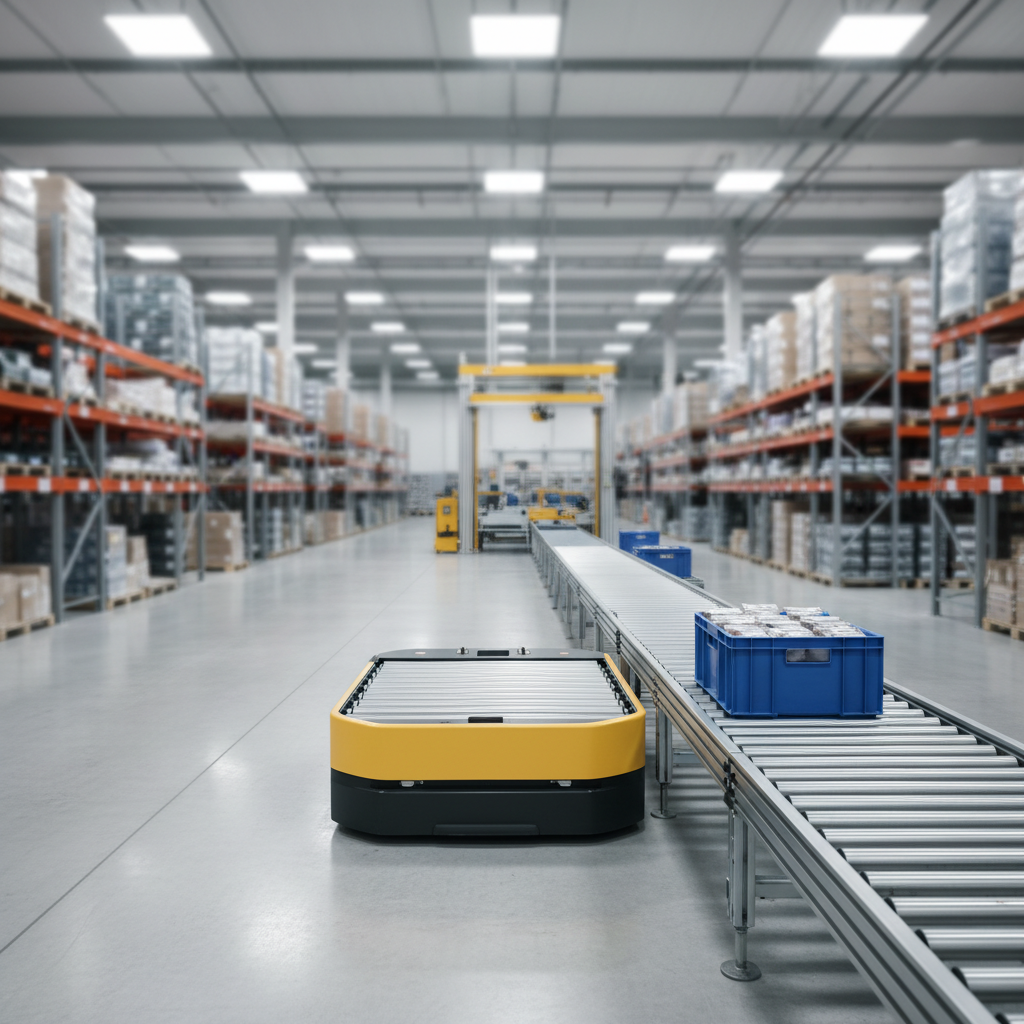
- Pickup: The robot arrives at the end of a conveyor line. The conveyor actuates to move a box onto the robot's payload area (which could be a simple platform, a lift, or a small roller bed).
- Drop-off: The robot arrives at an induction point of another conveyor system. Its payload area activates to transfer the box onto the receiving conveyor.
Comparative Analysis: AGV vs. AMR for Benelux Operations
Choosing the right technology requires a clear-eyed evaluation of their strengths and weaknesses in the context of your specific operational needs and budget. The table below provides a Benelux-focused comparison.
| Metric | Automated Guided Vehicle (AGV) | Autonomous Mobile Robot (AMR) |
|---|---|---|
| Navigation Method | Fixed paths (magnetic tape, wires, lasers) | Dynamic (SLAM, LiDAR, vision) |
| Initial Investment (per unit) | €25,000 - €70,000 | €35,000 - €90,000 (often includes charging station) |
| Payload Capacity | Up to 2,000 kg for pallet movers | Typically 100 kg to 500 kg; heavy-duty up to 1,500 kg |
| Typical Speed | 1.0 - 1.7 m/s | 1.2 - 2.0 m/s |
| Implementation Time | Weeks to months (requires floor/infrastructure prep) | Days to weeks (requires mapping & software integration) |
| Flexibility & Scalability | Low. Route changes are costly and disruptive. | High. Adapts to new layouts via software; easy to add more robots. |
| Best Fit Use Case | Repetitive, point-to-point transport between fixed conveyor lines in a stable production or warehousing environment. | Dynamic environments with changing layouts, such as e-commerce fulfillment, 3PLs, or goods-to-person workflows. |
Cost Implications in a Benelux Context
While AMRs have a higher unit cost, a Total Cost of Ownership (TCO) analysis is more revealing. AGV implementation requires significant upfront investment in route infrastructure. For a 2,000 square meter facility, preparing the floor for magnetic tape navigation can take 40-60 man-hours and cause operational downtime. Changing these routes later incurs similar costs and disruption. AMRs eliminate this entirely. Their implementation cost is centered on software integration and initial mapping, which can often be done in a few days without halting operations. Many companies find that this flexibility is essential; as processes evolve, their automation must be able to adapt without costly reinvestment.
Use Cases: Where Each Technology Shines
AGVs: The Predictable Workhorse
Consider a large food and beverage production facility in the Netherlands. Finished pallets come off a production line conveyor and need to be transported 200 meters to a stretch-wrapping machine, which then feeds a pallet conveyor system for storage. This is a perfect AGV use case. The path is fixed, the task is identical every time, and the environment is stable. The AGV provides reliable, low-cost transport with minimal complexity.
AMRs: The Agile Fulfilment Partner
Now, picture a large e-commerce fulfillment center near the port of Antwerp, Belgium. It handles thousands of SKUs and fluctuating order volumes. AMRs can be used to decouple processes. They can pick up totes from a consolidation conveyor after picking, and then dynamically travel to one of many packing stations based on real-time availability and order priority. If one packing lane is full, the AMR simply reroutes to another. This level of agility is impossible with an AGV and is crucial for meeting tight delivery windows.
Choosing Your Trusted Partner for Integration
The decision between AGVs and AMRs is not just a technology choice; it’s a strategic business decision. The right selection depends on a thorough analysis of your current material flow, future growth projections, and operational philosophy. Working with an experienced integration partner is critical to navigating this complexity.
At Easy Systems, we specialize in designing and implementing intelligent, modular conveyor solutions. We understand that mobile robots are not a standalone solution but a component of a larger, interconnected system. Our expertise lies in creating the seamless physical and digital handshake between our robust conveyor systems and the mobile robot technology—AGV or AMR—that best fits your unique operational needs in the Benelux and across Europe. We focus on creating holistic, scalable, and future-proof intralogistics systems that deliver measurable ROI.
This article is part of the Conveyor-Design knowledge hub, edited by Easy Systems engineers who design conveyor and warehouse automation systems across the Benelux every week.
Frequently asked questions
What is the main difference between an AGV and an AMR?+
The main difference is navigation. An AGV follows fixed, predefined paths like magnetic stripes or wires, while an AMR navigates dynamically using onboard maps and sensors (like SLAM), allowing it to avoid obstacles and change routes.
Are AMRs always better than AGVs?+
Not necessarily. For highly repetitive, simple point-to-point tasks in a stable environment with no layout changes, an AGV can be a more cost-effective and reliable solution. AMRs excel in dynamic, complex environments where flexibility is key.
How much does an AGV or AMR cost in Europe?+
In the Benelux, an AGV suitable for conveyor integration can cost between €25,000 and €70,000 per unit. An equivalent AMR typically costs 15-25% more, ranging from €35,000 to €90,000, though this often has a lower total cost of ownership.
What is required to integrate an AMR with a conveyor?+
Integration requires three key components: 1) A physical interface, often a small powered conveyor on the AMR or at the station. 2) A software layer (WCS/WES) to manage tasks between the AMR fleet manager and conveyor PLC. 3) Network infrastructure (Wi-Fi) for reliable communication.