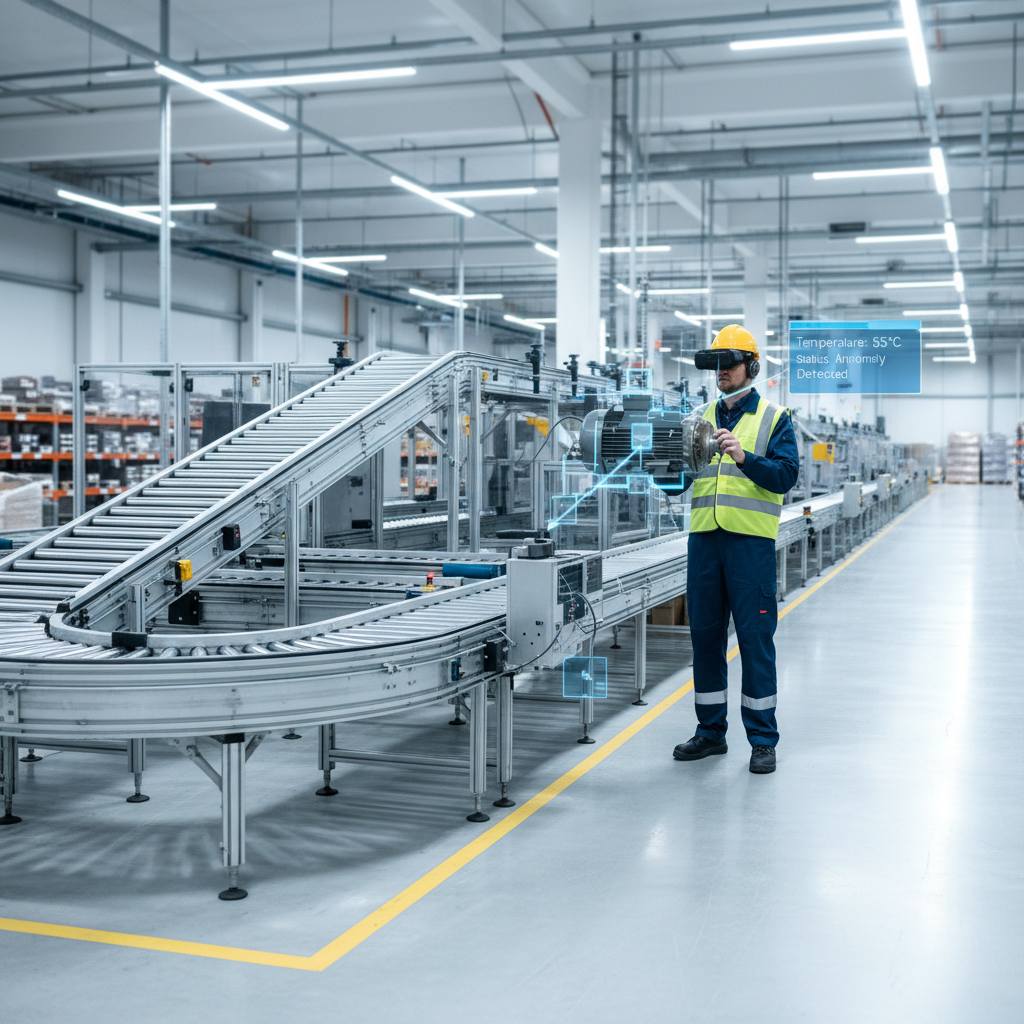
Predictive Maintenance for Conveyors: Big Data & ML for Maximum Uptime
Discover how leveraging Big Data, IIoT sensors, and Machine Learning for predictive maintenance can transform your conveyor system

In high-throughput distribution centers and manufacturing plants across Europe, unplanned downtime is the ultimate profit killer. A single hour of a critical conveyor system being offline can cost a company tens of thousands of Euros. The transition from reactive or calendar-based maintenance to a data-driven, predictive model is no longer an innovation—it's a competitive necessity for achieving maximum operational uptime and efficiency.
Definition
Predictive Maintenance (PdM) is an advanced Industry 4.0 strategy that utilizes data analysis tools and machine learning techniques to detect anomalies in operation and forecast potential equipment failures before they occur. For conveyor systems, this means analyzing real-time data from components to perform maintenance at the exact moment it is needed, not before or after.
Key Numbers
| Metric | Typical range (EU 2026) | Notes |
|---|---|---|
| Initial Investment (per system) | €5,000 - €50,000 | Includes sensors, gateway hardware, and software licenses/setup. |
| Reduction in Unplanned Downtime | 20% - 40% | Compared to a purely reactive maintenance strategy. |
| Reduction in Maintenance Costs | 15% - 25% | Achieved by optimizing labor, reducing unnecessary parts replacement. |
| Return on Investment (ROI) | 1 - 3 years | Varies based on the cost of downtime at the specific facility. |
| Prediction Accuracy | 85% - 95% | Refers to the model's ability to correctly forecast a failure. |
| Data Volume per Sensor | 10 - 200 MB / day | Dependent on sensor type (vibration sensors are data-intensive). |
| Energy Consumption Reduction | 3% - 8% | Well-maintained motors and bearings operate more efficiently. |
From Reactive to Predictive: The Maintenance Evolution
Logistics operations have historically cycled through different maintenance philosophies. Understanding this evolution highlights the significant advantages that PdM offers over traditional methods. Each step provides more control and less disruption, but with increasing complexity and initial investment.
| Maintenance Strategy | Core Principle | Pros | Cons |
|---|---|---|---|
| Reactive Maintenance | "If it isn't broken, don't fix it." | Lowest initial cost; no "unnecessary" maintenance. | High unplanned downtime; high stress; secondary damage common; catastrophic failures. |
| Preventive Maintenance | "Fix it before it breaks." | Reduces unplanned downtime; more structured and planned work. | Can lead to over-maintenance; parts replaced prematurely; doesn't prevent all failures. |
| Predictive Maintenance (PdM) | "Fix it just in time." | Maximizes uptime; minimizes maintenance costs; extends asset life; data-driven decisions. | Higher initial investment; requires data science expertise; complex implementation. |
How Predictive Maintenance for Conveyors Works
Implementing a PdM strategy is a multi-stage process that transforms raw sensor readings into actionable maintenance alerts. This process forms a continuous feedback loop, where the system becomes more intelligent over time.
Step 1: Data Collection with IIoT Sensors
The foundation of PdM is high-quality data. Industrial Internet of Things (IIoT) sensors are retrofitted onto critical components of belt conveyors and other transport systems. Common sensor types include:
- Vibration Sensors: Attached to motors, gearboxes, and bearings to detect subtle changes in vibration patterns that indicate misalignment, wear, or imbalance.
- Thermal Sensors (Infrared): Monitor component temperature. Overheating is a classic early sign of electrical issues or excessive friction.
- Acoustic Sensors: Listen for changes in operational noise, which can signify issues like bearing wear or belt slippage.
- Power Consumption Monitors: Track the energy usage of a motor. A sudden increase can indicate strain on the system.
Step 2: Data Transmission and Processing
Sensor data is transmitted wirelessly or via cable to a gateway. From there, it can be processed in two main ways:
- Edge Computing: Initial data processing occurs directly on or near the gateway. This reduces latency and data transmission costs, providing near-instant alerts for critical deviations.
- Cloud Computing: Aggregated data is sent to a cloud platform for long-term storage and complex analysis. This is where machine learning models are trained on historical data to identify complex patterns.
Step 3: Machine Learning Analysis
This is the "brain" of the operation. Historical and real-time data are fed into machine learning algorithms. These models are trained to understand the "normal" operating signature of each component. When live data deviates from this baseline, the model can predict the probability of a failure and estimate the remaining useful life (RUL) of the component. Techniques like regression analysis, random forests, and neural networks are commonly employed.
Step 4: Actionable Insights & Integration
The output isn't just raw data; it's an actionable alert. For example: "Motor on conveyor line 7 shows a 90% probability of bearing failure within the next 72 operating hours." This alert can be sent directly to the maintenance team's mobile devices or integrated into a CMMS (Computerized Maintenance Management System) or WCS (Warehouse Control System) to automatically generate a work order.
The Business Case: ROI of a PdM Program
For a warehouse manager or financial controller, the key question is about return on investment. The ROI for PdM is compelling, especially in high-volume operations. Consider a medium-sized European e-commerce fulfillment center where a main sorting line being down costs €20,000 per hour in lost throughput and delayed orders.
If a PdM system, with an initial cost of €40,000, prevents just three hours of unplanned downtime in its first year, it has already paid for itself. This simple calculation doesn't even account for reduced maintenance labor costs, savings on spare parts, and the extended life of the machinery. Improved operational scalability becomes a tangible asset, not just a buzzword. For many facilities, particularly those with complex roller and belt conveyor systems, the ROI period is often between 12 and 24 months.
Implementation Considerations for European Warehouses
A successful PdM implementation requires more than just technology. European operators must consider several factors.
Integration with Legacy Systems
Most warehouses have existing control infrastructure, including a PLC (Programmable Logic Controller) for machine control and often a WCS or WMS for higher-level management. A new PdM system must integrate seamlessly, pulling data from and pushing alerts to these existing platforms without creating data silos. Standards like OPC UA are becoming crucial for this interoperability.
Data Security and GDPR
While machine data is less sensitive than personal data, the aggregation and cloud storage of operational information have security implications. The system must be secure from cyber threats, and if any data could be tangentially linked to employee performance, GDPR compliance must be carefully considered.
Skills and Training
Your maintenance team needs to evolve from mechanics to data-informed technicians. Training is required not just on how to use the new dashboard, but on how to trust the data and act on the system's recommendations. This often involves a cultural shift within the organization.
Easy Systems: Your Partner for Intelligent Conveyor Solutions
At Easy Systems, part of the BOA Concept group, we understand that conveyors are the arteries of your operation. We design, manufacture, and integrate robust, high-performance conveyor systems built for the demands of the modern European market. While our systems are engineered for reliability, we recognize that intelligent maintenance is the key to unlocking their full potential and guaranteeing long-term uptime. We can help you instrument your new or existing conveyor systems with the right sensors and data hooks, preparing your facility for a data-driven future with predictive maintenance. Our expertise ensures that your hardware is ready to become a core part of your Industry 4.0 strategy, turning potential downtime into predictable, planned, and efficient action.
Frequently asked questions
What is the main benefit of predictive maintenance for conveyors?+
The primary benefit is a significant reduction in unplanned downtime, typically between 20% and 40%. By forecasting failures, maintenance can be scheduled during planned shutdowns, maximizing operational availability and protecting revenue-generating throughput.
How much does a predictive maintenance system cost in Europe?+
Initial investment for a conveyor line can range from €5,000 for a basic setup to over €50,000 for a complex system with many sensors and advanced software. This cost should be weighed against the high price of unplanned downtime in your specific operation.
What sensors are used for conveyor predictive maintenance?+
The most common sensors are for vibration, temperature, and acoustics. Vibration sensors detect mechanical issues in motors and bearings, while thermal sensors spot overheating from friction or electrical faults. Power consumption monitors are also frequently used.
Predictive vs. preventive maintenance: what is the key difference?+
Preventive maintenance is time-based (e.g., "service motor every 1,000 hours"), while predictive maintenance is condition-based ("service motor when vibration pattern indicates impending failure"). Predictive maintenance is more efficient, avoiding unnecessary work and cost.
How long does it take to see ROI on a PdM system?+
In a typical European logistics or manufacturing environment, the Return on Investment (ROI) for a predictive maintenance system is usually between 1 to 3 years. For facilities with a very high cost of downtime, this can be less than 12 months.
Can predictive maintenance be retrofitted to older conveyor systems?+
Yes, one of the major advantages of modern PdM solutions is that they can be retrofitted. Wireless IIoT sensors can be attached to existing motors, gearboxes, and bearings of older systems, allowing them to be integrated into a smart maintenance program with minimal disruption.

The Easy Systems engineering team designs, integrates and commissions conveyor systems and warehouse automation across Belgium, the Netherlands and Luxembourg. Combined experience covers roller and belt conveyors, sorters, AGV/AMR fleets, AutoStore, shuttle AS/RS and WMS/WCS integration for distribution centers and e-commerce fulfillment operations.
- Conveyor design (roller, belt, modular plastic)
- Sortation & merge logic
- AGV / AMR fleet integration
- AutoStore & shuttle AS/RS
- WMS / WCS integration