Predictive Maintenance for Conveyors: Benelux Guide 2026
Predictive maintenance uses sensor data and AI to forecast conveyor failures before they happen, reducing downtime by up to 50% and maintenance costs by 30%. This guide covers the technology, implementation, and ROI for logistics in the Benelux.
In the high-stakes, high-speed logistics landscape of the Benelux, a single hour of conveyor downtime can cost thousands of euros in lost throughput and delayed orders. Traditional preventive maintenance helps, but it's often inefficient—replacing components that may still have months of life left. Predictive maintenance (PdM) offers a smarter, data-driven approach, transforming maintenance from a reactive necessity into a proactive, strategic advantage.
Definition
Predictive Maintenance (PdM) is an Industry 4.0 strategy that uses data-gathering sensors and analysis tools to monitor the real-time condition of equipment, such as a belt conveyor, in order to predict when a failure is likely to occur. This allows maintenance to be scheduled only when needed, just before a fault happens, thereby minimizing downtime and optimizing resource allocation.
Key Numbers
| Metric | Typical range (Benelux/EU 2026) | Notes |
|---|---|---|
| Initial PdM System Investment | €15,000 - €75,000 | Depends on system size, sensor count, and software complexity. |
| Typical ROI | 18 - 24 months | Achieved through reduced downtime, lower spare parts inventory, and optimized labor. |
| Downtime Reduction | 30% - 50% | Compared to a reactive or purely preventive maintenance strategy. |
| Maintenance Cost Reduction | 25% - 30% | By avoiding unnecessary component replacement and emergency repairs. |
| Component Lifespan Extension | 15% - 25% | Maximizing the useful life of motors, bearings, and belts. |
| Cost per Sensor Point | €80 - €400 | Varies by type (vibration, thermal, acoustic, power). |
| Energy Savings | 5% - 10% | Healthy, well-maintained motors and bearings consume less power. |
The Evolution from Reactive to Predictive Maintenance
Historically, maintenance has followed a simple, but costly, path. You wait for something to break (reactive maintenance) or you service it on a fixed schedule (preventive maintenance), regardless of its actual condition. PdM represents a fundamental shift. Instead of relying on averages or assumptions, it uses live data to understand the health of each individual component. For a busy distribution center in Antwerp or a fulfillment hub near Schiphol, this means moving from "fix it when it fails" to "fix it before it breaks."
Core Technologies Driving Predictive Maintenance
A successful PdM program is built on a foundation of interconnected technologies that work in concert to monitor, analyze, and act.
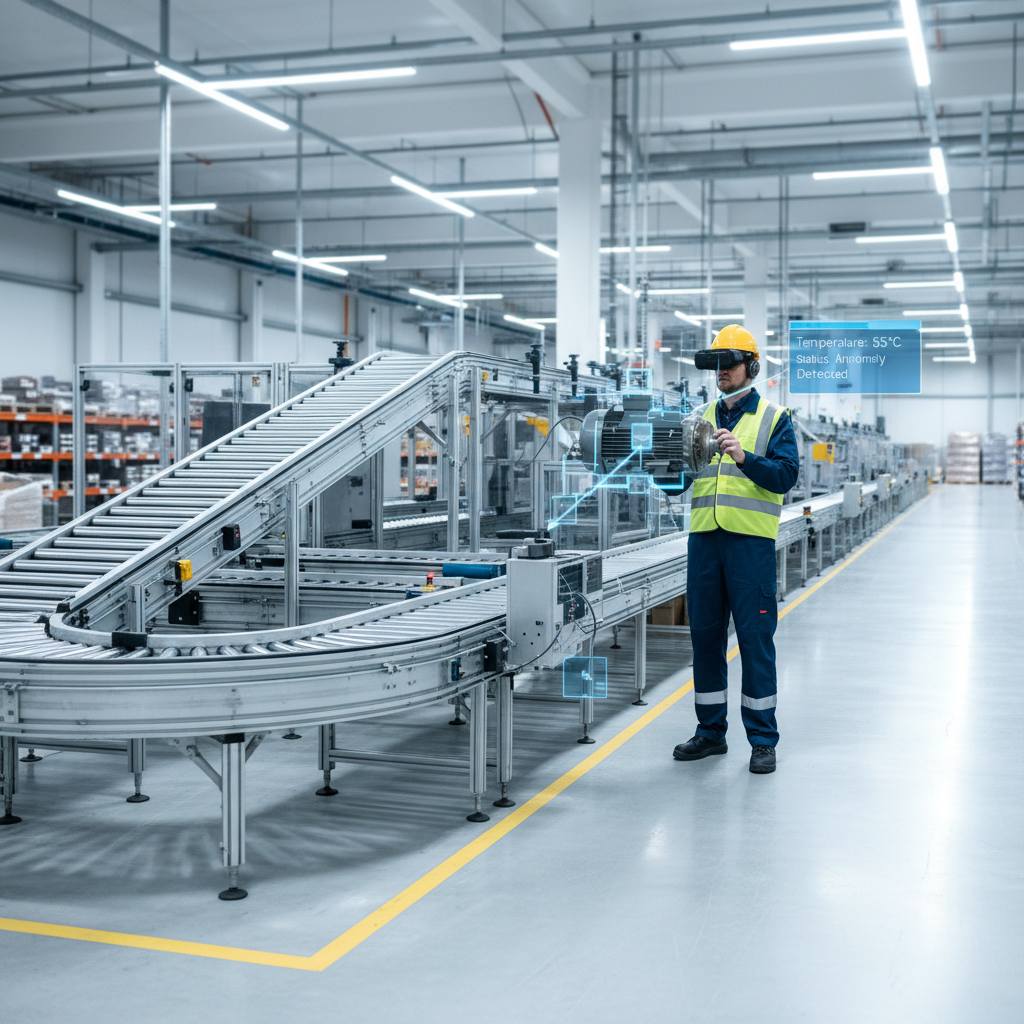
- IoT Sensors: These are the eyes and ears of the system. Attached to critical components like motors, gearboxes, and bearings, they collect raw data on equipment health. Common types include vibration sensors, thermal cameras, acoustic sensors, and motor current monitors.
- Data Aggregation & Communication: Sensor data is transmitted, often wirelessly, to a central processing unit. This can be integrated with the main conveyor PLC (Programmable Logic Controller) or a separate system, using protocols like OPC-UA for interoperability.
- AI & Machine Learning Analytics: This is the brain. Software platforms use algorithms to analyze the incoming data streams, identifying patterns and anomalies that precede a failure. A gradual increase in motor vibration by 1.5 mm/s over three weeks, for instance, might trigger a high-probability alert for bearing failure.
- WCS/WES Integration: The output isn’t just an alarm. The analytics platform communicates with the Warehouse Control System (WCS) or Warehouse Execution System (WES) to create maintenance orders, schedule technicians, and even order the required spare parts automatically.
Comparing PdM Sensor Technologies
Choosing the right sensors is critical for effective monitoring. The most common types for conveyor systems have distinct advantages and are often used in combination.
| Sensor Type | Measures | Best For Detecting | Typical Cost/Point (EUR) |
|---|---|---|---|
| Vibration Analysis | Velocity, acceleration (mm/s, g) | Bearing wear, misalignment, imbalance in motors and rollers. The most common and effective sensor type. | €150 - €400 |
| Thermal Imaging (Infrared) | Temperature (°C) | Overheating motors, failing electrical connections, friction on belts. | €100 - €350 |
| Acoustic Analysis | Sound patterns (dB) | High-frequency distress signals from failing parts, air leaks, lack of lubrication. | €80 - €250 |
| Motor Current Analysis | Amperage (A), Voltage (V) | Electrical faults, motor stress due to overload or obstructions on the conveyor line. | €200 - €500 |
Implementation Strategy for Benelux Operations
Adopting PdM is a strategic project, not just an IT installation.
Step 1: Criticality Assessment
You cannot and should not monitor everything. Start by identifying the most critical components in your system. Which failures cause the most significant downtime? This is often the main drive motor on an incline, a key merge point, or a sorter. A detailed process analysis is crucial. For companies experiencing rapid growth, their internal processes often don't scale at the same pace, making this assessment even more critical. You can learn more about this challenge and its solutions in this analysis of scaling business processes.
Step 2: Pilot Program
Select one or two critical conveyor lines for a pilot project. For instance, a main outbound line at an e-commerce facility in the Netherlands. This allows you to validate the technology, establish baseline data, and demonstrate ROI with a contained investment of around €20,000 - €30,000.
Step 3: Integration & Training
Ensure the PdM software integrates seamlessly with your existing CMMS (Computerized Maintenance Management System) and WMS/WCS. Train your maintenance staff not just on how to react to alerts, but how to interpret the data and transition to a proactive mindset. This new way of working is a core part of the value.
Positioning Easy Systems as Your Trusted Partner
Implementing a successful predictive maintenance strategy requires more than just technology; it demands a deep understanding of conveyor systems, warehouse processes, and data integration. At Easy Systems, we are not just a supplier of modular conveyors; we are your partner in operational excellence. Our systems, including advanced Motorized Drive Roller (MDR) conveyors, are designed with modern diagnostics in mind. We provide the foundational knowledge and robust hardware that a sophisticated PdM strategy is built upon. We work with you to identify critical points in your material flow—from accumulation zones to high-speed sortation—and ensure your conveyor backbone is ready for the future of maintenance. Whether you are exploring options like a roller conveyor guide or need to optimize your entire material handling process, our Benelux-based team has the expertise to guide you from initial concept to a fully optimized, resilient operation.
Frequently asked questions
What is the typical ROI for conveyor predictive maintenance in the Benelux?+
The typical Return on Investment (ROI) for a predictive maintenance program in the Benelux is between 18 and 24 months. This is achieved by significantly reducing unplanned downtime costs, which can be €5,000-€10,000 per hour, and lowering overall maintenance expenses by 25-30% through optimized labor and spare parts inventory.
How much does it cost to implement a predictive maintenance system in a Belgian warehouse?+
For a medium-sized warehouse in Belgium, a pilot predictive maintenance program on a critical conveyor line can start from €15,000 to €30,000. A full-scale implementation across multiple lines can range from €50,000 to €150,000, depending on the number of sensors and software complexity.
Which components of a conveyor belt are best for predictive maintenance?+
The best candidates for PdM monitoring are high-impact components whose failure causes major disruption. This includes main drive motors, gearboxes, critical bearings (especially on curves and inclines), and tensioning systems. These components typically show detectable signs like vibration or heat long before a catastrophic failure.
Can predictive maintenance be retrofitted to older conveyor systems?+
Yes, absolutely. Many predictive maintenance solutions are designed to be retrofitted. Wireless sensors for vibration and temperature can be attached to motor housings or bearing blocks of older equipment (10+ years old) without complex wiring, making it a viable upgrade for existing infrastructure.
What is the difference between preventive and predictive maintenance for conveyors?+
Preventive maintenance involves servicing equipment at fixed intervals (e.g., replacing a bearing every 2,000 operating hours), regardless of its condition. Predictive maintenance uses real-time data to service equipment only when it's showing signs of degradation, maximizing its useful life and preventing unnecessary work.
How does predictive maintenance reduce energy consumption of conveyors?+
PdM can reduce energy costs by 5-10%. It identifies issues causing motors to work harder, such as bearing friction, belt misalignment, or component imbalance. By fixing these root causes, the motor draws less current to achieve the same performance, directly lowering electricity consumption.

The Easy Systems engineering team designs, integrates and commissions conveyor systems and warehouse automation across Belgium, the Netherlands and Luxembourg. Combined experience covers roller and belt conveyors, sorters, AGV/AMR fleets, AutoStore, shuttle AS/RS and WMS/WCS integration for distribution centers and e-commerce fulfillment operations.
- Conveyor design (roller, belt, modular plastic)
- Sortation & merge logic
- AGV / AMR fleet integration
- AutoStore & shuttle AS/RS
- WMS / WCS integration