Predictive Maintenance for Conveyors: A Practical IoT Guide
Leverage the power of IoT and big data for predictive maintenance on your conveyor systems. This guide explains how to use sensors to monitor vibration, temperature, and energy use to preemptively address issues, minimizing costly downtime and extending equipment lifespan.

In the high-stakes world of logistics and manufacturing, conveyor system downtime is not just an inconvenience; it's a significant financial drain. Every minute a line is stopped translates to lost productivity and potential shipment delays. Traditionally, maintenance has been either reactive (fixing things when they break) or preventive (servicing on a fixed schedule). Now, a more intelligent approach is taking hold across Europe: predictive maintenance (PdM), powered by the Internet of Things (IoT) and big data analytics. This guide provides a practical overview of how to apply these Industry 4.0 principles to your conveyor systems.
Definition
Predictive Maintenance (PdM) for conveyor systems is a proactive strategy that uses data analysis tools and techniques to detect anomalies in operation and identify possible defects in processes and equipment so they can be fixed before they result in failure. By installing sensors on critical components of a belt conveyor or roller conveyor, you can continuously monitor their health, moving from a schedule-based or failure-based maintenance model to a condition-based, data-driven one.
Key Numbers
| Metric | Typical range (EU 2026) | Notes |
|---|---|---|
| Reduction in Downtime | 15-30% | Compared to preventive maintenance schedules. |
| Maintenance Cost Reduction | 10-25% | Reduced labor for unnecessary checks and fewer expensive emergency repairs. |
| Initial Investment per 100m Line | €5,000 - €15,000 | Includes sensors, gateways, and basic software subscription. |
| Typical ROI Period | 1.5 - 3 years | Heavily dependent on the cost of downtime for the specific operation. |
| Avg. Sensor Data per Point | 5-50 MB/day | Vibration, temperature, and acoustic sensors generate continuous data streams. |
| Increase in Asset Lifespan | 5-15% | Proactive repairs prevent catastrophic failures that damage equipment permanently. |
How Predictive Maintenance Works in Practice
Implementing a PdM strategy is a structured process that transforms raw sensor data into actionable maintenance tasks. It can be broken down into three main stages.
1. Data Collection: The Role of IoT Sensors
The foundation of any PdM program is high-quality, real-time data. This is achieved by retrofitting or integrating sensors onto the most critical—and most failure-prone—components of your conveyor system. Common choices include:
- Vibration Sensors: Attached to motor housings and bearing blocks, these sensors detect subtle changes in vibration patterns (measured in mm/s). An increase can indicate bearing wear, misalignment, or imbalance long before audible or visible signs appear.
- Temperature Sensors: Placed on gearboxes, motors, and bearings, these monitor for overheating, a classic sign of friction from poor lubrication or excessive load.
- Acoustic Sensors: These listen for changes in the sound profile of a running conveyor, identifying issues like the high-frequency sounds of a failing bearing.
- Power Consumption Monitors: An increase in the energy (kWh) drawn by a motor to run the conveyor at a set speed can signal increased friction or a struggling component.
2. Data Transmission and Processing
Once collected, this data needs to be sent to a central system for analysis. In a modern European warehouse, this is often handled wirelessly via protocols like LoRaWAN or Wi-Fi to a central gateway. From there, the data is typically fed into a cloud platform or an on-premise server. This is where a Warehouse Control System (WCS) or a specialized PdM software platform takes over, aggregating and contextualizing the data streams from hundreds of sensors.
3. Analysis, Alerting, and Action
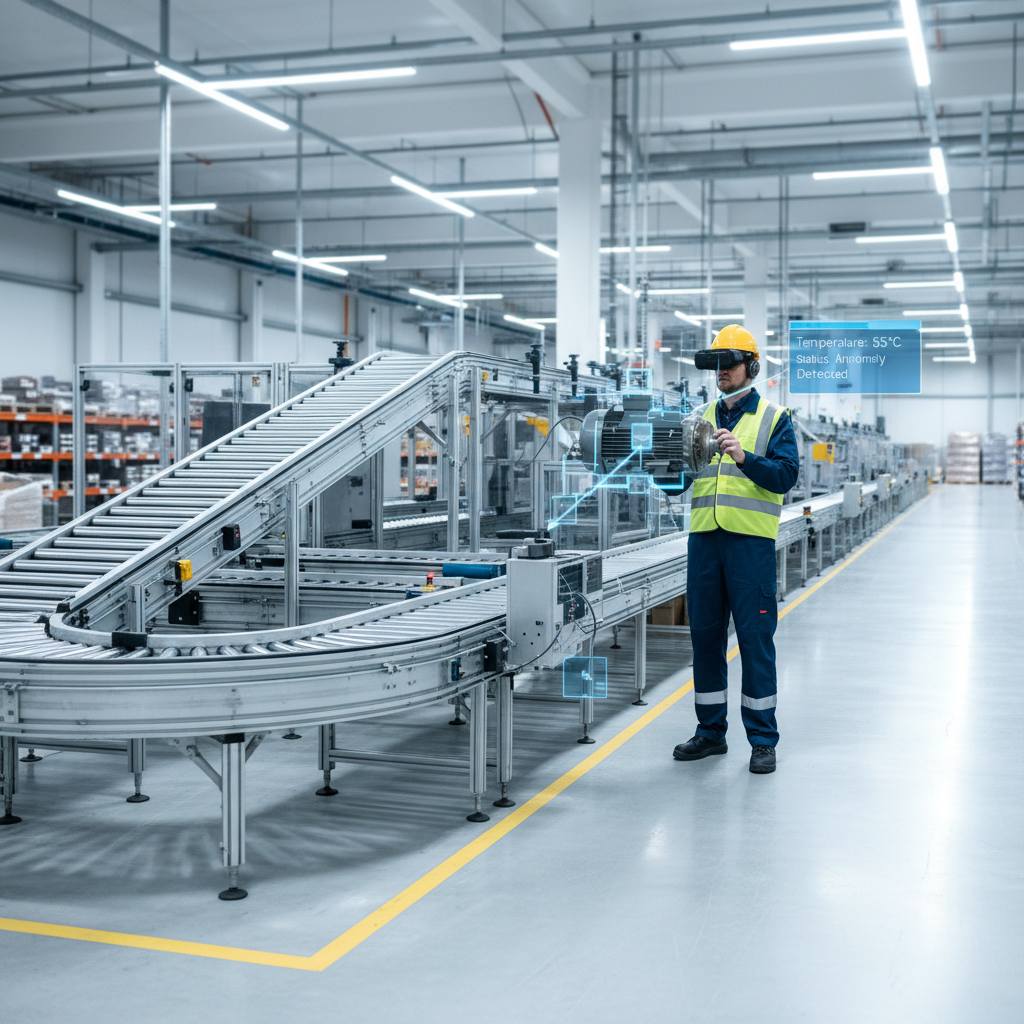
This is where the "predictive" element comes in. The software platform uses machine learning algorithms to establish a baseline of "normal" operation for each component. It then continuously compares the live data stream against this baseline. When the algorithm detects a deviation that correlates with a known failure pattern, it triggers an alert. For example, a gradual increase in vibration combined with a 5°C rise in temperature might predict a bearing failure within the next 150 operating hours. This alert is sent to the maintenance team's dashboard or mobile devices, complete with recommendations, allowing them to schedule a replacement during a planned shutdown, not during peak operations.
Understanding the components and logic of these systems is crucial. For a deeper dive into conveyor hardware itself, our Roller Conveyor guide offers foundational knowledge.
Comparing Maintenance Strategies
To fully appreciate the value of PdM, it helps to compare it with traditional approaches. Each strategy has its place, but their impact on operational efficiency and cost differs significantly.
| Strategy | Principle | Pros | Cons |
|---|---|---|---|
| Reactive Maintenance | "If it ain't broke, don't fix it." | Lowest initial effort; no "unnecessary" maintenance. | High downtime costs; unpredictable failures; secondary damage; safety risks. |
| Preventive Maintenance | "Fix it before it breaks." | Reduces likelihood of failure; more predictable schedule. | Can perform unnecessary maintenance; parts replaced prematurely; doesn't prevent all failures. |
| Predictive Maintenance | "Fix it when it needs to be fixed." | Minimizes downtime; optimizes labor and spare parts; increases asset lifespan. | Higher initial investment (€); requires data analysis capability; implementation complexity. |
The Business Case: ROI of Predictive Maintenance
The primary driver for investing in PdM is financial. Consider a distribution center where a critical sortation conveyor has an average downtime cost of €10,000 per hour. A reactive approach might result in 5-6 major failures a year, leading to 15 hours of unplanned downtime, costing €150,000 annually.
- A preventive plan might reduce this to 8 hours of downtime (€80,000) but adds €30,000 in scheduled maintenance labor and parts, for a total cost of €110,000.
- A predictive system, after a €40,000 initial investment, could reduce unplanned downtime to just 2 hours (€20,000) by catching issues early. The maintenance is more targeted, costing perhaps €25,000. Total annual cost: €45,000.
In this scenario, the PdM system delivers an annual saving of €65,000 over a preventive strategy, achieving a return on investment in well under a year. This clear financial benefit is why many companies find that as they scale, their legacy processes no longer suffice. Indeed, many growing businesses find their processes haven't kept up with their expansion, making scalable solutions like PdM essential for sustainable growth.
Implementing a PdM Program for Your Conveyor System
Transitioning to PdM is a strategic project. The key steps involve:
- Criticality Analysis: Identify which conveyors and components are most critical. A failure in a main sortation line is more impactful than one on a peripheral packing station. Focus investment there first.
- Pilot Project: Start small. Select one critical conveyor line for a pilot implementation. This allows you to test technologies, validate the ROI, and build expertise.
- Technology Selection: Choose sensors, gateways, and a software platform that match your needs and can integrate with your existing systems, such as your MES or WMS. Ensure compliance with European standards like OPC UA for interoperability.
- Team Training: Your maintenance team needs to shift its mindset from mechanical repairs to data analysis and scheduled interventions. Training is paramount.
- Scale and Integrate: Once the pilot proves successful, roll out the PdM program across all critical assets and integrate the data streams for a holistic view of your facility's health.
The Future: AI and Machine Learning Synergy
The next frontier is the deeper integration of Artificial Intelligence (AI). While current PdM uses machine learning to detect known patterns, future systems will use AI to predict novel failure modes—issues they have never seen before. AI could also automate the entire workflow, from detecting an anomaly on a MDR conveyor section to creating a work order, ordering the part, and scheduling the repair, creating a truly autonomous maintenance ecosystem.
Easy Systems: Your Partner in Intelligent Conveyor Automation
Successfully implementing a predictive maintenance strategy requires more than just technology; it requires a deep understanding of the equipment itself. The mechanical and electrical design of a conveyor system is the bedrock upon which any data strategy is built. At Easy Systems, we specialize in designing and manufacturing robust, modular conveyor systems that are "Industry 4.0 ready." Our expertise in high-quality drives, controls, and system integration ensures you have a reliable foundation for building your predictive maintenance program. We engineer systems not just for today's throughput, but for tomorrow's data-driven efficiency. Partner with us to create a resilient and intelligent material handling backbone for your operations.
Frequently asked questions
What is the main benefit of predictive maintenance for conveyor belts?+
The main benefit is a significant reduction in unplanned downtime. By identifying potential failures in components like motors and bearings before they occur, businesses can avoid costly operational stoppages. This typically results in a 15-30% reduction in downtime compared to traditional maintenance methods.
How much does it cost to implement predictive maintenance on a conveyor?+
The initial investment for a pilot project on a single, 100-meter conveyor line typically ranges from €5,000 to €15,000 in Europe. This cost covers sensors, data gateways, and software. The cost is highly dependent on the number of monitoring points and the sophistication of the analytics platform.
What kind of sensors are used for conveyor predictive maintenance?+
The most common sensors are vibration sensors on motors and bearings, temperature sensors on gearboxes, and power consumption monitors for the main drive. Acoustic sensors can also be used to detect changes in operating noise, which might indicate wear and tear on rollers or belts.
Can predictive maintenance be retrofitted to older conveyor systems?+
Yes, absolutely. Most PdM solutions are designed to be retrofitted. Wireless IoT sensors can be easily mounted onto existing motors, gearboxes, and structural frames of older conveyors, making it a viable upgrade for almost any existing system without a complete overhaul.
How long does it take to see a return on investment (ROI) from a PdM system?+
The ROI period for a predictive maintenance system is typically between 1.5 and 3 years. For facilities with very high costs of downtime, such as e-commerce hubs or automotive plants, the ROI can be achieved in less than 12 months due to the immediate savings from preventing just one or two major outages.
Does predictive maintenance replace the need for a human maintenance team?+
No, it enhances them. PdM tools empower maintenance teams by shifting their work from reactive firefighting to proactive, scheduled repairs. Technicians can focus on high-value tasks based on data insights, rather than routine inspections or emergency calls. It changes the nature of the work to be more strategic and less stressful.

The Easy Systems engineering team designs, integrates and commissions conveyor systems and warehouse automation across Belgium, the Netherlands and Luxembourg. Combined experience covers roller and belt conveyors, sorters, AGV/AMR fleets, AutoStore, shuttle AS/RS and WMS/WCS integration for distribution centers and e-commerce fulfillment operations.
- Conveyor design (roller, belt, modular plastic)
- Sortation & merge logic
- AGV / AMR fleet integration
- AutoStore & shuttle AS/RS
- WMS / WCS integration