Predictive Maintenance for Conveyors: A Benelux Guide
Predictive maintenance uses sensor data and AI to forecast equipment failures in conveyor systems before they happen. This guide details how Benelux logistics hubs can cut costs and minimize downtime.

In the high-stakes logistics landscape of the Benelux—a pivotal European trade hub—unplanned downtime is not just an inconvenience; it's a critical financial drain. Every minute a conveyor system stands still, order fulfillment halts, costs accumulate, and customer satisfaction plummets. This guide explores predictive maintenance (PdM) as the strategic answer to this challenge, moving beyond reactive fixes and scheduled servicing to a smarter, data-driven approach that keeps your operations flowing smoothly and profitably.
Definition
Predictive Maintenance (PdM) is a proactive maintenance strategy that uses data analysis tools and techniques to detect anomalies in operation and possible defects in processes and equipment so that they can be fixed before they result in failure. For conveyor systems, this means using sensors to monitor the health of components in real-time and predicting when a part is likely to fail.
Key Numbers
| Metric | Typical Range (EU 2026) | Notes |
|---|---|---|
| Downtime Reduction | 30% - 50% | Compared to reactive or preventive maintenance schedules. |
| Maintenance Cost Reduction | 25% - 30% | Includes savings on labor, emergency repairs, and spare parts inventory. |
| Return on Investment (ROI) | 1.5 - 2 years | For a medium-sized distribution center in the Benelux region. |
| Initial Investment Cost | €10,000 - €50,000 | Includes sensors, software, and basic integration for a 200m system. |
| Sensor Unit Cost | €50 - €300 | Varies by type (vibration, thermal, acoustic, infrared). |
| Component Lifespan Increase | 20% - 40% | By addressing issues early and avoiding catastrophic failures. |
The Shortcomings of Traditional Maintenance
For decades, warehouse managers have relied on two primary maintenance strategies: reactive ("run-to-failure") and preventive (time-based). While simple to implement, both have significant drawbacks in a modern, high-throughput environment.
Reactive vs. Preventive Maintenance
Reactive maintenance is the practice of fixing components only when they break. This approach inevitably leads to unplanned and often lengthy periods of downtime, causing major disruptions. Preventive maintenance, while an improvement, involves servicing equipment on a fixed schedule (e.g., replacing a motor bearing every 12 months) regardless of its actual condition. This can lead to unnecessary maintenance, discarding parts that are still perfectly functional, or failing to prevent a breakdown that occurs before the scheduled service date.
| Maintenance Strategy | Core Principle | Cost Profile | Downtime Risk | Best For |
|---|---|---|---|---|
| Reactive | "If it ain't broke, don't fix it." | Low initial cost, very high failure cost. | Very High & Unplanned | Non-critical, easily swappable components. |
| Preventive | Time/usage-based servicing. | Predictable, but potentially wasteful. | Low-Medium | Systems with predictable wear patterns. |
| Predictive (PdM) | Condition-based, data-driven. | Higher initial investment, lowest total cost. | Very Low & Planned | Critical, high-throughput systems like conveyors. |
Core Technologies Driving Predictive Maintenance
A successful PdM program is built on a foundation of modern technology that works in concert to collect, transmit, and analyze equipment data.
Key Technological Components
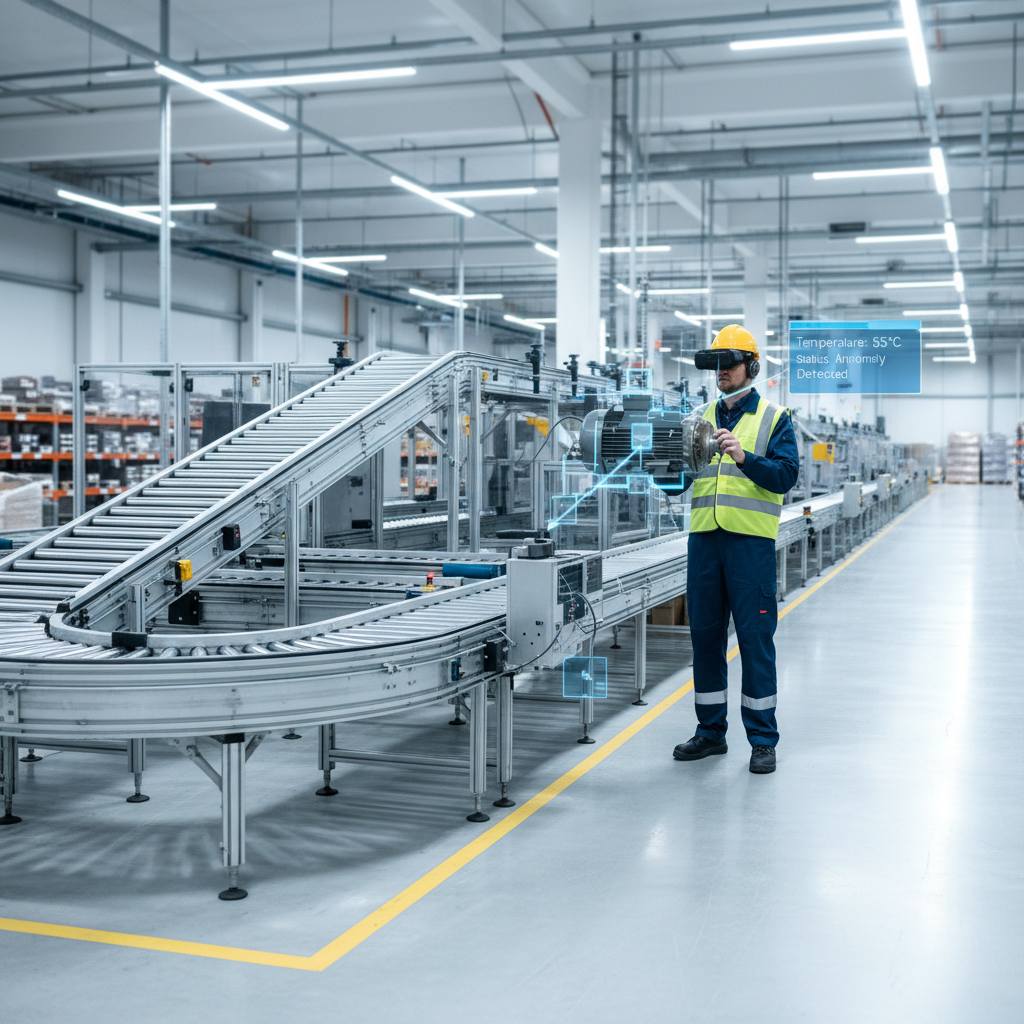
- Sensors: These are the eyes and ears of the system. Common types for conveyors include vibration sensors on motors and gearboxes, thermal imagers for detecting overheating in electrical panels and rollers, and acoustic sensors to identify unusual noises from bearings.
- Internet of Things (IoT) Connectivity: Sensors are connected to a network, allowing them to continuously stream data to a central platform. This data is often first processed at the edge (near the equipment) before being sent to the cloud for analysis.
- Data Analytics & AI/Machine Learning: This is the brain of the operation. Software platforms use machine learning algorithms to analyze the incoming data streams, identify patterns, and compare them against a baseline of normal operation. When deviations suggest an impending failure, the system generates an alert.
- Integration with Control Systems: For seamless operation, the PdM system must integrate with the warehouse's existing control architecture, including the PLC (Programmable Logic Controller) and Warehouse Control System (WCS).
Implementing a PdM Strategy for Your Conveyors
Shifting to predictive maintenance is a strategic project, not just an IT upgrade. It requires a clear, phased approach for success in a busy Benelux warehouse.
Step 1: Start with a Criticality Analysis
You cannot monitor everything. Analyze your entire conveyor network and identify the most critical sections. Which failures would cause the biggest bottlenecks? Focus your initial efforts on these high-impact areas, such as main sortation lines, inclines, or the motors driving a belt conveyor system.
Step 2: Select and Install Sensors
Based on the failure modes of your critical components, select the appropriate sensors. For motor-driven rollers (MDR), small vibration and temperature sensors are key. For long belt sections, infrared cameras can detect friction heat before a fire hazard develops. Begin with a pilot project on a single conveyor line to test and refine your sensor placement and data collection methods.
Step 3: Choose a Platform & Integrate
Select a software platform that can ingest and analyze the data. This could be a specialized PdM application or a module within a larger WES/WCS. Integration is crucial. The system should be able to create work orders automatically in your maintenance management software (CMMS) when a potential failure is detected.
Step 4: Establish a Baseline and Train the Model
Once data is flowing, you need to let the system learn what "normal" looks like. This typically takes several weeks of operation. The machine learning model will use this baseline to detect meaningful anomalies. It is a continuous process; as companies grow, their processes do not always keep pace, and the baseline of what is 'normal' can shift. You can find more information here: Companies are growing, but their processes aren't always keeping up.
The Business Case for Benelux Warehouses
For logistics operations in Belgium, the Netherlands, and Luxembourg, the argument for PdM is compelling. The region's high labor costs (averaging €40-€45 per hour in logistics) and intense competition mean that efficiency is paramount. A single day of downtime at a large e-commerce fulfillment center can easily result in losses exceeding €100,000 in delayed shipments and overtime costs. By investing in a system that turns unplanned stops into scheduled, off-peak maintenance, the ROI is clear and swift. For a more detailed understanding of conveyor types, our Ultimate Guide to Roller Conveyor Systems provides an in-depth look at the available technologies.
Partnering for Success with Easy Systems
Implementing a sophisticated predictive maintenance strategy requires more than just technology; it requires a deep understanding of conveyor systems and warehouse workflows. The real value is unlocked when sensor data is contextualized with operational knowledge. At Easy Systems, we design and build robust, modular conveyor solutions with modern maintenance needs in mind. Our systems are engineered for easy sensor integration and transparent data access. We partner with Benelux companies to create material handling solutions that are not only efficient from day one but are also optimized for a future of intelligent, predictive maintenance, ensuring maximum uptime and a lower total cost of ownership throughout the system's lifespan.
Frequently asked questions
How much does predictive maintenance for conveyors cost in the Benelux?+
An initial predictive maintenance program for a medium-sized conveyor system (approx. 200 meters) in the Benelux typically costs between €10,000 and €50,000. This includes sensors, software licenses, and integration. The cost varies based on system complexity and the number of monitored points.
What is the typical ROI of predictive maintenance for a warehouse?+
Most Benelux warehouses can expect a full return on investment (ROI) from a predictive maintenance system within 18 to 24 months. This is achieved through significant reductions in unplanned downtime (up to 50%), lower emergency repair costs, and optimized spare parts inventory.
Which sensors are best for monitoring conveyor systems?+
The most effective sensors for conveyors are vibration sensors for motors and gearboxes, thermal sensors for rollers and electrical panels, and acoustic sensors for bearings. For belt systems, laser or ultrasonic sensors can also monitor tension and tracking, preventing major failures.
How long does it take to deploy a predictive maintenance system?+
A pilot project on a critical conveyor line can be deployed in 2-4 weeks. A full-scale implementation across a large distribution center can take 3-6 months. The data collection and model training phase, which establishes a performance baseline, typically requires an additional 4-6 weeks of normal operation.
Can predictive maintenance be added to older conveyor systems?+
Yes, predictive maintenance is very suitable for retrofitting onto existing and older conveyor systems. Wireless sensors and standalone software platforms can be installed with minimal disruption to the existing hardware and control systems, often providing a cost-effective way to modernize and extend the life of valuable assets.

The Easy Systems engineering team designs, integrates and commissions conveyor systems and warehouse automation across Belgium, the Netherlands and Luxembourg. Combined experience covers roller and belt conveyors, sorters, AGV/AMR fleets, AutoStore, shuttle AS/RS and WMS/WCS integration for distribution centers and e-commerce fulfillment operations.
- Conveyor design (roller, belt, modular plastic)
- Sortation & merge logic
- AGV / AMR fleet integration
- AutoStore & shuttle AS/RS
- WMS / WCS integration