Predictive Maintenance for Conveyors: A Benelux Guide
Predictive maintenance uses IoT sensors and AI to forecast conveyor system failures before they happen, drastically cutting costly downtime. This guide details the process, benefits, and ROI for logistics hubs in the Benelux, helping you shift from reactive repairs to proactive optimization.

In the high-stakes logistics landscape of the Benelux, where every minute counts, unplanned conveyor downtime is more than an inconvenience—it's a critical financial drain. As warehouses and distribution centers operate at near-peak capacity, the focus is shifting from fixing breakdowns to preventing them entirely. Predictive Maintenance (PdM) is emerging as the definitive strategy for ensuring operational continuity, using smart technology to forecast issues before they bring your line to a halt.
Definition
Predictive Maintenance (PdM) is a proactive maintenance strategy that uses data analysis tools and techniques to detect anomalies in operation and possible defects in processes and equipment so that they can be fixed before they result in failure. For conveyor systems, this involves outfitting key components with sensors to monitor their real-time condition and predict their failure point.
Key Numbers: Predictive Maintenance for Conveyors
| Metric | Typical range (EU 2026) | Notes |
|---|---|---|
| Downtime Reduction | 25% - 40% | Compared to reactive or preventive maintenance schedules. |
| Maintenance Cost Savings | 20% - 30% | Achieved by reducing unnecessary checks and emergency repairs. |
| ROI Period | 12 - 24 months | Depends on system scale and cost of downtime. |
| Cost of Downtime | €10,000 - €25,000 / hour | For a large, automated Benelux e-commerce fulfillment center. |
| Cost per Sensor Point | €50 - €400 | Includes vibration, temperature, and acoustic sensors. |
| Improvement in OEE | 5% - 15% | Overall Equipment Effectiveness increase due to higher uptime. |
| Data Analysis Time | < 5 ms per asset | Real-time analysis performed by edge or cloud platforms. |
How Predictive Maintenance for Conveyors Works
Predictive maintenance isn't magic; it's a data-driven process that transforms your maintenance approach from a calendar-based schedule to a condition-based one. This is achieved through a continuous cycle of monitoring, analyzing, and acting.
Step 1: Data Collection with IoT Sensors
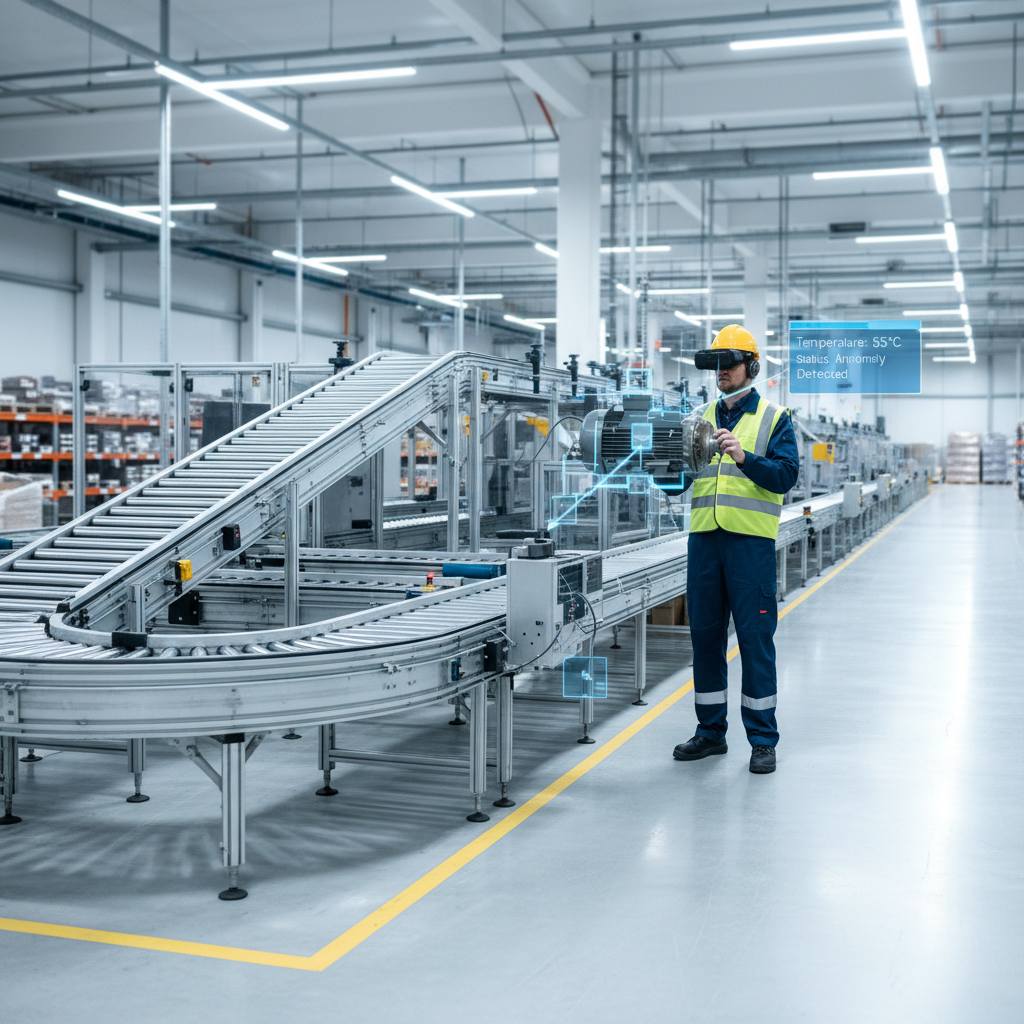
The foundation of any PdM strategy is data. Smart sensors are retrofitted onto critical components of the conveyor system to gather real-time performance metrics. Common sensor types include:
- Vibration Sensors: Attached to motors, gearboxes, and bearings to detect subtle changes in vibration patterns that indicate impending mechanical failure.
- Thermal Sensors: Monitor the temperature of motors and electrical panels. Overheating is a primary indicator of stress, overload, or failing components.
- Acoustic Sensors: Listen for changes in the sound profile of bearings and rollers. A high-frequency screech, for example, can precede a bearing seizure.
- Power Consumption Monitors: Track the energy usage of drive motors. A gradual increase in power draw can signal increased friction from a misaligned belt conveyor or worn-out parts.
Step 2: Data Transmission and Analysis
Raw data from sensors is continuously streamed to a central platform, which can be on-premise or in the cloud. This data is often aggregated by the local PLC (Programmable Logic Controller) or a dedicated gateway before being sent for analysis. It is here that the raw numbers are transformed into actionable insights. AI and machine learning algorithms analyze the incoming data streams, comparing them against established baseline performance models to identify deviations and anomalies that signal a developing fault.
Step 3: Alerts and Work Orders
When the AI model predicts a component is likely to fail within a specific timeframe, it automatically triggers an alert. This alert is far more advanced than a simple "check engine" light. It can specify the likely point of failure, the probable cause, and a recommended timeframe for intervention. This alert is sent to the maintenance team's dashboard or an integrated WCS (Warehouse Control System), which can then automatically generate a work order. Maintenance can be scheduled during planned downtime, parts can be ordered in advance, and the repair can be made with minimal disruption to operations.
Predictive vs. Preventive Maintenance: A Key Distinction
While often used interchangeably, predictive and preventive maintenance are fundamentally different. Preventive maintenance is time-based (e.g., "lubricate bearing every 500 hours"), while predictive maintenance is condition-based (e.g., "lubricate bearing when vibration analysis indicates lubricant degradation").
| Aspect | Preventive Maintenance (Time-Based) | Predictive Maintenance (Condition-Based) |
|---|---|---|
| Trigger | Fixed schedule (time or usage cycles) | Real-time asset condition data |
| Goal | Reduce failure probability | Prevent failure by predicting it |
| Cost Efficiency | Moderate; can lead to unnecessary maintenance and parts replacement. | High; maintenance is only performed when needed, maximizing component lifespan. |
| Downtime | Scheduled downtime for maintenance, but still vulnerable to unexpected failures. | Minimizes unplanned downtime; maintenance is scheduled for non-peak hours. |
| Typical Use Case | Replacing motor brushes every 2,000 operating hours. | Replacing motor brushes when sensor data shows a 15% drop in efficiency. |
Implementing a Predictive Maintenance Strategy in the Benelux
For logistics and e-commerce companies in the Netherlands, Belgium, and Luxembourg, implementing PdM requires a structured approach. The high cost of labor and the strategic importance of uptime make the business case compelling. As detailed in a recent analysis, companies grow, but their processes don't always grow with them; moving from a reactive to a predictive model is a critical maturation step. The journey begins with identifying the most critical and failure-prone sections of your conveyor network. This could be a high-speed sortation system or a crucial incline conveyor. Start with a pilot project on a single line to prove the concept and calculate a tangible ROI before scaling up. This is particularly relevant for systems involving complex components like those found in a roller conveyor guide.
Calculating the ROI for Your Benelux Operations
The return on investment for a PdM program is calculated by weighing the cost of implementation against the savings generated. The primary saving is the cost of avoided downtime. If an hour of downtime costs your facility €15,000 and the PdM system prevents just 10 hours of unplanned downtime per year, that's €150,000 in direct savings. Add to this the cost savings from reduced emergency repairs, optimized spare parts inventory, and more efficient use of maintenance staff. A typical investment in sensors and software for a 100-meter conveyor line might range from €20,000 to €50,000, leading to a payback period that is often less than two years.
The Future: Integrated Systems & Digital Twins
The evolution of PdM is heading towards the creation of "digital twins"—virtual replicas of your physical conveyor system. These models are fed real-time sensor data, allowing you to not only predict failures but also simulate the impact of different operational speeds, loads, and maintenance scenarios. This allows for continuous optimization of both performance and reliability, turning the maintenance department from a cost center into a strategic partner in operational excellence.
Partner with Easy Systems for Uptime and Reliability
Transitioning to predictive maintenance requires more than just technology; it requires a partner with deep expertise in both conveyor systems and data integration. At Easy Systems, we design and build robust, modular conveyor solutions that are ready for the future of maintenance. Our systems are engineered for reliability and easy integration of monitoring technologies. We work with our Benelux clients to identify critical failure points and develop maintenance strategies that maximize uptime and profitability. By choosing a partner who understands the mechanics and the data, you ensure your investment in predictive maintenance delivers the highest possible return and keeps your operations running smoothly around the clock.
Frequently asked questions
What is the primary benefit of predictive maintenance for conveyor systems?+
The primary benefit is a drastic reduction in unplanned downtime. By predicting when a component like a motor or bearing will fail, maintenance can be scheduled during non-operational hours, preventing costly line stoppages that can cost a Benelux warehouse over €15,000 per hour.
How much does it cost to implement predictive maintenance?+
The cost varies, but a pilot project on a critical 100-meter conveyor line can range from €20,000 to €50,000. This includes sensors, hardware, and software. The ROI is typically achieved within 12-24 months through downtime and repair cost savings.
Can predictive maintenance be added to an old conveyor system?+
Yes, retrofitting is a very common approach. IoT sensors for vibration, heat, and power consumption can be non-invasively attached to existing motors, gearboxes, and frames. This allows older, yet still functional, systems to benefit from modern maintenance strategies.
What kind of data is collected for conveyor predictive maintenance?+
Data collection focuses on the physical state of components. This includes vibration patterns from motors, temperature readings from electrical and mechanical parts, acoustic signatures from bearings, and the amperage draw of drive systems. This data provides a complete health profile of the conveyor.
How does predictive maintenance differ from preventive maintenance?+
Preventive maintenance is time-based (e.g., replace a belt every 12 months), often leading to wasted component life or unexpected failures. Predictive maintenance is condition-based, meaning action is only taken when data indicates a developing fault, optimizing both component lifespan and system uptime.

The Easy Systems engineering team designs, integrates and commissions conveyor systems and warehouse automation across Belgium, the Netherlands and Luxembourg. Combined experience covers roller and belt conveyors, sorters, AGV/AMR fleets, AutoStore, shuttle AS/RS and WMS/WCS integration for distribution centers and e-commerce fulfillment operations.
- Conveyor design (roller, belt, modular plastic)
- Sortation & merge logic
- AGV / AMR fleet integration
- AutoStore & shuttle AS/RS
- WMS / WCS integration