Integrating AGVs and Conveyor Systems for Seamless Material Flow
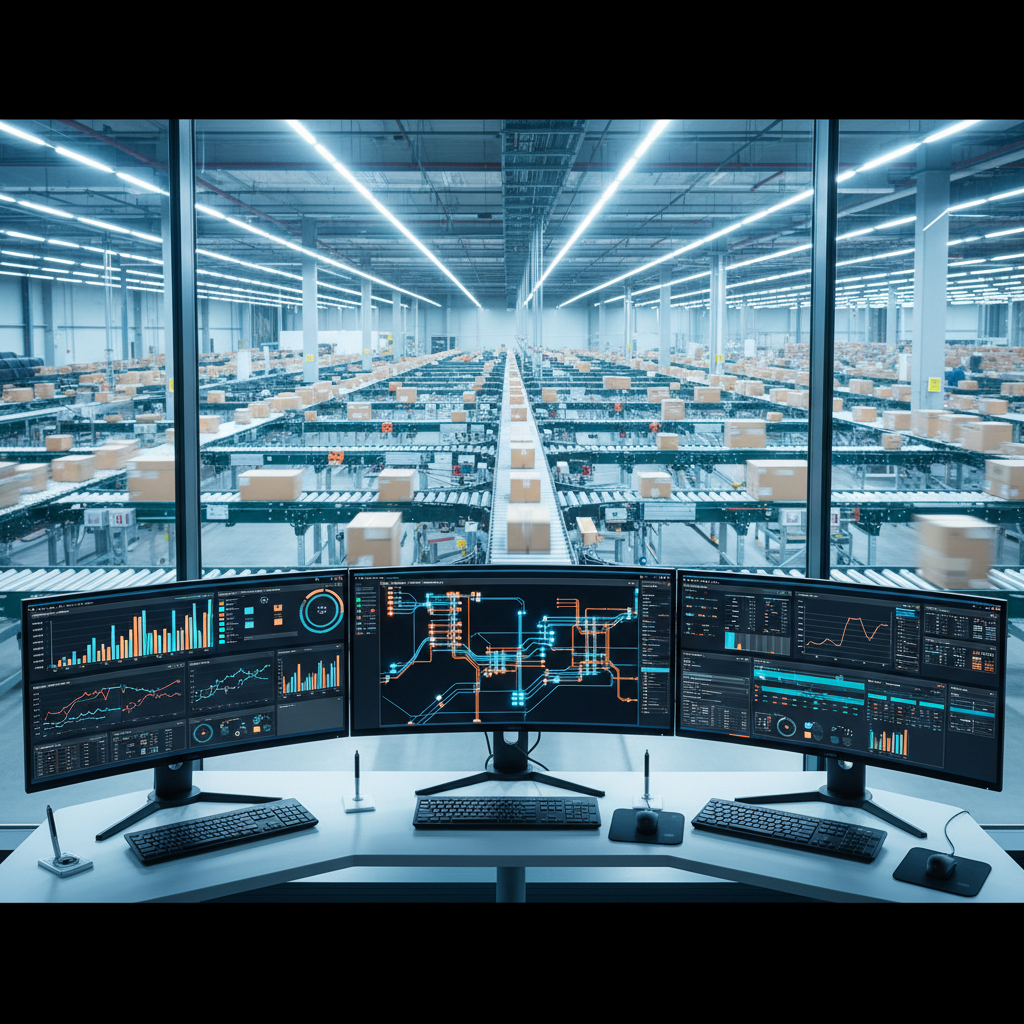
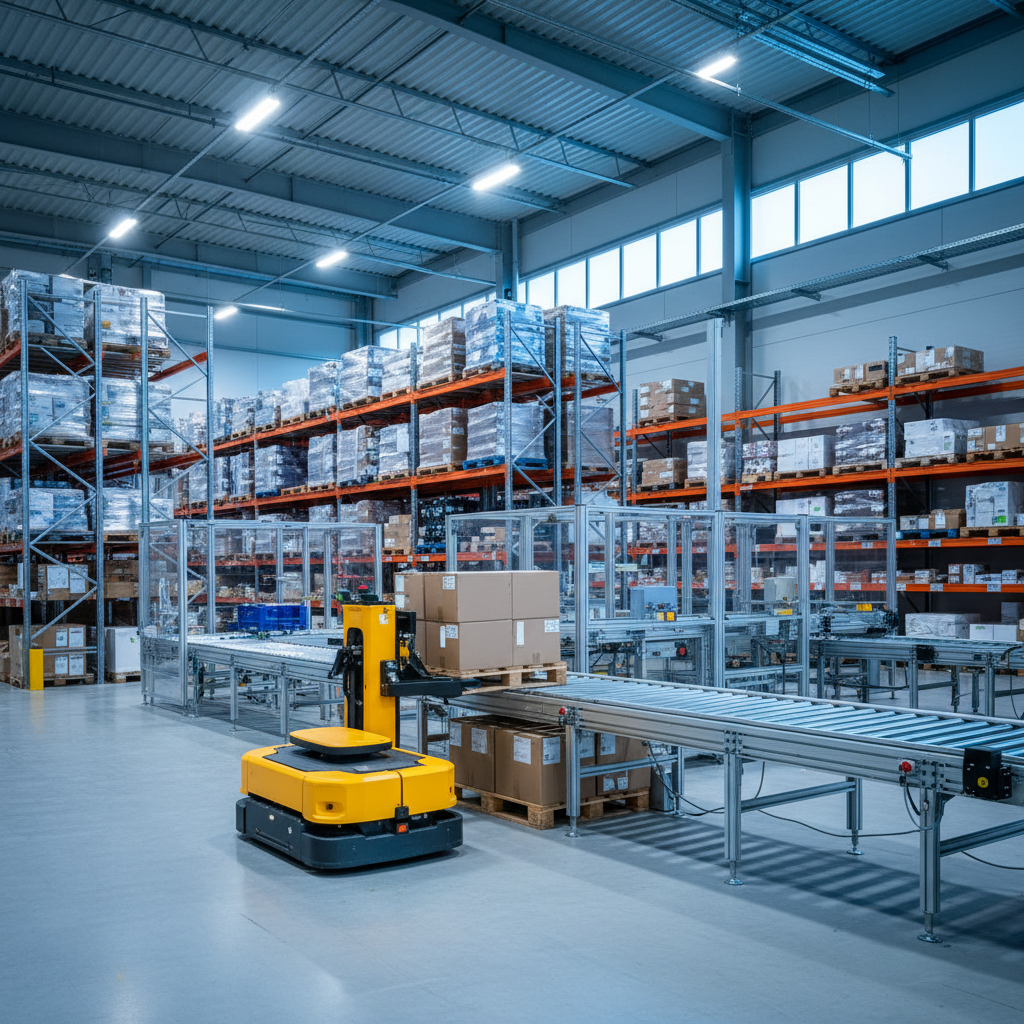
Integrating Automated Guided Vehicles (AGVs) with conveyor systems creates a hybrid automation solution that enhances flexibility and efficiency. This approach combines the high-throughput capacity of conveyors with the operational versatility of AGVs for a truly seamless material flow.
In the push for hyper-efficiency, warehouse managers face a critical choice: structured, high-speed conveyance or flexible, intelligent automation? The answer is increasingly "both." By integrating traditional conveyor systems with fleets of Automated Guided Vehicles (AGVs), European logistics centres are creating powerful, hybrid solutions that deliver a truly seamless and adaptable flow of materials.
Definition
AGV and conveyor integration is the orchestration of fixed conveyor systems and mobile AGVs to move goods within a warehouse. This synergy allows items to travel on high-speed conveyors for long, straight distances and then be picked up by AGVs for flexible delivery to dynamic locations like packing stations, dispatch zones, or storage areas not serviced by the conveyor network.
Why Integrate? The Best of Both Worlds
Standalone conveyor systems are the undisputed champions of high-volume, point-to-point transport. A typical belt conveyor can move goods at speeds up to 1.5 m/s, handling thousands of units per hour. Their weakness, however, is inflexibility. Once installed, their path is fixed. AGVs, conversely, offer complete routing freedom but typically have lower throughput and speed (around 1.0 m/s) and can create traffic bottlenecks if not managed properly.
Integration mitigates the weaknesses of each system:
- Enhanced Flexibility: AGVs bridge the "last mile" within the warehouse, connecting fixed conveyor lines to constantly changing drop-off points (e.g., dynamic packing stations for e-commerce).
- Increased Scalability: A warehouse can start with a core conveyor network and add AGVs incrementally as demand grows, avoiding massive upfront investment. Adding 5-10 AGVs to an existing system is far less disruptive than rerouting metres of steel conveyor.
- Improved Resilience: If an AGV requires maintenance, other units can automatically take over its tasks. This redundancy is much harder to achieve with a linear conveyor system.
- Space Optimisation: Conveyors can be elevated or routed through less-used areas, while AGVs operate on the floor, sharing pathways with personnel where necessary. This dual-use of space is a key advantage in costly European real estate markets.
The Integration Backbone: WMS, WES, and VDA 5050
True integration is more than just having AGVs and conveyors in the same building; it's about intelligent, centralised control. This is where the software stack becomes critical. For a detailed overview of these systems, our guide on WMS, WCS, and WES integration is a must-read.
The Role of the WES
While the Warehouse Management System (WMS) manages the overall inventory and order logic, the Warehouse Execution System (WES) acts as the on-the-ground traffic controller. The WES is the key to seamless integration, as it:
- Receives a transport order from the WMS (e.g., "Move tote box #T567 from conveyor exit A to packing station P4").
- Communicates with the conveyor's PLC to stop the tote at the designated handover point.
- Assigns the nearest available AGV to the pickup task.
- Manages the AGV's route, avoiding congestion with other vehicles.
- Confirms successful drop-off, updating the WMS in real-time.
European Standards: The VDA 5050 Advantage
A significant challenge in Europe has been the proprietary nature of AGV fleet managers. A company might be locked into one AGV vendor. The VDA 5050 communication interface is a game-changer. It standardises communication between a central master control (like a WES) and AGVs from different manufacturers. This allows operators to run a mixed fleet, choosing the best AGV for the job, without being constrained by vendor-specific software. This interoperability is crucial for future-proofing and cost control.
AGV vs. Conveyor: A Comparative Analysis
Choosing the right tool for the job is essential. Not all warehouse movements are created equal. The table below compares the two systems across key operational parameters.
| Parameter | Conveyor System (e.g., Roller Conveyor) | Automated Guided Vehicle (AGV) |
|---|---|---|
| Throughput (Units/Hour) | High (1,000 - 3,500+) | Low to Medium (30 - 100 per vehicle) |
| Typical Speed | 0.5 - 1.5 m/s | 0.8 - 1.2 m/s |
| Flexibility / Scalability | Low (Fixed path) | High (Software-defined paths, add units easily) |
| Cost per Metre | €400 - €1,500 (depending on type/width) | N/A (Cost is per vehicle: €25,000 - €70,000) |
| Best Use Case | Long-distance, high-volume transfer between fixed points. | Connecting multiple fixed points to multiple variable points. |
Practical Application: From Dock-to-Stock
Consider a typical inbound process. Pallets are unloaded and placed on a roller conveyor system. They travel efficiently to a central depalletising station. Here, operators break down the pallets into smaller cases or totes, which are then placed onto another conveyor. This conveyor transports the totes to a handover zone. Instead of building a complex and expensive sorter with miles of additional conveyor to reach every possible storage aisle, the system uses AGVs. The WES directs an AGV to pick up a specific tote and transport it to the precise aisle and level for put-away, potentially interfacing with an AS/RS or a manual shelving area.
As many businesses have experienced, processes that are not scalable can inhibit growth. An inflexible material handling system is a prime example. Integrating AGVs introduces a vital layer of adaptability, allowing the physical flow of goods to evolve alongside business needs. This type of dynamic infrastructure is discussed in-depth at our Dutch-language corporate blog, where we explore how processes must scale with company growth.
Handover Mechanisms: The Physical Interface
The physical handshake between the systems is a critical detail. Common methods include:
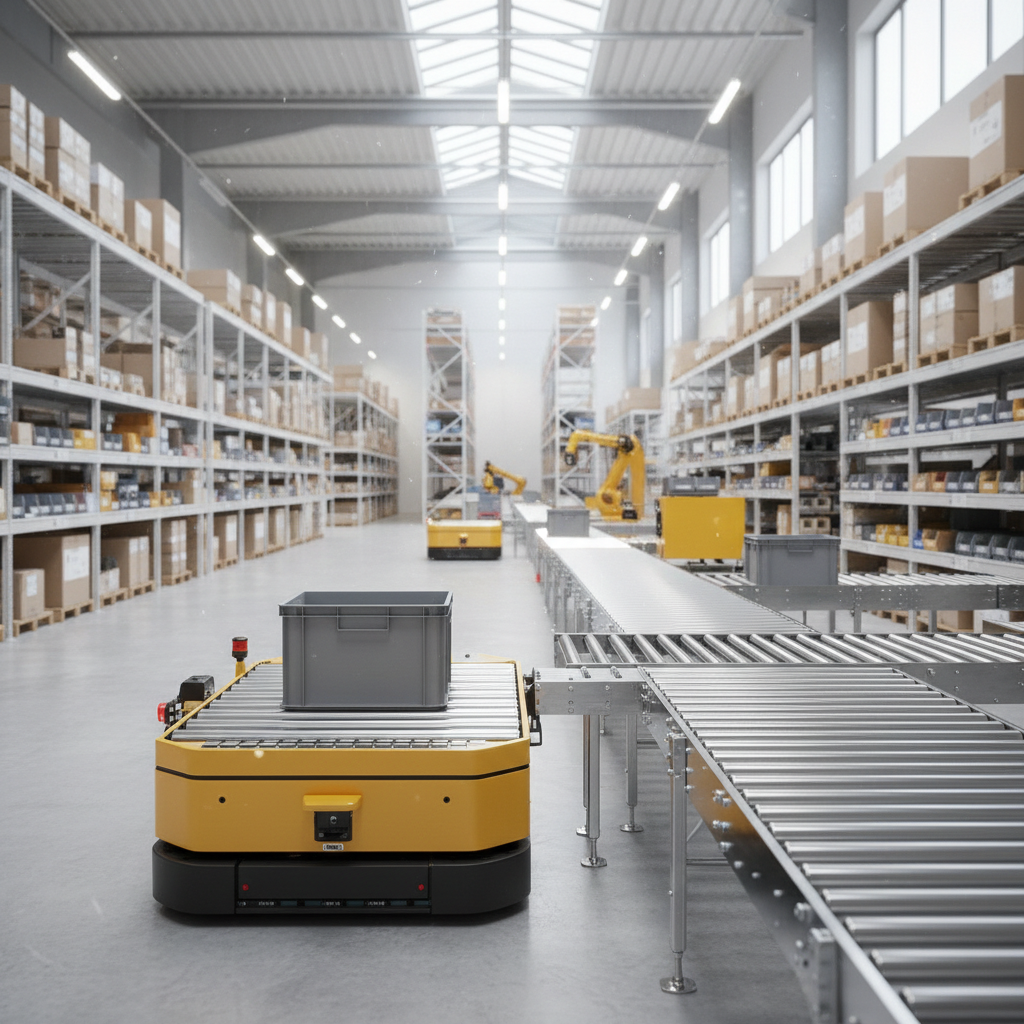
- Roller-Top AGVs: The AGV is equipped with a powered roller bed on its surface. It aligns perfectly with the end of a conveyor section, and the rollers on both systems activate to move the load smoothly from one to the next.
- Lift & Carry: The AGV drives underneath a stationary conveyor stand and lifts the item (tote, pallet) from above. This requires specialised conveyor sections (lift stations).
- Robotic Arm Interface: For more complex tasks, a small robotic arm can be stationed at the conveyor exit to pick items and place them onto a simple flat-top AGV. This is slower but extremely versatile.
Positioning Your Business for the Future with Easy Systems
Successfully integrating AGVs and conveyors is not just a technical challenge—it's a strategic one. It requires a deep understanding of your unique material flow, operational bottlenecks, and future growth ambitions. A poorly planned integration can create more problems than it solves, leading to underutilised assets and operational chaos.
At Easy Systems, we specialise in designing the connective tissue of modern warehouses. We don't just supply hardware; we analyse your entire process to design robust, modular roller conveyor systems that are primed for future automation. We design our systems with standard mechanical and electrical interfaces, ensuring they can communicate seamlessly with WES software and third-party robotics like AGVs. By building on a solid foundation of smart, modular conveyance, you create a platform for scalable automation, allowing you to integrate AGVs and other technologies when the time is right, without costly retrofits. Partner with us to build a material handling backbone that is efficient today and ready for the automated future of tomorrow.
Frequently asked questions
What is the main benefit of integrating AGVs and conveyors?+
The primary benefit is combining the high throughput and reliability of conveyors for fixed paths with the flexibility of AGVs for variable routes, creating a more dynamic and scalable system than either could achieve alone.
What software is needed for this integration?+
A Warehouse Execution System (WES) is typically required. It acts as the 'brain', coordinating tasks between the Warehouse Management System (WMS), the conveyor PLC/WCS, and the AGV fleet manager.
Can any AGV work with any conveyor?+
Not automatically. Integration requires compatible communication protocols (like OPC UA) and physical interfaces (e.g., roller-top AGVs for conveyor handoffs). Using a standard like VDA 5050 can simplify a multi-vendor AGV fleet's integration with the WES.
What is a typical cost for such an integration project?+
Costs vary widely, but a pilot project for a small fleet (3-5 AGVs) integrating with an existing conveyor line could range from €80,000 to €250,000, depending on software complexity, AGV type, and necessary conveyor modifications.