Conveyor Safety in the Benelux: A Manager's Guide to EN/ISO Standards
Navigate the complex landscape of conveyor safety regulations in the Benelux. This guide details crucial EN/ISO standards, risk assessment procedures, and technical requirements to ensure a safe, compliant, and efficient warehouse operation.
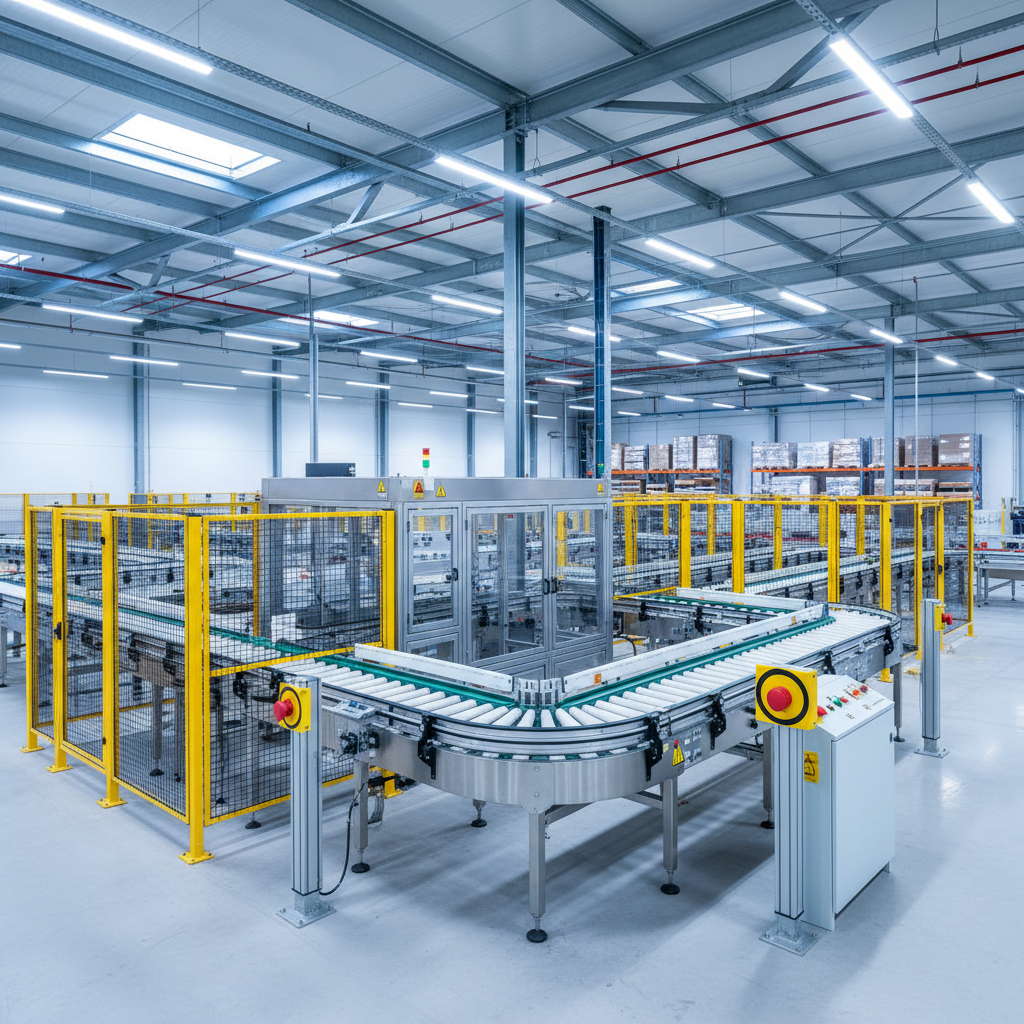
Key numbers
| Metric | Typical range (EU 2026) | Notes |
|---|---|---|
| Fines for severe non-compliance | €50,000 – €820,000 | Varies by country (BE, NL, LU) and incident severity. |
| Mandatory operator safety training | 4 - 8 hours per person | Initial training, with a 1-2 hour annual refresher required. |
| Risk assessment review frequency | 2 - 3 years | Or immediately after any system modification or incident. |
| Cost of third-party safety audit | €5,000 – €15,000 | For a standard 100-metre conveyor line. |
| Max. distance between E-stops | 20 - 30 metres | And at each operator station, per EN ISO 13850. |
| Min. clearance for overhead conveyors | 2.1 metres | Over pedestrian walkways and operator areas. |
| Permissible noise exposure limit | < 85 dB(A) | Measured over an 8-hour average at operator positions. |
In the high-speed logistics landscape of the Benelux, conveyor systems are the arteries of any modern warehouse or distribution center. However, with great efficiency comes great responsibility. For logistics and warehouse managers, understanding and implementing the correct safety standards is not just a matter of compliance—it's a fundamental duty of care. This guide provides a clear overview of the essential safety regulations and standards for conveyor systems in Belgium, the Netherlands, and Luxembourg.
Definition
Conveyor safety standards are a set of compulsory regulations and technical specifications, primarily governed by the European Machinery Directive 2006/42/EC and supported by harmonised standards (EN). These standards dictate the minimum requirements for the design, manufacturing, installation, and operation of conveyor systems to prevent accidents and ensure a safe working environment.
The Regulatory Framework in the Benelux
All machinery, including conveyor systems, placed on the market or put into service within the European Union, and by extension the Benelux, must comply with the Machinery Directive 2006/42/EC. This directive is legally binding and outlines the essential health and safety requirements (EHSRs) that equipment must meet. For managers in Belgium, the Netherlands, or Luxembourg, this means that any conveyor system—whether sourced locally or from abroad—must bear the CE mark, signifying its conformity with EU law.
The directive places the primary responsibility on the manufacturer to ensure compliance. However, the end-user—the warehouse or factory manager—is responsible for ensuring the system is used correctly, maintained properly, and that the workplace conditions surrounding the conveyor are safe. This shared responsibility is crucial for creating a holistic safety culture.
Core EN/ISO Standards for Conveyor Safety
To meet the EHSRs of the Machinery Directive, manufacturers and integrators rely on "harmonised standards." Compliance with these standards provides a "presumption of conformity" with the directive's requirements. For conveyor systems, the most critical standard is:
- EN 619:2002+A1:2010: Continuous handling equipment and systems - Safety and EMC requirements for equipment for mechanical handling of unit loads. This is the cornerstone standard for most logistics conveyor systems, including roller conveyors and belt conveyors. It specifies requirements to eliminate or minimise hazards such as crushing, shearing, and entanglement.
Underpinning all machinery safety is the process of risk assessment, governed by:
- ISO 12100:2010: Safety of machinery — General principles for design — Risk assessment and risk reduction. This standard provides the framework for identifying hazards, estimating and evaluating risks, and implementing protective measures. A proper risk assessment must be carried out before any conveyor system is designed or installed.
Practical Risk Assessment: A Manager's Duty
A risk assessment isn't a one-off checkbox exercise; it's a continuous process. As a manager, you must ensure this assessment is performed and documented. It typically involves:
- Hazard Identification: Pinpointing all potential sources of harm. This includes mechanical hazards (nip points, moving parts), electrical hazards, and ergonomic risks (e.g., manual handling heights).
- Risk Estimation: For each hazard, determining the potential severity of injury and the probability of its occurrence.
- Risk Evaluation: Deciding if the risk is acceptable or if risk reduction measures are necessary.
- Risk Reduction: Implementing protective measures. This follows a strict hierarchy: first, try to design the risk out completely. If that's not possible, implement safeguarding and, finally, provide personal protective equipment (PPE) and training.
For example, if a risk of entanglement is identified at a drive motor, the first choice is to place the motor outside the normal operator area (designing it out). If that's not feasible, a fixed physical guard must be installed.
Key Safety Features and Design Considerations
Based on the risk assessment, several technical solutions are mandated by EN standards. These are non-negotiable features for any modern conveyor system in a European warehouse.
Comparison of Common Safety Measures
| Safety Measure | Primary Function | Typical Application | Approximate Cost per unit/meter |
|---|---|---|---|
| Fixed Guarding | Provides a permanent physical barrier to prevent contact with moving parts (chains, belts, motors). | Around drive stations, tension units, and any accessible moving part along the conveyor line. | €80 - €250 per meter |
| Emergency Stop Buttons | Immediately halts conveyor movement in a danger zone when activated manually. | Placed at regular intervals (typically every 10-20 meters) and at all operator stations. | €150 - €400 per unit |
| Pull-cord Switches | Functions as a continuous emergency stop along the full length of the conveyor. | Long sections of belt conveyor or roller conveyor where an operator might not be near a button. | €30 - €60 per meter |
| Light Curtains / Photo-electric Sensors | Creates an invisible sensing field that stops the machine if breached. | Access points, palletizer/depalletizer areas, and robotic cell entries. | €900 - €3,000 per set |
Control System Safety
Modern conveyor systems are controlled by a PLC (Programmable Logic Controller). The safety circuits, such as emergency stops and light curtains, must be hardwired and integrated into the control system in a way that is failsafe. This means that in case of a component failure (like a broken wire), the system should default to a safe state (i.e., stop). These circuits must be independent of the standard operational logic of the PLC.
Operator Training and Maintenance: The Human Factor
A perfectly designed conveyor can still be dangerous if operated or maintained incorrectly. As a manager in the Benelux, you are obligated to provide:
- Thorough Training: Operators must be trained on the specific system they use, including safe operating procedures, the location and function of all safety devices, and lockout-tagout (LOTO) procedures for maintenance. Training must be documented and refreshed regularly.
- Clear Work Instructions: Instructions should be visible and easy to understand, potentially using graphics and multiple languages if necessary for your workforce.
- Scheduled Maintenance: A documented preventive maintenance plan is essential. Worn-out parts, misaligned sensors, or loose guards can create significant hazards. Maintenance staff must be specifically trained on how to safely de-energize and secure the system before starting work. Many businesses find that as they scale, their operational processes fail to keep pace with their growth. Investing in robust safety and maintenance protocols from the start is critical for sustainable expansion. More details on aligning processes with growth can be found in our analysis on how business processes must evolve with company growth.
For guidance on optimizing conveyor systems themselves, consider our in-depth guide on roller conveyor systems, which covers various aspects of their application and design.
The Cost of Non-Compliance
Ignoring these regulations can have severe consequences for a business operating in the Netherlands, Belgium, or Luxembourg. The costs aren't just financial; they are reputational and legal.
- Legal Penalties: Fines for non-compliance can reach tens of thousands of euros per incident. In cases of serious injury or fatality, managers and directors can face individual criminal prosecution.
- Operational Downtime: An accident can shut down a part of your operation for hours or days, leading to direct losses of €5,000 - €50,000+ per hour depending on the facility's throughput.
- Increased Insurance Premiums: A poor safety record will invariably lead to higher insurance costs.
- Reputational Damage: Accidents and regulatory fines damage your company's reputation with clients, employees, and the public.
Easy Systems: Your Trusted Partner for Compliant Conveyor Solutions
Navigating the complexities of European safety standards requires expertise and diligence. At Easy Systems, we don’t just sell conveyors; we deliver fully compliant, safe, and efficient material handling solutions. Our engineering process is built on the foundation of the ISO 12100 risk assessment framework. Every system we design and install in the Benelux and across Europe strictly adheres to EN 619 and other relevant standards. We provide comprehensive documentation, CE certification, and on-site training to ensure your team can operate the system safely and efficiently. By partnering with us, you are not just investing in hardware; you are investing in peace of mind and a guaranteed safe, compliant, and productive automated environment.
Frequently asked questions
What is the most important safety standard for unit load conveyors in the Benelux?+
The most critical standard is EN 619:2002+A1:2010. It specifies the essential safety and EMC requirements for most logistics conveyors in Belgium, the Netherlands, and Luxembourg. Adherence provides a presumption of conformity with the EU Machinery Directive, detailing over 100 safety points, from guard design to electrical safety.
Who is legally responsible for conveyor safety in a warehouse?+
Responsibility is shared. The manufacturer must deliver a CE-marked system. However, the warehouse manager (end-user) is legally responsible for its safe use, maintenance, and operator training. This duty is non-transferable and, in case of a serious incident, can result in personal fines potentially exceeding €50,000.
How often should a risk assessment be reviewed?+
A risk assessment under ISO 12100 must be a living document, not a one-off task. It must be formally reviewed at least every 2-3 years, and immediately following any significant modification, near-miss, or accident. Proper documentation of these reviews is a legal requirement to demonstrate ongoing due diligence.
What are the requirements for emergency stop buttons?+
Per EN ISO 13850, emergency stop (E-stop) buttons must be placed at all operator control stations and along the conveyor at intervals of no more than 30 metres. They must be clearly identifiable (red button, yellow background), constantly accessible, and execute a safe stop, which may involve cutting power or a controlled ramp-down.
What is the minimum safe height for an overhead conveyor?+
To prevent head injuries and ensure safe passage, standards like EN 619 mandate minimum clearance heights. For any section of a conveyor system that passes over a pedestrian walkway or a regular operator workspace, a clearance of at least 2.1 metres must be maintained from the floor to the lowest point of the conveyor.

The Easy Systems engineering team designs, integrates and commissions conveyor systems and warehouse automation across Belgium, the Netherlands and Luxembourg. Combined experience covers roller and belt conveyors, sorters, AGV/AMR fleets, AutoStore, shuttle AS/RS and WMS/WCS integration for distribution centers and e-commerce fulfillment operations.
- Conveyor design (roller, belt, modular plastic)
- Sortation & merge logic
- AGV / AMR fleet integration
- AutoStore & shuttle AS/RS
- WMS / WCS integration