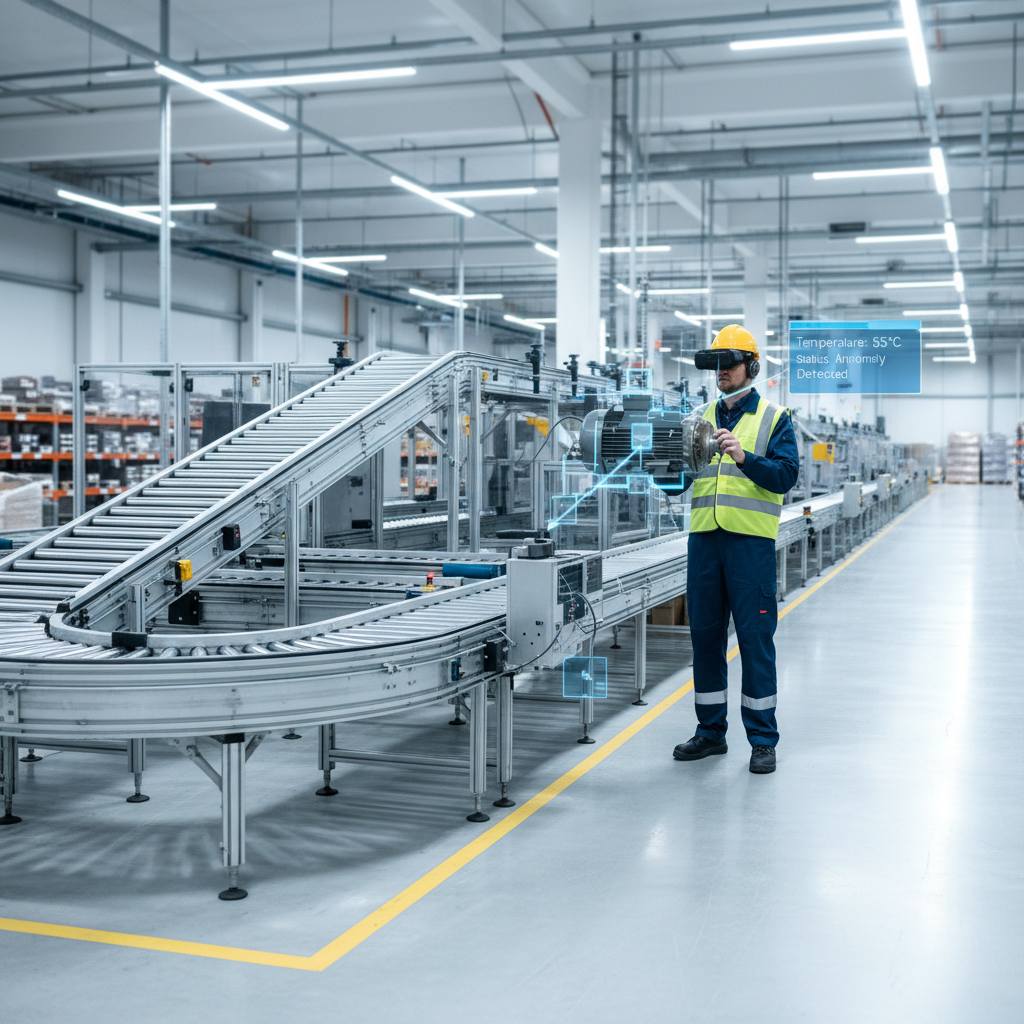
AI in Predictive Conveyor Maintenance: A Benelux Guide
This guide explores the role of AI in predictive maintenance for conveyor systems, specifically within the Benelux. Discover how to reduce downtime by up to 50% and lower maintenance costs by leveraging data and machine learning.

In the high-stakes logistics landscape of the Benelux, where every second of uptime counts, conveyor systems are the arteries of the warehouse. A single hour of unexpected downtime can cost thousands of euros in lost productivity and delayed shipments. This guide provides a practical overview of how Artificial Intelligence (AI) is transforming conveyor maintenance from a costly, reactive process into a smart, predictive, and cost-effective strategy.
Definition
AI-powered predictive maintenance (PdM) for conveyor systems is the practice of using data analysis and machine learning algorithms to detect potential equipment failures before they occur. Unlike traditional preventive maintenance, which operates on fixed schedules, PdM triggers maintenance activities based on the actual condition of the assets, such as a belt conveyor or roller conveyor, maximizing their lifespan and minimizing disruption.
Key Numbers
| Metric | Typical range (EU 2026) | Notes |
|---|---|---|
| Initial Investment | €25,000 - €75,000 | For a medium-sized (5,000 m²) warehouse in the Benelux. |
| ROI | 1.5 - 3 years | Driven by reduced downtime and lower reactive maintenance costs. |
| Downtime Reduction | 30% - 50% | Compared to reactive or purely preventive schedules. |
| Maintenance Cost Reduction | 20% - 40% | By eliminating unnecessary checks and reducing emergency repairs. |
| Energy Savings | 5% - 10% | From optimally running motors and drives, e.g. 500-1,000 kWh/year per drive. |
| Failure Prediction Accuracy | >85% | For common mechanical and electrical conveyor component failures. |
How AI-Powered Predictive Maintenance Works
The process transitions maintenance from a "fail and fix" or "inspect and replace" model to a "predict and prevent" paradigm. This is achieved through a continuous cycle of data collection, analysis, and action.
Step 1: Data Collection (The Foundation)
Effective AI models are built on high-quality, continuous data. For a conveyor system, this data comes from various sources:
- Vibration Sensors: Attached to motors, gearboxes, and bearings to detect subtle changes in vibration patterns that indicate impending wear or imbalance.
- Thermal Sensors: Monitor the temperature of critical components. Overheating is a classic early sign of friction, overload, or electrical issues.
- Acoustic Sensors: Listen for changes in operational noise, such as the specific frequencies of a worn bearing or a slipping belt.
- Power Consumption Data: Analyzes the energy drawn by conveyor motors. A gradual increase in power usage can signal increased friction or mechanical strain.
- System Data: Information from the PLC (Programmable Logic Controller) or WCS (Warehouse Control System), such as motor error codes, load volumes, and operating hours.
Step 2: AI Model Analysis (The Brain)
The collected data is streamed to a cloud or on-premise platform where machine learning models analyze it in real-time. These algorithms are trained to understand the "healthy" operational baseline of your specific conveyor system. They then look for anomalies and patterns that deviate from this norm, correlating different data streams to identify a credible failure signature.
Step 3: Alerting and Action
When the AI model predicts a potential failure with a high degree of confidence, it doesn’t just raise a generic alarm. It provides a specific, actionable insight. For example: "Vibration amplitude in Motor 7B has increased by 15% and temperature is up by 8°C. High probability of bearing failure within the next 72 hours." This allows maintenance teams to schedule a repair during a planned quiet period, ordering the exact part needed in advance.
Predictive vs. Preventive vs. Reactive Maintenance
Understanding the differences is key to appreciating the value of AI. Each strategy has its place, but their impact on operational efficiency and cost varies dramatically.
| Maintenance Strategy | Trigger | Cost Profile | Pros | Cons |
|---|---|---|---|---|
| Reactive | Equipment Failure | Very High (per incident) | No upfront cost | Maximum downtime, collateral damage, safety risks, high stress. |
| Preventive | Fixed Schedule (time/usage) | Medium | Reduces failures compared to reactive; more predictable. | Can lead to over-maintenance; parts replaced prematurely; doesn't prevent all failures. |
| Predictive (AI) | Data-driven Condition Alert | Low (operational) | Minimizes downtime; maximizes component life; lowers overall maintenance cost. | Requires initial investment in technology and setup. |
The Business Case: ROI in the Benelux Context
For a typical distribution center in cities like Venlo, Antwerp, or Tilburg, conveyor uptime is paramount. Let's calculate a simplified ROI:
Assume a medium-sized facility where one hour of conveyor downtime costs €10,000 in lost throughput and labor. If the facility experiences just 10 hours of unplanned downtime per year, the total cost is €100,000. An AI PdM system, with an initial cost of €50,000, that reduces this downtime by 50% saves €50,000 in the first year alone. This calculation doesn't even include the savings from a 20-40% reduction in maintenance labor and spare parts costs. As companies grow, their processes must scale efficiently to handle increased demand without a proportional increase in downtime risk, a challenge many struggle with. More complex systems, like those detailed in our Roller Conveyor Guide, benefit even more from this proactive approach.
Many businesses find that as they expand, their operational processes fail to keep pace, leading to bottlenecks and inefficiencies. Predictive maintenance is a key strategy to ensure that material handling systems can support this growth reliably. For more on this, read about how companies can ensure their processes grow with them.
Implementation Challenges
While the benefits are clear, implementation requires careful planning:
- Data Quality & Integration: The success hinges on clean data. Integrating sensors with older legacy systems can be a hurdle, often requiring middleware.
- Initial Cost: The investment in sensors, software, and integration can be a barrier for smaller operations, although modular, scalable solutions are becoming more accessible.
- Skills Gap: Your team needs to be trained to trust and act on the data-driven insights provided by the AI, shifting from a mechanical to a more analytical mindset.
Easy Systems: Your Partner for Intelligent Conveyor Maintenance
At Easy Systems, we don't just build state-of-the-art conveyor systems; we engineer reliability and intelligence into them from day one. Based in the heart of Europe, we understand the operational pressures faced by logistics companies in the Benelux and beyond. Our modular conveyor solutions are designed with "smart" in mind, ready for integration with modern sensor technology and AI-driven maintenance platforms. We provide the robust and reliable foundation upon which you can build a truly predictive and resilient operation. By partnering with us, you gain more than a supplier; you gain a collaborator dedicated to future-proofing your warehouse and maximizing your ROI through intelligent automation.
Frequently asked questions
How much does an AI predictive maintenance system for a conveyor cost?+
For a medium-sized Benelux warehouse, the initial investment for sensors, software, and integration typically ranges from €25,000 to €75,000. The final cost depends on the complexity and length of the conveyor system being monitored.
How much downtime can AI really prevent in a warehouse?+
AI-powered predictive maintenance can reduce unplanned conveyor downtime by 30% to 50%. For a facility that previously had 20 hours of downtime per year, this translates to 6-10 hours of additional operational time, often saving over €100,000 annually.
What data is needed for AI predictive maintenance on conveyors?+
The most critical data includes real-time vibration analysis, temperature readings from motors and bearings, acoustic data for noise anomalies, and power consumption metrics. This sensor data is often combined with operational data from the WCS, like throughput and error logs.
What is the typical ROI of predictive maintenance for conveyor systems?+
In the European logistics market, the return on investment (ROI) for an AI predictive maintenance system is typically between 1.5 and 3 years. This is achieved through significant savings in downtime costs, reduced emergency repairs, and optimized spare parts inventory.
Can AI predict all types of conveyor failures?+
No system is foolproof, but modern AI models can accurately predict over 85% of common mechanical and electrical failures, such as bearing wear, motor faults, belt misalignment, and gearbox issues. It is less effective for sudden, accidental damage.
How difficult is it to integrate AI with an existing PLC or WCS?+
Integration complexity varies. For modern systems with APIs or support for protocols like OPC UA, it can be straightforward, taking 2-4 weeks. For older, proprietary systems, it may require custom middleware, which adds time and cost to the project.

The Easy Systems editorial desk reviews and fact-checks every Conveyor-Design article against Benelux project experience. Editors translate engineering decisions — throughput, peak factors, layout, integration — into plain-language guides for operations managers, project leads and decision-makers.
- Warehouse layout & slotting
- Order-profile analysis
- Vendor-neutral comparison
- Benelux logistics market