Optimize Conveyor Performance with Low-Code/No-Code
Low-code/no-code platforms are revolutionizing warehouse automation by enabling managers in the Benelux to directly modify conveyor logic. This leads to faster adaptation, reduced downtime, and significant cost savings over traditional WCS modifications.
In the fast-paced logistics landscape of the Benelux, where every second and every square meter counts, the rigidity of traditional conveyor systems presents a significant operational bottleneck. Warehouse managers are often at the mercy of external software vendors or strained internal IT departments to make even minor adjustments to conveyor logic. However, a new paradigm is emerging: low-code and no-code development platforms. These tools are democratizing conveyor control, empowering on-site managers to optimize performance with unprecedented speed and autonomy.
Definition
Low-Code/No-Code Conveyor Control refers to a software environment that allows users to modify, configure, and manage the operational logic of conveyor systems using a graphical user interface with drag-and-drop components and pre-built modules, either minimizing or entirely eliminating the need for traditional, hand-written programming code.
The Challenge: Traditional Conveyor Control in the Benelux
A typical medium-sized distribution centre in the vicinity of Antwerp or Rotterdam might handle thousands of parcels per hour. Its conveyor system—a complex network of belts, rollers, sorters, and scanners—is governed by a Warehouse Control System (WCS). Traditionally, the logic of this WCS is "hard-coded".
Want to change a sorting destination for a new carrier? Need to adjust the speed of a specific segment to accommodate fragile goods? This requires a formal change request to the WCS provider. The process typically involves:
- Submitting a detailed specification.
- Waiting for a quote, which can range from €5,000 to €50,000 for complex changes.
- Scheduling the development work, often with lead times of 4-10 weeks.
- Planning downtime for implementation and testing, usually during off-peak hours.
This rigid model is ill-suited for the modern demands of e-commerce fulfillment, which requires constant adaptation to shifting delivery promises, seasonal peaks, and new product introductions. The dependency on external specialists, who often charge between €100 and €180 per hour, creates a significant barrier to operational agility.
A Paradigm Shift: Low-Code & No-Code for Conveyor Agility
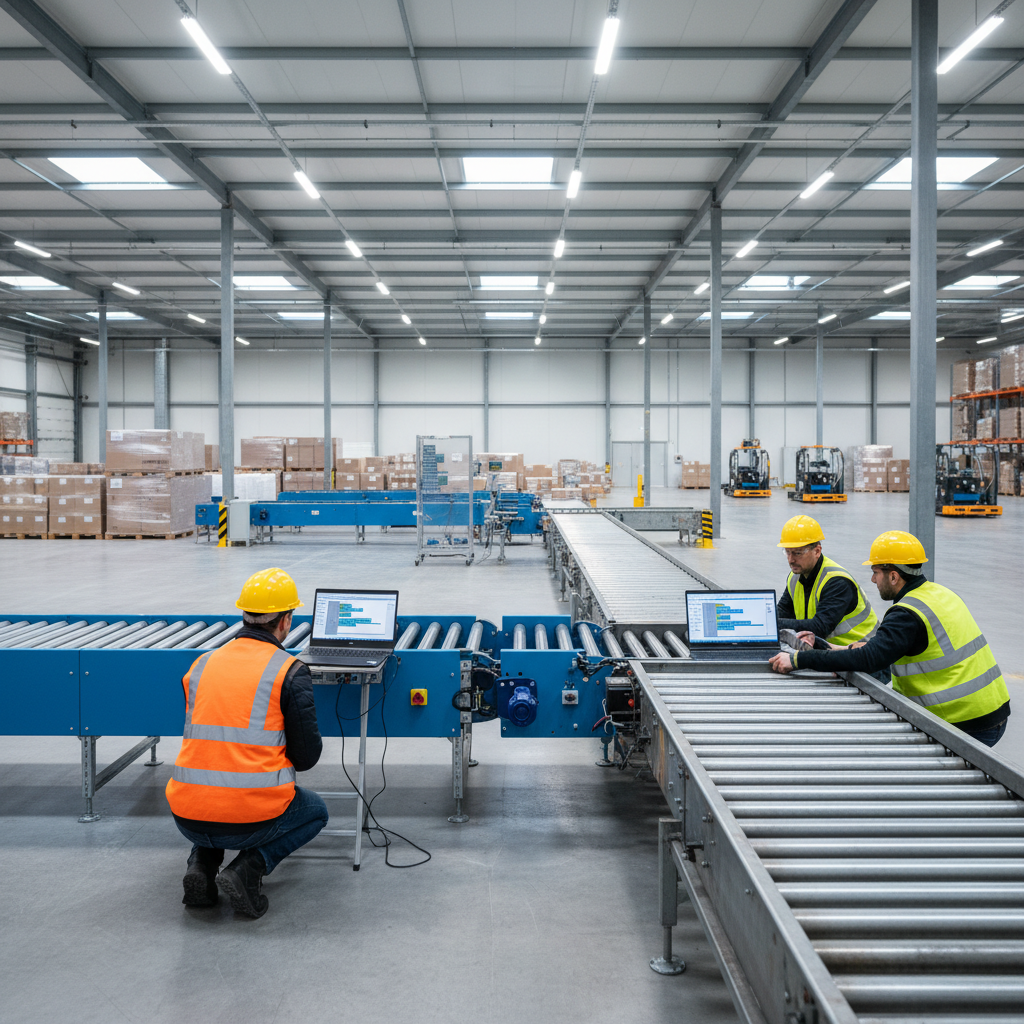
Low-code/no-code platforms function as an accessible abstraction layer between the high-level Warehouse Management System (WMS) and the low-level Programmable Logic Controllers (PLCs) that directly operate the conveyor hardware. Instead of writing complex code, the warehouse manager or an internal process engineer uses a visual interface to literally draw the desired logic.
Imagine needing to divert all packages for a specific postal code from sorter exit 5 to exit 12. With a low-code platform, this could be as simple as dragging a line on a screen, selecting the condition (postal code range), and deploying the change with a single click. The platform translates this visual instruction into the necessary commands for the WCS and PLCs. What previously took weeks of back-and-forth with a developer can now be executed in under an hour by the people who actually run the warehouse.
Low-Code vs. No-Code: Choosing the Right Platform
While often grouped together, "low-code" and "no-code" represent two distinct approaches to simplified development. The choice between them depends on your team's technical proficiency and the complexity of your operational needs.
When to Choose Low-Code
Low-code platforms are ideal for environments where you need a high degree of customization but want to accelerate the development process. They provide the graphical interface for 80-90% of the work but allow a process engineer or "power user" with basic scripting knowledge (e.g., Python or a proprietary scripting language) to write custom code for unique rules, API integrations, or complex decision-making logic. This is perfect for facilities with unique sorting requirements or those needing to integrate with bespoke legacy systems.
When to Choose No-Code
No-code platforms are purely visual and require zero programming. They are the ultimate tool for democratization, allowing any authorized user—from shift leaders to operations managers—to make changes. These platforms excel at standard tasks: re-routing flows, changing sorting parameters based on predefined triggers (like barcode data or weight), and adjusting conveyor speeds. They are best suited for standard distribution operations where the primary goal is empowering on-site staff to manage daily variations without any IT involvement.
| Feature | Low-Code Platform | No-Code Platform |
|---|---|---|
| Target User | Process Engineer, IT-savvy Operations Manager | Operations Manager, Shift Leader, non-technical staff |
| Flexibility | High (custom code allows for complex logic) | Medium (limited to pre-built blocks and configurations) |
| Speed of Change | Very Fast (hours to a day for complex changes) | Instant (minutes for standard changes) |
| Required Skillset | Basic scripting/process logic understanding | Operational knowledge, no technical skills required |
| Typical Cost Model | Higher initial license fee + per-user fee | Lower initial license fee, often tiered by usage/features |
| Use Case Example | Implementing a custom weighing-and-dimming logic that integrates with a carrier's API. | Changing the destination sorter for parcels from carrier A to carrier B. |
Tangible Benefits for Benelux Distribution Centres
The adoption of these platforms in warehouses across the Netherlands, Belgium, and Luxembourg yields concrete, measurable results:
- Drastic Cost Reduction: Avoids high development costs from external vendors. A single major sorting change that might cost €20,000 can be handled internally, saving the entire amount.
- Increased Uptime & Agility: Changes are implemented with zero to minimal downtime. A warehouse can adapt to a new marketing promotion or a sudden change in carrier capacity on the same day, maintaining optimal throughput of, for example, 6,000 units/hour without interruption.
- Empowerment of Staff: It places control in the hands of the people who understand the operational reality best. This reduces frustration, improves morale, and fosters a culture of continuous improvement.
- Reduced Risk: Changes can be tested in a sandboxed environment within the platform before being deployed. This minimizes the risk of errors that could halt the entire line, a disaster in a high-volume facility.
Integrating with Your Existing Conveyor System
A key advantage of modern low-code platforms is that they don't require a complete overhaul of your existing infrastructure. They are designed to integrate. For many businesses in the automation space, the path to modernization is a key concern. As a provider of modular and scalable conveyor solutions, we understand the importance of future-proofing. Many of our clients are looking for ways to enhance their existing systems without a complete rip-and-replace. That's why a partnership with a company that understands both the hardware and the software agility is crucial. You can explore a range of flexible and intelligent conveyor solutions on our corporate page: Easy Systems Benelux. The integration process is a bridge between your established hardware and new, agile software control.
The Future: AI and Predictive Maintenance
The next evolution is already here: AI-powered low-code platforms. These systems can analyse historical data on throughput, jams, and parcel characteristics to suggest optimal routing and speed configurations. For instance, an AI module could notice that parcels over 5 kg from a specific supplier have a higher tendency to jam at a 90-degree turn when the belt is running at 1.5 m/s. It could then automatically suggest reducing the speed to 1.2 m/s for that specific segment whenever such a parcel is detected upstream, preventing the jam before it happens. This moves from reactive control to predictive and prescriptive optimization, a true game-changer for warehouse efficiency.
Easy Systems: Your Trusted Partner for Agile Conveyor Automation
In a market as competitive as the Benelux, agility is not a luxury; it is a core component of survival and growth. The era of rigid, monolithic control systems is ending. Low-code and no-code platforms are the key to unlocking the full potential of your conveyor hardware, enabling you to adapt to market changes in real-time. Easy Systems, part of the BOA Concept group, is at the forefront of this evolution. We don't just supply state-of-the-art modular conveyor systems; we provide intelligent, software-driven solutions that are inherently flexible. Our systems are designed to integrate seamlessly with these modern control platforms, giving you the power to configure, adapt, and optimize your material flow yourself. By partnering with us, you invest in a conveyor system that is not only efficient today but also ready for the challenges and opportunities of tomorrow.
This article is part of the Conveyor-Design knowledge hub, edited by Easy Systems engineers who design conveyor and warehouse automation systems across the Benelux every week.
Frequently asked questions
What is the main difference between low-code and no-code for conveyor systems?+
Low-code platforms simplify development with visual tools but still require some basic scripting for complex logic. No-code platforms are entirely drag-and-drop, allowing non-technical staff to make changes, but are less flexible for highly customized rules.
Can a low-code platform replace our existing WMS or WCS?+
No, it's not a replacement. Low-code/no-code platforms act as a complementary layer of control that integrates with your existing WMS/WCS. They provide an accessible interface to manage the physical conveyor logic without altering the core system architecture.
What is a realistic ROI for implementing a low-code solution in a medium-sized Benelux warehouse?+
A realistic ROI can be achieved within 12-18 months. This is driven by reduced external developer costs (saving €80-€150 per hour), minimized downtime during reconfigurations, and faster adaptation to new products or workflows, which directly increases throughput.