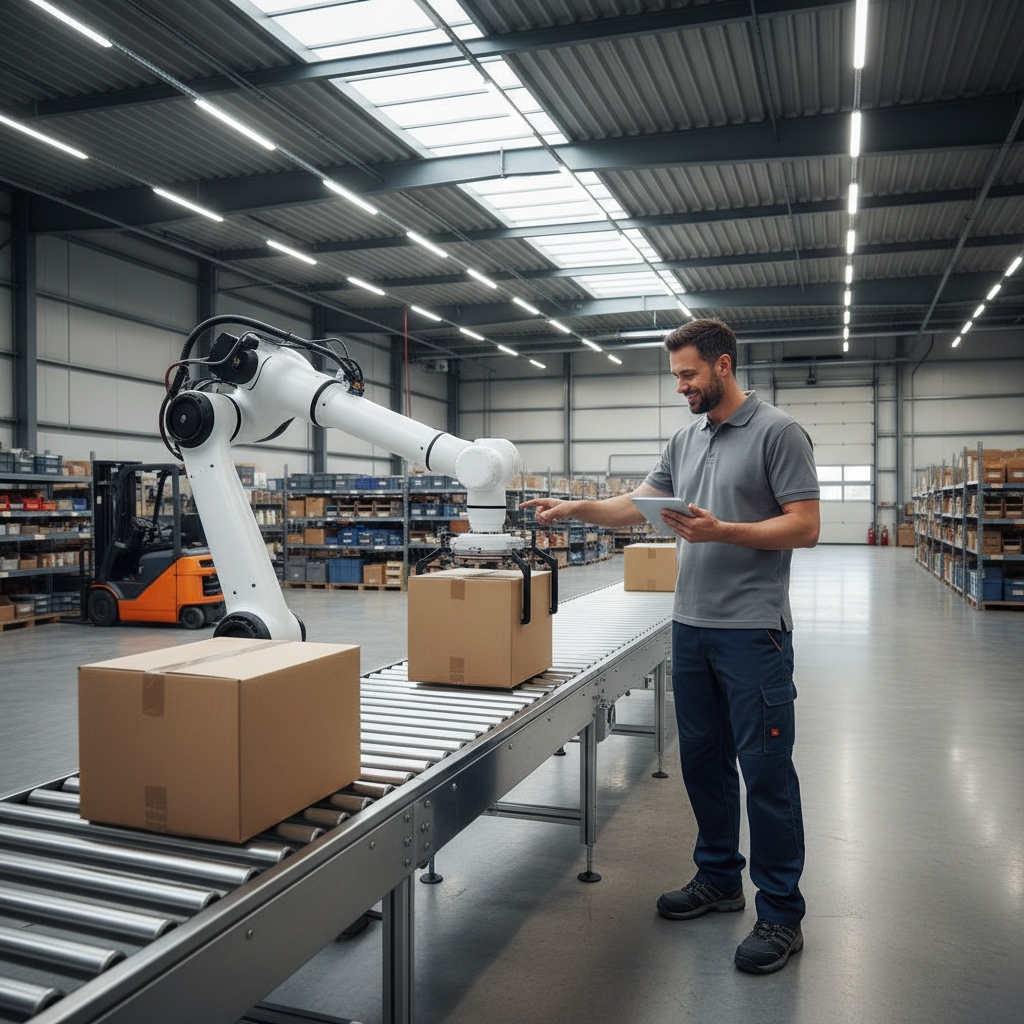
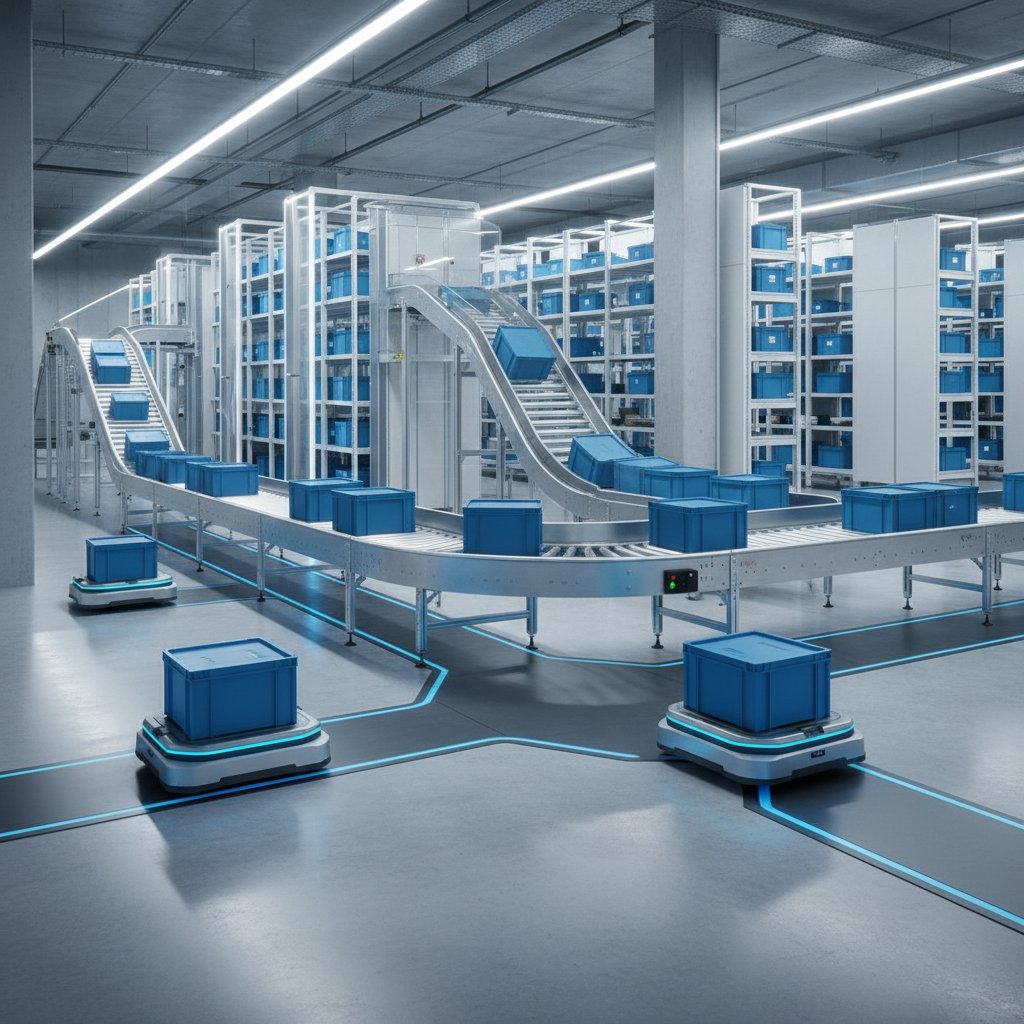
Human-Robot Collaboration in Conveyor Picking for Benelux Warehouses
Facing labor shortages and high costs? Human-Robot Collaboration (HRC) in conveyor-based picking offers a pragmatic solution for Benelux warehouses, increasing productivity by up to 300% while improving ergonomics.
Warehouses across the Benelux are at a critical juncture. Squeezed between the unrelenting pressure of e-commerce growth, a systemic shortage of skilled labour, and some of the highest labour costs in Europe, the traditional "person-to-goods" picking model is no longer sustainable. While full automation appears to be the logical conclusion, its high capital cost and rigidity present significant barriers. This is where Human-Robot Collaboration (HRC) emerges as a pragmatic and powerful paradigm shift, using conveyor systems as the crucial bridge between human and machine.
Definition
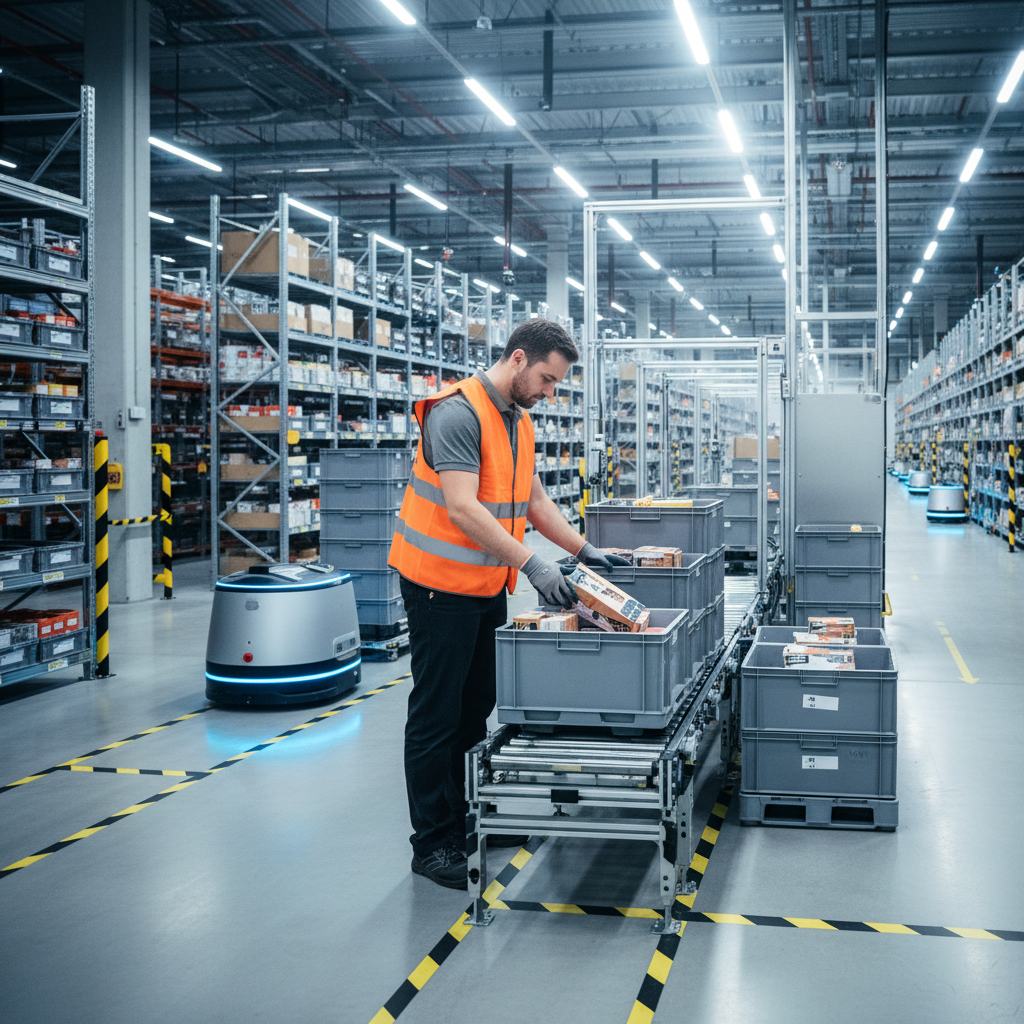
In the context of warehouse logistics, Human-Robot Collaboration (HRC) is a goods-to-person workflow where autonomous mobile robots (AMRs) and humans work in tandem at a shared workspace. Robots perform the strenuous and time-consuming task of travelling and transporting goods, while humans execute the complex, high-value tasks of final picking, quality control, and packing.
The Core Challenge: Inertia in Traditional Benelux Warehouses
The classic person-to-goods picking method, where an operator walks up and down aisles with a cart, is fundamentally inefficient. Industry studies consistently show that up to 60% of a picker's time is spent walking, not picking. In the Benelux—a region with hourly logistics labour costs frequently exceeding €35—this means a majority of expenditure is on non-productive movement.
This operational drag is compounded by several factors specific to the European context:
- Labour Scarcity: The logistics sector in Belgium, the Netherlands, and Luxembourg faces a chronic shortage of workers.
- Ergonomic Toll: Walking 10-15 km per shift and repeatedly lifting items leads to physical strain, higher rates of absenteeism, and employee turnover.
- SKU Proliferation: The rise of e-commerce means warehouses handle an ever-increasing variety of items, a challenge for rigid, fully automated systems.
How HRC on Conveyors Provides the Solution
HRC flips the script with a Goods-to-Person (GTP) model. Instead of the person going to the goods, the goods are brought to the person. This is not a new concept, but its implementation with AMRs and simple conveyor interfaces makes it more accessible and flexible than ever.
The HRC Workflow in Action
The process is a model of efficiency. A WMS (Warehouse Management System) receives an order and assigns it. An AMR is dispatched to retrieve a specific mobile shelving unit or tote containing the required SKU. The AMR navigates the warehouse floor and transports its payload—often between 500 kg and 1,500 kg—to a picking station. Here, it interfaces with a short conveyor belt or roller system, placing the tote onto it. The conveyor creates a small buffer, allowing several robots to queue up work for a single operator. The stationary operator is directed by a pick-to-light system to select the correct item from the tote, scan it, and place it into an order bin. Once the pick is complete, the AMR retrieves its tote and returns the shelf to storage or its next destination. The human operator never takes a single step.
The Role of Conveyors as the HRC Interface
Simple, powered conveyor belts are the unsung heroes of this process. They act as the perfect handshake mechanism between robot and human, decoupling their tasks. A short (2-3 meter) belt conveyor running at a controlled speed of 0.2-0.5 m/s can queue 2-3 totes, ensuring the human operator always has work ready. This eliminates operator waiting time and allows the AMR fleet to operate on its own optimized schedule. This simple integration is far more cost-effective and flexible than complex robotic hand-off mechanisms.
HRC vs. Traditional & Full Automation: A Comparative Analysis
Managers considering an upgrade must weigh the pros and cons of different approaches. HRC occupies a strategic middle ground that is particularly well-suited to the dynamic needs of modern distribution centers.
| Feature | Traditional (Person-to-Goods) | Full Automation (e.g., ASRS) | Human-Robot Collaboration (GTP) |
|---|---|---|---|
| Picking Rate (picks/hour/operator) | 80 - 150 | ~1,000+ (from system) | 300 - 600 |
| Initial Investment (CAPEX) | Low (€) | Very High (€€€€) | Medium (€€) |
| Implementation Time | 1-2 months | 18-36 months | 4-9 months |
| Flexibility & Scalability | High | Low (fixed infrastructure) | Very High (add robots/stations) |
| Return on Investment (ROI) | N/A | 5-10 years | 2-3 years |
| Handling Diverse SKUs | Excellent | Limited by grippers/tech | Excellent |
The Business Case for HRC in Benelux Logistics Hubs
For warehouses in the critical logistics corridors of Antwerp, Rotterdam, Liège, and Venlo, the numbers are compelling. Let's assume a picker's fully-loaded cost is €35 per hour.
- Traditional Picker: At 120 picks per hour, the cost per pick is €35 / 120 = €0.29.
- HRC-Assisted Picker: At 450 picks per hour, the cost per pick is €35 / 450 = €0.08.
This represents a staggering 72% reduction in the cost per pick. When scaled across millions of picks per year, the savings run into the millions of Euros. This calculation doesn't even include the savings from reduced picking errors, lower employee turnover, and minimized workplace injuries, all of which positively impact the bottom line.
Implementation Strategy: A Scalable Approach
The beauty of HRC lies in its modularity. Unlike monolithic automation projects, you can start small and scale intelligently.
- Phase 1: Pilot Zone. Implement 1-2 picking stations and a small fleet of 5-10 AMRs in a contained area of your warehouse.
- Phase 2: Measure & Validate. Track KPIs meticulously for 3-6 months. Validate the ROI against projections, focusing on picks per hour, error rate, and system uptime.
- Phase 3: Scale Up. Based on the validated success, add more picking stations and AMRs. Because the core infrastructure is flexible, this expansion does not require shutting down operations.
Easy Systems: Your Partner for the Critical Interface
While AMRs and software provide the intelligence, the physical interaction between robot and human happens on the conveying equipment. This interface must be robust, reliable, and perfectly suited to the workflow. A poorly designed transfer point can create a bottleneck that negates all the benefits of robotic speed. This is where expertise in conveyor system design becomes paramount.
At Easy Systems, we specialize in designing and manufacturing the modular conveyor solutions that form a seamless HRC interface. Our systems are engineered for the specific demands of the European market, focusing on reliability, modularity, and safety. We understand that in an HRC environment, the conveyor is not just moving a box; it is a crucial part of a collaborative symphony between human and machine. Partnering with a conveyor specialist like Easy Systems ensures that this critical link in your automation chain is efficient, ergonomic, and future-proof.
This article is part of the Conveyor-Design knowledge hub, edited by Easy Systems engineers who design conveyor and warehouse automation systems across the Benelux every week.
Frequently asked questions
What is HRC in a warehouse context?+
Human-Robot Collaboration (HRC) in a warehouse is a goods-to-person workflow where robots handle strenuous travel, bringing items via conveyors to stationary human operators who perform the final, complex picking tasks.
How much does HRC increase picking speed?+
A well-implemented HRC system can increase an individual operator's productivity from a traditional baseline of 80-150 picks per hour to an enhanced rate of 300-600 picks per hour.
Is Human-Robot Collaboration cheaper than full automation?+
Yes. HRC systems typically have a significantly lower initial investment and a faster Return on Investment (2-3 years) compared to large-scale, fixed infrastructure projects like an ASRS, which can have an ROI of 5-10 years.