Human-Robot Collaboration in Conveyor Operations: A New Era for Benelux Warehouses
Human-Robot Collaboration (HRC) integrates collaborative robots (cobots) into conveyor workflows, allowing warehouse staff in the Benelux to handle complex tasks while robots manage repetitive movements. This synergy boosts productivity and enhances ergonomics.
The logistics landscape of the Benelux, a pivotal European trade hub, is defined by a relentless demand for speed and accuracy. As e-commerce continues to surge and labor markets tighten, warehouse managers face a critical challenge: how to increase throughput without overburdening their workforce. The answer lies not in replacing humans, but in empowering them. Human-Robot Collaboration (HRC) is emerging as a transformative strategy, creating a powerful synergy between human intelligence and robotic stamina directly on the conveyor line.
Definition
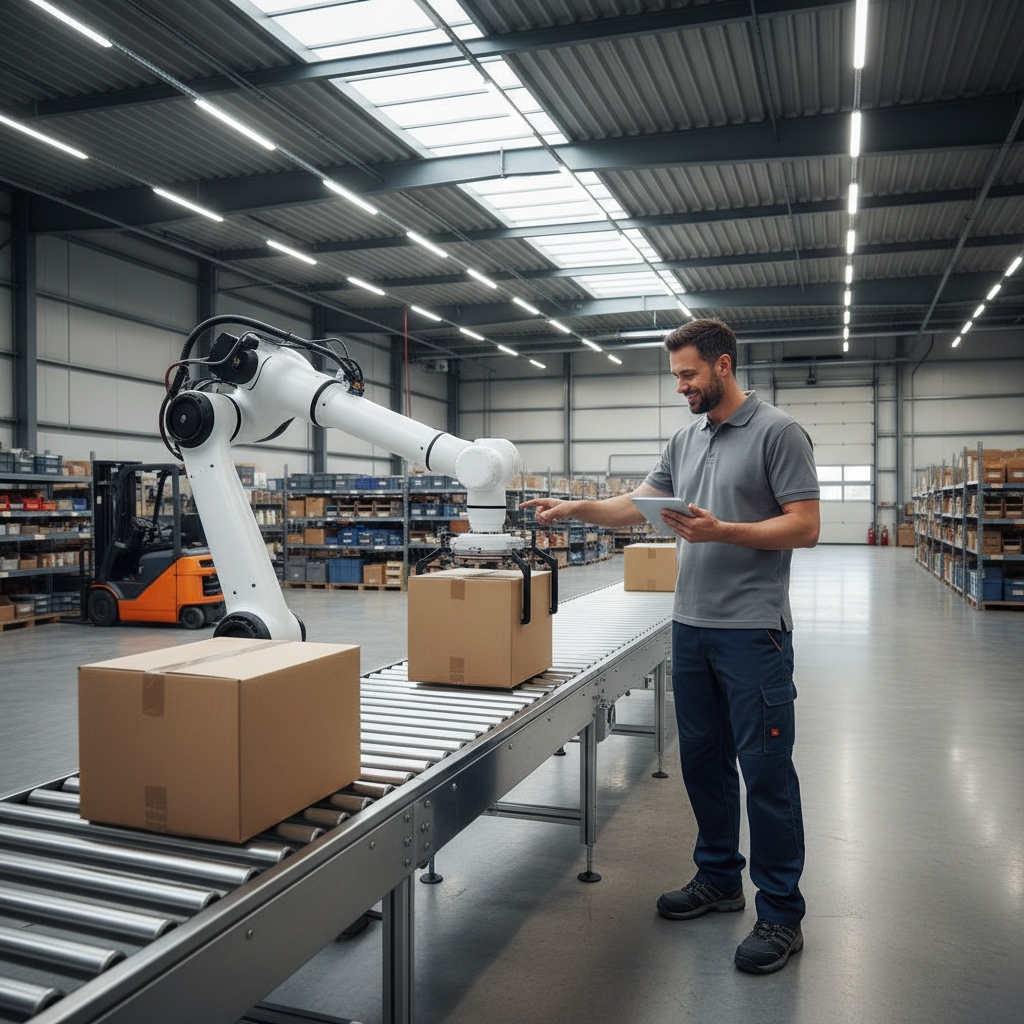
Human-Robot Collaboration (HRC) in a conveyor context refers to a shared workspace where human operators and collaborative robots (cobots) perform tasks simultaneously and interactively. Unlike traditional automation where robots are caged, cobots are designed with advanced sensors to work safely alongside people, augmenting their capabilities for tasks like picking, sorting, and packing.
The Strategic Imperative for HRC in the Benelux
The Benelux region, with its major ports like Rotterdam and Antwerp and extensive transportation network, is the beating heart of European logistics. This strategic position brings unique pressures. E-commerce has conditioned consumers to expect next-day or even same-day delivery, putting immense strain on fulfillment centers. Simultaneously, an aging workforce and a general scarcity of logistics personnel make it difficult to scale operations traditionally. HRC provides a targeted solution.
- Addressing Labor Shortages: Cobots can take over physically demanding and repetitive tasks, such as lifting boxes from a conveyor or placing items into shipping cartons for hours on end. This frees up human workers for more complex, cognitive tasks like quality control, exception handling, and customer-specific preparations.
- Boosting Competitiveness: For logistics service providers in Belgium, the Netherlands, and Luxembourg, efficiency is a key differentiator. Integrating HRC allows them to process higher volumes with greater accuracy, offering a superior service level that is crucial for retaining major European clients.
- Improving Ergonomics: Warehouse jobs are often physically taxing. HRC directly mitigates risks of musculoskeletal injuries by automating awkward or strenuous movements, leading to a healthier workforce and reduced absenteeism.
How HRC Works in a Conveyor Environment
The integration of cobots with conveyor systems is versatile and can be adapted to various warehouse processes. The core principle is simple: the conveyor delivers a steady flow of goods, and the cobot-human team processes them.
H3: Collaborative Picking and Placing
In a typical "goods-to-person" setup, a conveyor belt delivers totes with various SKUs to a workstation. A cobot, equipped with a gripper and often a vision system, can pick items from the tote and place them into order boxes. The human partner might oversee the process, handle fragile or unusually shaped items the robot cannot, and manage the user interface. This division of labor leverages the robot's speed for simple picks and the human's dexterity for complex ones.
H3: Ergonomic Sorting and Palletizing
At the end of a sorting conveyor, items often need to be moved into different shipping containers or palletized. A cobot can be positioned to handle items below a certain weight threshold, for instance, anything up to 15 kg. It can scan a barcode, identify the target lane or pallet, and perform the lift-and-place motion flawlessly. The human operator can then handle heavier items (often with ergonomic lifting aids) or manage the overall flow, preventing bottlenecks.
HRC vs. Traditional Automation: A Comparative Analysis
Understanding where HRC fits requires comparing it to both fully manual processes and traditional, high-speed industrial automation. Cobots occupy a unique middle ground that prioritizes flexibility and human-centric design.
| Parameter | Manual Operation (Human Only) | Human-Robot Collaboration (Cobot) | Traditional Automation (Industrial Robot) |
|---|---|---|---|
| Flexibility | Very High: Infinitely adaptable to new tasks. | High: Can be quickly reprogrammed for different tasks without physical changes. | Low: Purpose-built for one high-speed task; difficult to reconfigure. |
| Footprint & Infrastructure | Minimal: Requires only space for the worker. | Small: Mounts easily next to existing conveyors; no large safety cage required. | Large: Requires significant floor space and extensive safety caging. |
| Typical Throughput Speed | Variable: Averages 100-200 picks/hour. | Medium: 300-500 picks/hour, augmenting human speed. | Very High: 1,000+ picks/hour. |
| Initial Investment | Low (hiring/training costs). | Medium: €25,000 - €45,000 per station. | High: €100,000 - €500,000+ per installation. |
| Human Interaction | N/A | Direct & Collaborative: Humans and robots work in the same space. | Separated: Humans are excluded from the work cell during operation. |
Implementing HRC: A Practical Roadmap
Adopting HRC requires a structured approach that prioritizes both process efficiency and worker safety.
- Task Identification: Analyze your conveyor line for tasks that are repetitive, physically straining, or create bottlenecks. Good candidates for HRC are simple pick-and-place, sorting, or packing tasks where the robot an handle 80% of the work.
- Choosing the Right Cobot: Select a cobot based on payload (how much it can lift, e.g., 3 kg, 10 kg, or 25 kg), reach (the distance from its base to its gripper, e.g., 500 mm to 1750 mm), and speed.
- Safety First (ISO/TS 15066): A thorough risk assessment is mandatory. European standards like ISO/TS 15066 provide guidelines for designing HRC workstations. This includes setting safe speed limits when humans are near and ensuring there are no pinch points.
- Integration with Conveyor Systems: This is a critical step where hardware and software must align. The cobot needs to communicate with the conveyor’s PLC (Programmable Logic Controller) to know when a new item has arrived or when the line needs to stop. For a detailed assessment of how HRC can be integrated with modular conveyor systems, partners like Easy Systems offer tailored advice and system integration expertise.
- Training and Change Management: Introduce the technology as a tool to help employees. Provide training on how to operate, supervise, and perform basic troubleshooting for the cobots. This transforms a manual laborer into a value-added robot operator.
The Financial Case: ROI in the Benelux Context
While the initial cost of a cobot workstation (€25,000 - €45,000 for a basic setup) is not trivial, the return on investment in a high-wage region like the Benelux is compelling. A single cobot can often perform the work of 1-1.5 full-time employees per shift. In a two-shift operation, this can lead to a payback period of just 12-18 months. Beyond labor savings, the ROI is bolstered by increased accuracy (fewer mis-picks), higher throughput, and lower costs associated with workplace injuries.
Your Trusted Partner for Integrated Conveyor Solutions
The transition to a collaborative automated environment can seem daunting. It requires a deep understanding of not just robotics, but also the material flow and system integration that underpins warehouse efficiency. Easy Systems, as part of the BOA Concept group, specializes in designing and delivering modular, intelligent conveyor systems that are ready for the future of work.
We don't just sell conveyors; we provide the backbone for advanced automation. Our expertise in creating flexible and scalable material handling solutions makes us the ideal partner for Benelux companies looking to integrate Human-Robot Collaboration. We can help you analyze your current workflow, identify the perfect points for HRC integration, and ensure that your conveyor system communicates flawlessly with your new robotic colleagues. Let us help you build a more efficient, ergonomic, and future-proof warehouse.
This article is part of the Conveyor-Design knowledge hub, edited by Easy Systems engineers who design conveyor and warehouse automation systems across the Benelux every week.
Frequently asked questions
What is the main difference between a cobot and an industrial robot?+
A cobot is specifically designed to work safely alongside humans without extensive caging, thanks to built-in sensors and force-limiting technology. A traditional industrial robot is typically isolated for high-speed, heavy-payload tasks and requires significant safety fencing to protect workers.
Can HRC be retrofitted to existing conveyor lines?+
Yes, one of the key advantages of cobots is their flexibility and small footprint. They can often be integrated into existing conveyor systems with minimal disruption, usually mounted alongside or above the line to perform specific tasks, making them ideal for phased automation projects.
What is the main difference between a cobot and an industrial robot?+
A cobot is specifically designed to work safely alongside humans without extensive caging, thanks to built-in sensors and force-limiting technology. A traditional industrial robot is typically isolated for high-speed, heavy-payload tasks and requires significant safety fencing to protect workers.
Can HRC be retrofitted to existing conveyor lines?+
Yes, one of the key advantages of cobots is their flexibility and small footprint. They can often be integrated into existing conveyor systems with minimal disruption, usually mounted alongside or above the line to perform specific tasks, making them ideal for phased automation projects.