AGVs vs. AMRs: What's Right for Your Benelux Warehouse?
Choosing between AGVs and AMRs is a critical decision for Benelux warehouses. AGVs offer cost-effective, predictable transport for fixed routes, while AMRs provide unmatched flexibility for dynamic environments.
In the hyper-competitive logistics landscape of the Benelux—a crucial gateway to Europe—warehouse operators are constantly seeking an edge. Integrating mobile robots with existing conveyor systems is no longer a futuristic concept but a strategic necessity. The critical question, however, is not *if* you should automate, but *how*. The decision between Automated Guided Vehicles (AGVs) and Autonomous Mobile Robots (AMRs) can define your facility's efficiency, scalability, and profitability for years to come. This article provides a comprehensive comparison to guide your choice.
Definition
Automated Guided Vehicles (AGVs) are material transport systems that follow long-established, predictable paths marked by wires, magnetic stripes, or laser-guided reflectors. Autonomous Mobile Robots (AMRs) are a more recent evolution, using advanced sensors, AI, and onboard maps (employing technologies like SLAM) to navigate environments dynamically and safely, independent of fixed infrastructure.
Core Technology: Navigation & Guidance
The fundamental difference between AGVs and AMRs lies in their intelligence and how they perceive and interact with their environment. This dictates their entire operational model.
AGVs: Following the Line
AGVs are the veterans of warehouse automation. Their navigation is based on external, physical infrastructure. Common methods include:
- Magnetic Tape Guidance: The AGV is equipped with a magnetic sensor and follows a path defined by a magnetic tape applied to the floor. This is cost-effective to install but susceptible to wear and tear.
- Wire Guidance: A radio frequency signal is transmitted through a wire embedded in the warehouse floor, which the AGV follows. It's robust but highly invasive to install (€150-€200 per metre) and very inflexible.
- Laser Target Navigation: The most common modern AGV method. The robot has a rotating laser that reflects off strategically placed reflectors to triangulate its position. It’s precise but requires line-of-sight and the installation of these reflectors.
AMRs: Forging Their Own Path
AMRs represent a leap in technology. They create and store a map of the facility in their memory and navigate using it. The primary technology is Simultaneous Localization and Mapping (SLAM). This allows the AMR to use data from its own sensors (like LiDAR, 3D cameras, and accelerometers) to understand where it is and to navigate freely. If an AMR encounters an obstacle, its internal software instantly calculates the best alternative route, ensuring the workflow continues uninterrupted. This is a game-changer in busy, shared human-robot workspaces, common in the fast-paced logistics hubs of Rotterdam, Antwerp, and Venlo.
Conveyor Integration: The Critical Handshake
For most Benelux facilities, mobile robots don't work in isolation. Their primary value is unlocked when they seamlessly connect islands of automation, most notably conveyor systems. How they achieve this is a key differentiator.
AGV-Conveyor Integration
AGV integration is typically a straightforward, point-to-point affair. For example, a conveyor line moves finished goods to an accumulation point. An AGV is programmed to pick up a full pallet (weighing up to 1,500 kg) from that precise end-of-line position and transport it along its fixed magnetic or laser-guided path to another fixed point, such as a stretch-wrapping machine or a staging lane for outbound shipping. This is highly efficient and reliable for static, high-volume processes where the start and end points never change. The AGV operates like a train on a predictable schedule.
AMR-Conveyor Integration
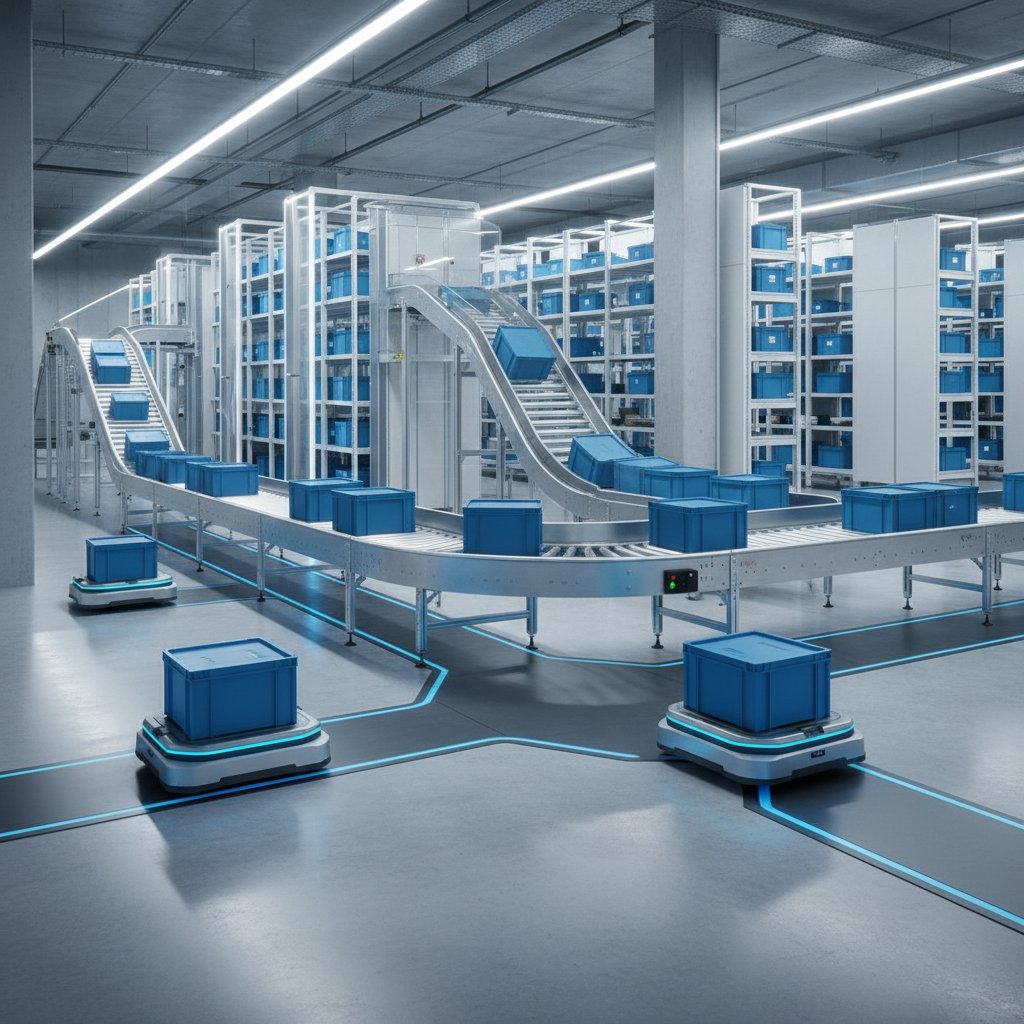
AMR integration is dynamic and data-driven. An AMR can service multiple conveyor lines and multiple destinations. Integrated with a Warehouse Management System (WMS), an AMR can be dispatched to pick up a tote from sorter lane #7, which is full, while ignoring lane #8, which is still filling. It can then deliver that tote not to a fixed destination, but to the packing station with the lowest current workload. This flexibility allows for Goods-to-Person (G2P) workflows, where robots bring items to stationary workers, drastically reducing travel time and boosting picking efficiency by up to 60-70%.
Performance & Cost Analysis: A Benelux Perspective
Choosing between AGVs and AMRs requires a careful analysis of both upfront costs and long-term value, especially within the context of European operational costs and space constraints.
Comparative Analysis: AGV vs. AMR
| Feature | Automated Guided Vehicle (AGV) | Autonomous Mobile Robot (AMR) |
|---|---|---|
| Navigation | Fixed paths (magnetic tape, lasers, wires) | Dynamic, free-roaming (SLAM, LiDAR) |
| Flexibility | Low; requires infrastructure changes to alter paths | High; adapts to new layouts via software in a few hours |
| Obstacle Handling | Stops and waits for obstacle to clear | Navigates around obstacles in real-time |
| Implementation Time | Longer, more disruptive install (weeks) | Fast, minimal facility changes (days) |
| Typical Speed | 1.0 - 1.5 m/s | 1.5 - 2.0 m/s |
| Initial Cost | Lower per unit (€30,000 - €60,000), but high infrastructure cost | Higher per unit (€45,000 - €85,000), but minimal infrastructure cost |
| Best For | Repetitive, predictable point-to-point transport | Complex, dynamic environments; Goods-to-Person |
| Conveyor Integration | Ideal for static end-of-line pallet transport | Flexible for servicing multiple sorter lines and dynamic stations |
Total Cost of Ownership (TCO)
While an individual AMR unit often carries a higher price tag than an AGV, the TCO equation is more complex. AGV projects can involve significant hidden costs: the production downtime during floor modifications, the cost of installing reflectors, and the future cost of re-installing everything if you change your warehouse layout. AMRs, with their rapid deployment and infrastructure-free navigation, often present a lower overall TCO, especially for businesses that anticipate growth and change. Their ability to reroute avoids costly downtime that occurs every time an AGV’s fixed path is blocked.
Use Cases in Benelux Logistics Hubs
The right choice is entirely dependent on the application.
- AGV Use Case (Port of Antwerp): A large 3PL facility handles a consistent flow of pallets from a specific container unloading conveyor to a cross-docking area 300 metres away. The route is clear, unchanging, and handles 50 pallets per hour. A fleet of pallet-moving AGVs is perfect here. They provide reliable, high-volume transport at a predictable cadence, acting as a horizontal conveyor.
- AMR Use Case (E-commerce in Venlo): An e-commerce fulfillment center faces massive fluctuations in order profiles and volume. AMRs are used to connect a multi-tiered picking and conveyor system with dozens of packing stations. The AMRs dynamically retrieve bins filled with sorted items from various conveyor outfeeds and bring them to the next available packer, optimizing flow for both single-item and multi-item orders. This system could not function with the rigidity of AGVs.
Safety, Standards, and the Human Factor
Both AGVs and AMRs are designed to be safe, adhering to European standards like ISO 3691-4. However, their operational nature implies different interactions with human workers. AGVs, with their predictable paths, are easy for staff to anticipate. AMRs are designed for collaborative environments ("cobots") and are equipped with more advanced 360-degree safety sensors that can predict the path of a human and adjust their own path smoothly, rather than stopping abruptly. This creates a more fluid and less disruptive flow in mixed environments.
Easy Systems: Your Partner in Integrated Automation
The choice between AGVs and AMRs is not just a technology decision; it's a strategic business decision that impacts your entire intralogistics process. The optimal solution is rarely just one or the other—it involves a holistic view of your material flow, from conveyor infeed to final dispatch. At Easy Systems, we specialize in designing the intelligent conveyor systems that form the backbone of warehouse automation. We don't just sell conveyors; we engineer material flow solutions. Whether your process requires the predictable efficiency of an AGV-integrated workflow or the dynamic flexibility of an AMR-serviced ecosystem, our expertise ensures the "handshake" between your systems is seamless, reliable, and perfectly tailored to your Benelux operations. To discuss your unique integration challenge, visit us at Easy Systems and let's build the future of your warehouse together.
This article is part of the Conveyor-Design knowledge hub, edited by Easy Systems engineers who design conveyor and warehouse automation systems across the Benelux every week.
Frequently asked questions
Can AGVs and AMRs work together in the same warehouse?+
Yes, a hybrid approach is possible. AGVs can handle long-haul, fixed-route transport, while AMRs manage flexible "last-mile" delivery within a specific zone.
What is the average cost difference between an AGV and an AMR?+
A single AMR unit can cost 30-50% more than an AGV, but the overall project cost can be lower for AMRs as they don't require major infrastructure changes like installing magnetic tape or reflectors.
How do I know if my Benelux warehouse is better suited for AGVs or AMRs?+
Analyze your workflow. If you have stable processes and high-volume, repetitive movements between fixed points (e.g., end-of-line palletizing to stretch wrapper), an AGV is efficient. If you have dynamic order picking and a constantly changing environment, an AMR is superior.