AGVs and Conveyors: The Synergy for Seamless Warehouse Flow
Discover how the integration of Automated Guided Vehicles (AGVs) and fixed conveyor systems creates a hybrid solution that maximizes both flexibility and high-throughput efficiency for seamless internal transport streams in today's automated warehouses.
In the high-stakes environment of modern logistics, the pursuit of efficiency is relentless. European distribution centers face a perfect storm of rising labour costs, skilled worker shortages, and escalating consumer demands for speed. The solution isn't a single piece of technology, but the intelligent integration of multiple systems. This article explores the powerful synergy between two cornerstones of warehouse automation: Automated Guided Vehicles (AGVs) and conveyor systems. While often seen as competing solutions, their true potential is unlocked when they work in concert, creating a seamless, robust, and scalable internal transport flow.
Definition
The synergy between AGVs and conveyors refers to the strategic integration of fixed, high-throughput conveyor lines with flexible, programmable mobile robots. This hybrid approach creates a multi-layered material handling system where each component is used for its optimal strength: conveyors for continuous, high-volume trunk-line transport and AGVs for dynamic, point-to-point "last-mile" tasks.
The Core Conflict: Flexibility vs. Throughput
To understand the synergy, one must first appreciate the fundamental differences between AGVs and conveyors. They are not interchangeable; they solve different operational problems. A conveyor system is a fixed artery of the warehouse, built for relentless, high-speed movement along a set path. An AGV is a flexible courier, capable of navigating complex environments and adapting its path on demand. The choice is not "either/or", but "when and where".
| Metric | Conveyor Systems | Automated Guided Vehicles (AGVs) |
|---|---|---|
| System Type | Fixed, continuous flow | Flexible, point-to-point |
| Typical Throughput | High (1,000 - 3,000+ units/hour) | Low to Medium (30 - 100 transfers/hour/vehicle) |
| Flexibility | Low; requires re-engineering to change path | High; routes can be reprogrammed via software |
| Typical Speed | Consistent (0.5 - 2.0 m/s) | Variable (1.0 - 2.5 m/s, includes acceleration/deceleration) |
| Payload Capacity | Wide range (from grams to >2,000 kg per unit load) | Varies by type (50 kg for small bots to >5,000 kg for unit load AGVs) |
| Initial Cost (EUR) | €500 - €2,500+ per meter (infrastructure heavy) | €30,000 - €80,000+ per vehicle (unit heavy) |
| Ideal Application | Long-distance transport, accumulation, sorting, connecting fixed processes | Connecting islands of automation, delivery to workstations, WIP movement |
How AGVs and Conveyors Create Synergy: A Hybrid Model
The magic happens when you stop seeing these systems in isolation. By integrating them, you create a "best of both worlds" solution that addresses the weaknesses of one with the strengths of the other. The conveyor handles the marathon, and the AGV handles the last-mile sprint.
The "Trunk Line and Branch" Model
Think of your warehouse logistics like a city's traffic system. A conveyor system acts as the multi-lane motorway or 'trunk line.' It's designed for one purpose: moving high volumes of goods (cartons, totes, pallets) quickly and efficiently over long, fixed distances—for example, from receiving docks to a central storage or sorting area. It’s the most energy- and cost-effective way to achieve this. However, a motorway cannot deliver a package to a specific house. For that, you need smaller, more agile vehicles. This is where AGVs come in, acting as the 'branch' delivery fleet. They pick up goods from dedicated output spurs on the conveyor and navigate to specific, often variable, destinations like picking stations, packing tables, or temporary storage buffers.
Use Case: E-commerce Order Fulfilment
Consider a large e-commerce distribution center in the Netherlands or Germany. Here’s how the synergy plays out:
- Inbound & Storage: Pallets are unloaded at the receiving dock and placed on a heavy-duty chain conveyor, which transports them to a depalletizing station. The individual cartons are then moved via a network of roller conveyors into an automated storage and retrieval system (AS/RS).
- High-Speed Transfer: When goods are needed for orders, the AS/RS releases totes onto a high-speed belt conveyor system. This 'warehouse highway' transports thousands of totes per hour from the storage zone towards the picking area, covering hundreds of meters in minutes.
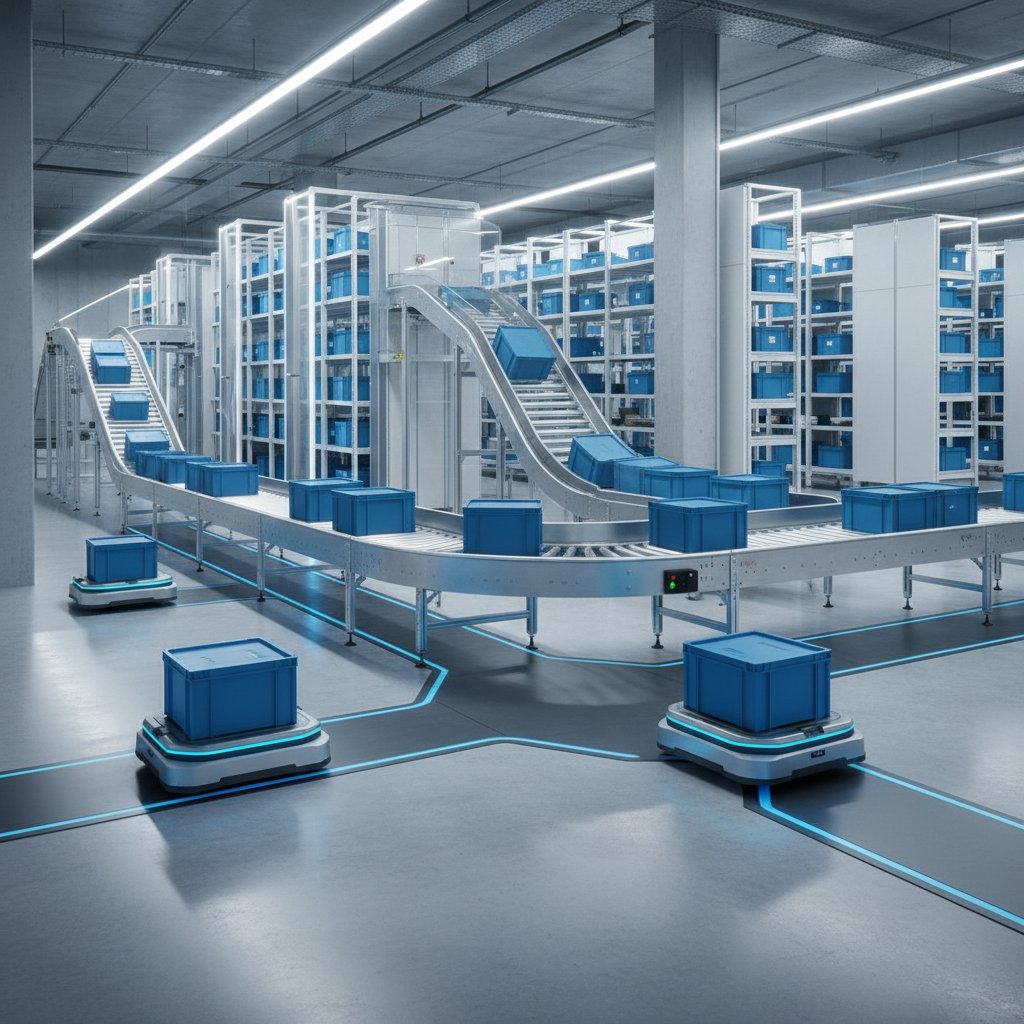
- Flexible Last-Mile Delivery: At the end of the conveyor line, the totes arrive at a transfer station. Here, a fleet of AGVs (or more advanced AMRs) is waiting. An AGV docks with the conveyor, the tote is automatically transferred, and the AGV then transports it to one of perhaps 50 different Goods-to-Person (G2P) workstations, based on real-time demand allocated by the Warehouse Management System (WMS).
- Dynamic Routing: If a picking station is busy, the WMS can instantly reroute the AGV to another available station, a level of flexibility impossible with a fixed conveyor alone. Once picking is complete, the AGV can transport the tote to a packing or shipping area.
Key Integration Points & Technologies
A seamless hybrid system is more than just placing an AGV next to a conveyor. It requires sophisticated technical and software integration.
- Warehouse Control System (WCS): This is the digital-physical bridge. The WCS acts as the conductor of the orchestra, taking high-level commands from the Warehouse Management System (WMS) and translating them into specific instructions for both the conveyor PLC (Programmable Logic Controller) and the AGV Fleet Manager. It tells the conveyor when to stop/start and which AGV to interface with.
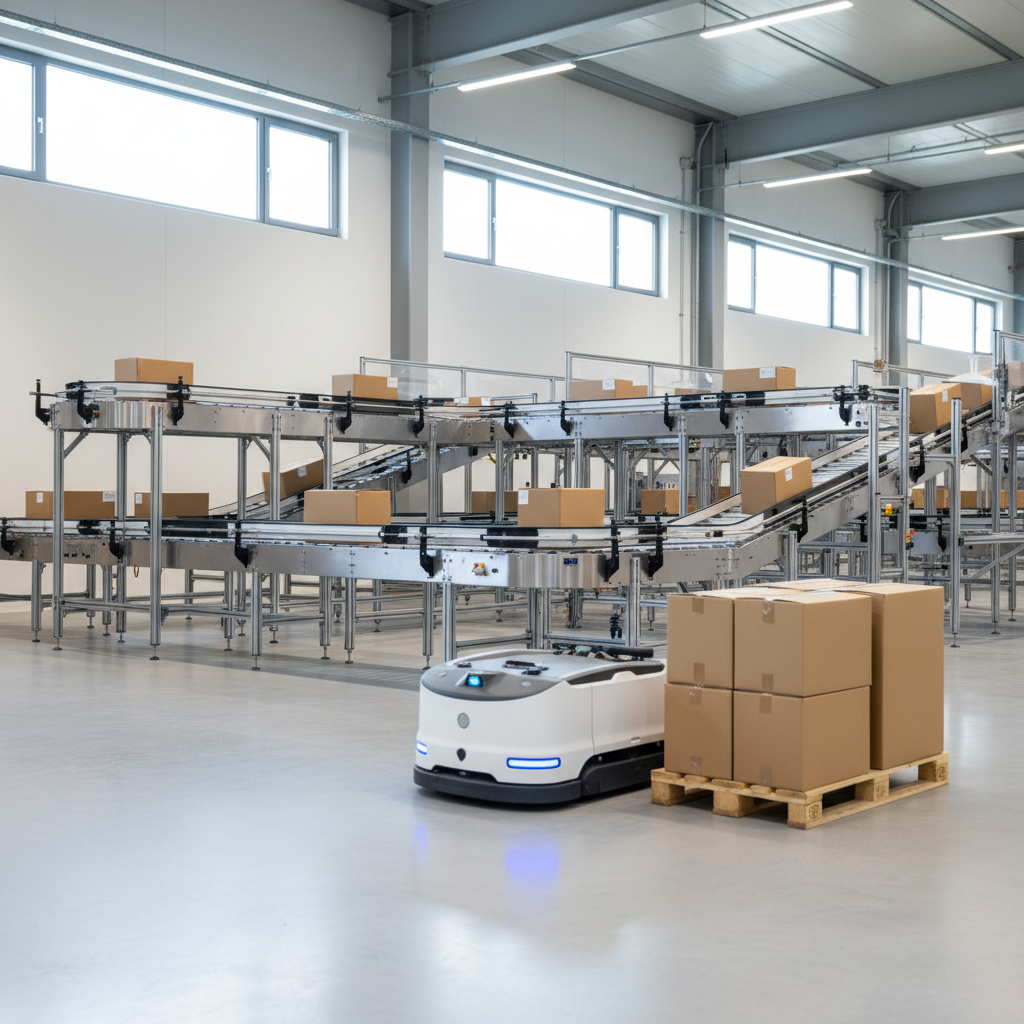
- Physical Handshake: The point of transfer must be flawless. This is often achieved using specialized conveyor-AGV interface stations. For example, a roller-top AGV can perfectly align its height and position with a powered roller conveyor spur, allowing for a smooth, automated transfer of a 30 kg tote without any manual intervention.
- Traffic Management: The AGV Fleet Manager software must be aware of the conveyor system's fixed footprint, treating it as a no-go zone to prevent collisions and ensure clear transfer points.
Financial Considerations: TCO and ROI in a European Context
Implementing a hybrid automation system requires significant capital investment, and a clear financial analysis is paramount. A Total Cost of Ownership (TCO) approach is essential.
A conveyor system's cost is largely upfront infrastructure. A 100-meter line of sophisticated sorting conveyor could run into hundreds of thousands of Euros. Its operational costs are relatively low and predictable. In contrast, AGVs have a high per-unit cost (€30,000 - €80,000), but offer scalability. You can start with a fleet of five and add more as throughput demands increase. This modularity is a significant advantage for businesses facing uncertain growth.
When planning such a significant investment, partnering with an experienced integrator is key. For instance, solutions provided by specialists like Easy Systems are designed to ensure a smooth integration process and a clear path to ROI. The return on investment in the European market is typically calculated based on labour savings (reducing dependency on manual trolley pushers), increased accuracy, and higher throughput, often leading to ROI timeframes of 2-5 years.
Future Trends: The Rise of AMRs
The principles of synergy discussed here are evolving with technology. The successor to the AGV is the Autonomous Mobile Robot (AMR). While AGVs follow fixed guides (tape, wires, reflectors), AMRs navigate dynamically using LiDAR and SLAM (Simultaneous Localization and Mapping), much like a self-driving car. This adds another layer of intelligence and flexibility, but the fundamental synergy with high-throughput conveyors remains. An AMR-conveyor system is an even more powerful combination of a fixed, high-speed backbone and a hyper-flexible, intelligent delivery network.
Easy Systems: Your Partner for Integrated Automation
Understanding the theoretical synergy between AGVs and conveyors is the first step. Successfully designing, implementing, and integrating a system that delivers on its promise requires deep domain expertise. As a part of the BOA Concept group, Easy Systems brings decades of experience in modular conveyor design to the table. We don't just sell conveyors; we engineer material flow solutions.
We specialize in creating the robust, reliable conveyor "highways" that form the foundation of any successful hybrid automation project. Our modular systems are designed for seamless integration with third-party technologies, including AGV and AMR fleets. We work with you and your robotics partner to define the critical handshake points, establish communication protocols, and ensure that the entire system—from the PLC on the conveyor to the WCS in the server room—operates as a single, cohesive unit. For businesses in Europe looking to harness the power of integrated automation, Easy Systems is the trusted partner for building the fast, reliable, and scalable transport foundation you need to thrive.
This article is part of the Conveyor-Design knowledge hub, edited by Easy Systems engineers who design conveyor and warehouse automation systems across the Benelux every week.
Frequently asked questions
What's the main difference between an AGV and an AMR?+
AGVs (Automated Guided Vehicles) typically follow fixed, predefined paths using guides like magnetic tape or wires. AMRs (Autonomous Mobile Robots) use advanced sensors like LiDAR and onboard maps to navigate dynamically, allowing them to create their own routes and avoid obstacles.
Can AGVs and conveyors from different manufacturers be integrated?+
Yes, integration is common but requires a sophisticated Warehouse Control System (WCS) or middleware that can communicate with both systems' distinct APIs. Using standardized communication protocols like VDA 5050 is making this process easier and more reliable.
What is the typical payload difference between AGVs and conveyors?+
It varies greatly, but conveyors are generally better for sustained transport of a consistent product size, from a few grams on a narrow belt to pallets weighing over 1,500 kg on a chain conveyor. AGVs have specific payload limits per model, ranging from 50 kg for smaller robots to over 5,000 kg for heavy-duty 'tugger' types.