Vertical Conveyor Systems: Maximizing Storage in Benelux
In the space-constrained Benelux market, building 'up' is more viable than building 'out'. This guide explores how vertical conveyor systems unlock massive storage density gains by efficiently connecting mezzanines and multi-level structures.
In the densely populated economic heart of Europe, the Benelux region, industrial land is both scarce and expensive, with prices regularly exceeding €800 per square meter in prime logistics hubs. For warehouse and distribution center operators, this presents a critical challenge: how to expand capacity without incurring the prohibitive cost of a larger footprint. The answer lies not in building out, but in building up. Vertical conveyor systems are the enabling technology for this strategy, providing the vital link to unlock the vast potential of vertical space.
Definition
A vertical conveyor system is an automated material handling solution designed to transport goods, totes, or pallets between different elevations within a facility. Unlike a standard inclined belt conveyor, a vertical conveyor moves items on a vertical or near-vertical plane, occupying a minimal footprint to connect ground floors with mezzanines, multi-level racking systems, or different stories of a building.
The Challenge: High Land Costs and the Need for Verticality in the Benelux
The Benelux is a premier logistics hotspot, home to the ports of Antwerp-Bruges and Rotterdam, Europe's largest. This strategic location comes at a cost. According to recent real estate reports, prime industrial land prices can reach €1,000/m² near Amsterdam and Antwerp. Expanding a 10,000 m² facility by just 20% could mean land acquisition costs alone of €2 million, before a single brick is laid. This economic reality makes vertical expansion the only viable path forward for many.
The Vertical Solution: Mezzanines
Installing a mezzanine floor is a cost-effective way to double your usable floor space. However, a mezzanine is only as effective as your ability to move goods to and from it. Manual transport via forklifts is slow, dangerous, and inefficient. It creates bottlenecks and negates the very efficiency gains you seek. This is precisely the problem that vertical conveyors solve, creating a seamless, automated flow of materials between levels.
Types of Vertical Conveyor Systems Explained
Choosing the right vertical conveyor depends on throughput, load characteristics, and available space. Three main types dominate the European market: Reciprocating Vertical Conveyors (RVCs), Spiral Conveyors, and Platform Lifts (also known as Vertical Reciprocating Conveyors or VRCs - a slightly confusing term).
H3: Reciprocating Vertical Conveyor
An RVC is like an elevator for goods. It uses a carriage that lifts or lowers items and can serve multiple levels. It’s highly versatile for handling boxes, totes, or even pallets. Its start-stop nature makes it ideal for intermittent flow rather than continuous streams.
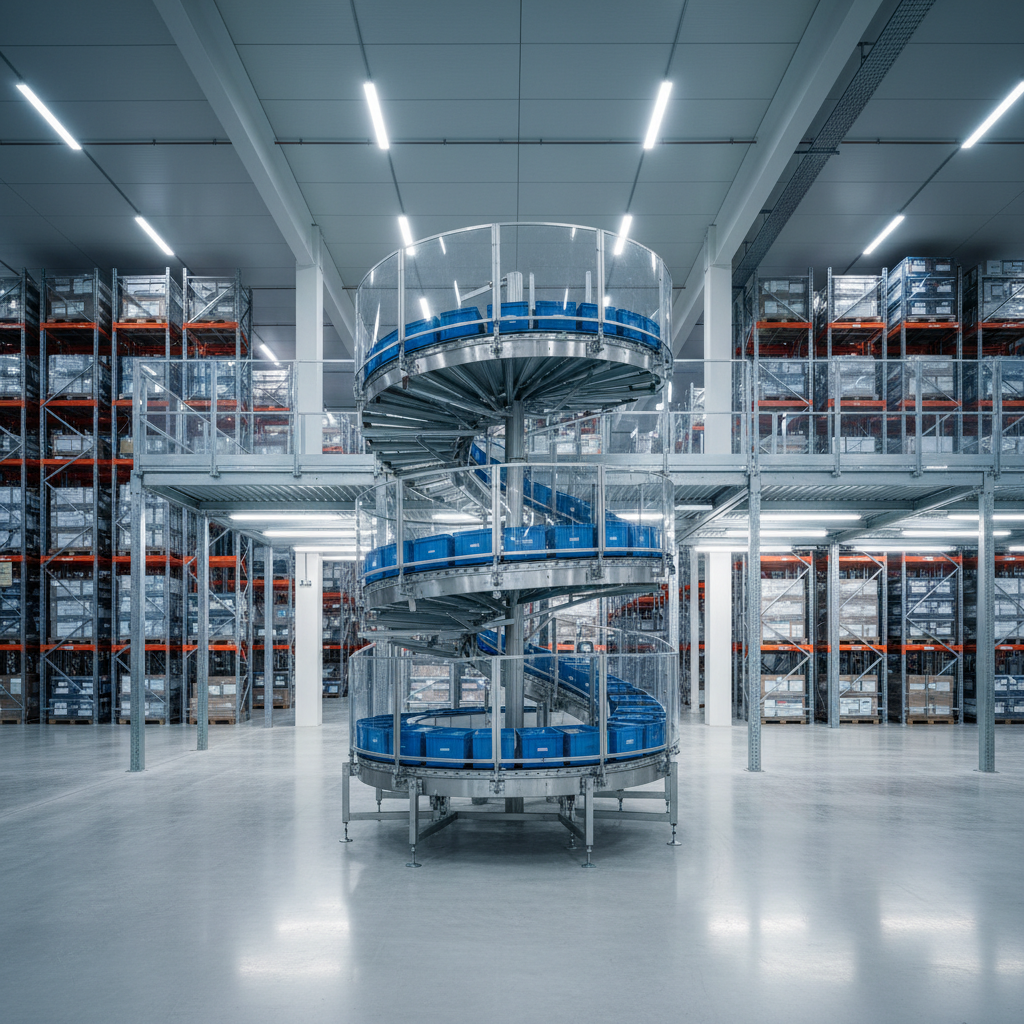
H3: Spiral Conveyor
As the name suggests, this conveyor transports items in a continuous flow along a helical path. It offers very high throughput and is perfect for moving large quantities of uniform-sized cartons or totes, making it a favorite in e-commerce and parcel handling facilities.
H3: Platform Lift (VRC)
A platform lift is the heavy-duty workhorse of vertical transport. It is designed to move very large, heavy, or irregularly shaped loads, such as fully laden pallets, carts, or machinery. They are slower but offer maximum capacity and safety for bulky items.
Comparative Analysis of VCS Types
The following table provides a direct comparison to aid in the selection process for a typical Benelux warehouse application:
| Feature | Reciprocating Vertical Conveyor (RVC) | Spiral Conveyor | Platform Lift (VRC) |
|---|---|---|---|
| Throughput | Medium (5-15 units/min) | High (20-50+ units/min) | Low (1-5 cycles/min) |
| Footprint | Small to Medium | Large | Medium |
| Load Type | Boxes, Totes, Pallets | Boxes, Totes, Cartons | Pallets, Heavy/Bulky Items |
| Typical Load (kg) | 50 - 250 kg | 1 - 50 kg | 500 - 3,000+ kg |
| Typical Cost (Installed) | €25,000 - €70,000 | €40,000 - €120,000 | €50,000 - €150,000+ |
| Best For | Flexible, multi-level access for mixed goods. | Continuous, high-volume flow between two levels. | Very heavy, oversized loads requiring robust transport. |
Key Benefits of Implementing Vertical Conveyors
- Maximized Storage Density: The primary benefit. A VCS enables the full utilization of vertical space via mezzanines, effectively doubling storage capacity on an existing footprint without expensive construction or land acquisition.
- Increased Throughput: A spiral conveyor can move over 3,000 cartons per hour, a rate impossible to match with forklifts. This eliminates bottlenecks between floors.
- Enhanced Safety and Ergonomics: Automating vertical transport removes the need for forklifts to maneuver in congested areas or near mezzanine edges, drastically reducing accident risk. It also eliminates manual lifting and carrying of goods up stairs.
- Reduced Operational Costs: A single VCS can do the work of 1-2 full-time employees per shift, whose fully-loaded cost in the Benelux can be €50,000-€60,000 per year.
Calculating ROI for Vertical Conveyors: A Benelux Perspective
A return on investment calculation justifies the capital expenditure. Consider this conservative scenario for a distribution center in the Netherlands:
- System Cost: A high-quality Reciprocating Vertical Conveyor is installed for €60,000 to service a new picking mezzanine.
- Labor Savings: The system replaces the need for 1.5 FTEs previously tasked with moving goods with a forklift. Annual savings: 1.5 * €55,000 = €82,500.
- Avoided Costs: The mezzanine and lift combo avoids the need for a 5,000 m² warehouse extension. At €600/m² for land and construction, this represents an avoided capital outlay of €3,000,000.
- Payback Period: Based on labor savings alone, the payback period is (€60,000 / €82,500) * 12 months = approximately 9 months. Factoring in the immense avoided expansion cost, the ROI is immediate and overwhelmingly positive.
Positioning Your Business with a Trusted Partner
Implementing a vertical conveyor is not just about purchasing a machine; it's about integrating a critical artery into your logistical heart. The success of such a project hinges on partnering with an expert who understands the European regulatory landscape, the nuances of warehouse processes, and the importance of modular, scalable design. A specialist partner can ensure your system is perfectly specified for your load, speed, and spatial requirements, providing a future-proof solution. For businesses in the Benelux and across Europe, leveraging a partner with deep engineering expertise is key. As a leading European designer and manufacturer of modular conveyor systems, Easy Systems offers the expertise and high-quality solutions needed to integrate vertical transport seamlessly into your broader warehouse automation strategy under the innovative BOA Concept.
This article is part of the Conveyor-Design knowledge hub, edited by Easy Systems engineers who design conveyor and warehouse automation systems across the Benelux every week.
Frequently asked questions
What is the primary driver for adopting vertical conveyors in the Benelux?+
The high cost and scarcity of industrial land in Belgium, the Netherlands, and Luxembourg make vertical expansion a more cost-effective strategy than horizontal expansion. Vertical conveyors are the enabling technology for this strategy.
Can a vertical conveyor handle different product sizes?+
Yes. Systems like Reciprocating Vertical Conveyors (RVCs) are highly flexible and can be designed with adjustable fixtures to handle various items, from small totes (e.g., 400mm x 600mm) to full pallets (1200mm x 1000mm).
What is the typical speed of a vertical conveyor?+
It varies by type. A high-speed spiral conveyor can move over 50 items per minute in a continuous flow, while a heavy-duty platform lift might perform 1-5 cycles per minute. The choice depends on the required throughput.