Optimizing Order Picking with Automated Conveyor Systems
Unlock significant efficiency gains in your e-commerce warehouse. This article details how automated conveyor systems can optimize order picking, improve accuracy, and reduce costs, illustrated by a real-world Benelux case study.
In the hyper-competitive European e-commerce market, speed and accuracy are not just advantages; they are fundamental requirements for survival. For distribution centers across the Benelux—a critical logistics hub for the continent—optimizing the order picking process is a top priority. Manual, person-to-goods picking methodologies are increasingly becoming a bottleneck, leading to high labor costs, inefficient workflows, and a higher propensity for errors. This article explores how automated conveyor systems provide a robust solution, using a real-world case study from the region to illustrate the transformative impact on warehouse efficiency.
The Challenge: Scaling E-commerce Fulfillment in the Benelux
E-commerce businesses in Belgium, the Netherlands, and Luxembourg face immense pressure. Customers expect next-day or even same-day delivery, order accuracy must be near-perfect, and a tight labor market makes scaling the workforce challenging. A mid-sized fashion e-tailer operating from a 15,000 m² distribution center near Antwerp faced these exact issues. Their manual picking process involved pickers walking up to 15 kilometers per shift, pushing carts through endless aisles. This resulted in low pick rates (averaging 60-80 units per hour), frequent errors, and significant physical strain on employees, leading to high turnover.
Solution: A Goods-to-Person (G2P) Conveyor System
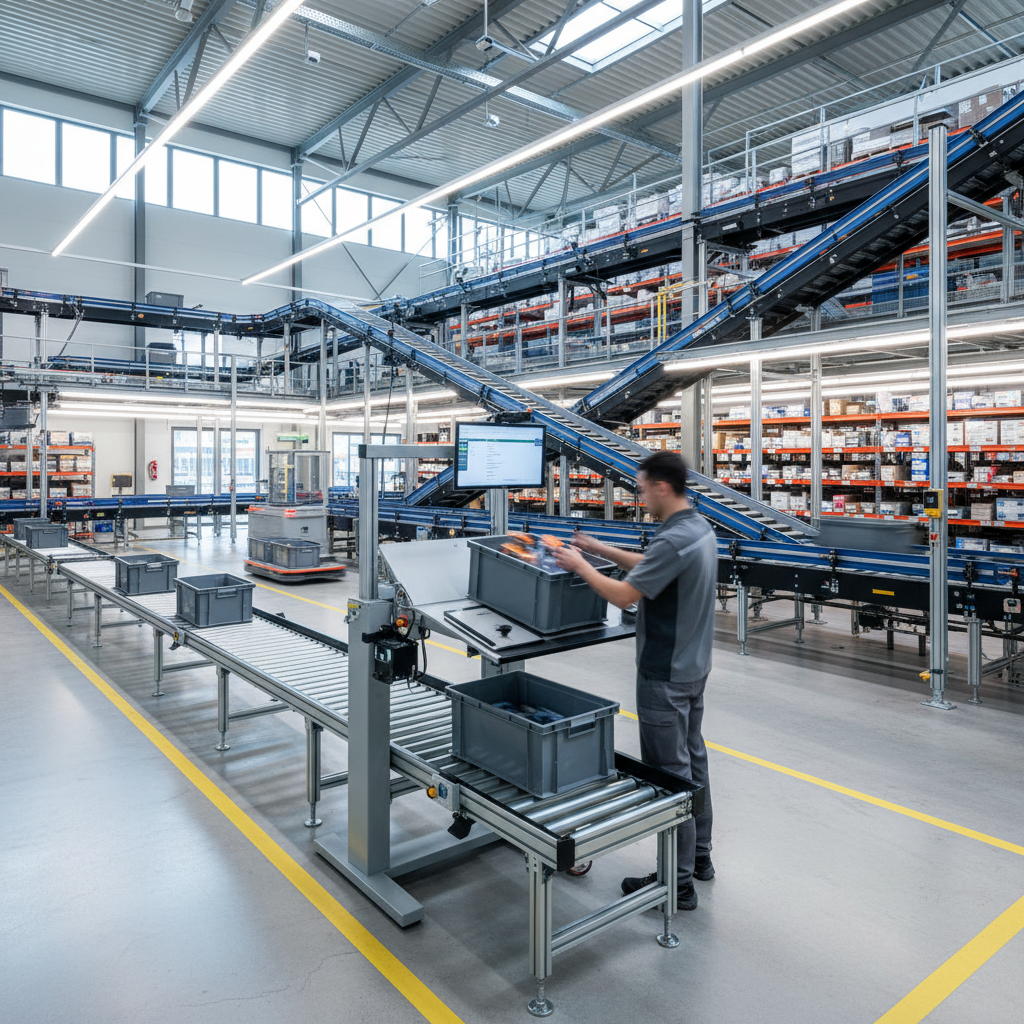
To overcome these challenges, the company implemented a goods-to-person (G2P) strategy powered by an integrated system of belt and roller conveyors. Instead of pickers traveling to the items, the items were automatically transported from storage locations to centralized picking stations. The system was designed to bring totes containing SKUs for active orders directly to pickers, who remained in their ergonomic workstations. This fundamental shift from a person-to-goods to a goods-to-person model was the cornerstone of the optimization strategy.
System Design and Workflow Transformation
The solution involved several key components working in concert:
- Storage & Retrieval: A high-density storage area where product totes were kept.
- Main Conveyor Line: A primary conveyor belt that acted as the backbone of the system, transporting totes from storage to the picking zones.
- Sorting & Diversion: Scanners and diverters automatically routed totes to the correct picking station based on the orders assigned to that station.
- Ergonomic Picking Stations: Each station was equipped with a screen displaying order details, put-to-light indicators, and direct access to the outgoing shipping conveyor.
- Trash & Completed Order Lines: Separate conveyor lines efficiently removed empty totes and transported completed order boxes to the packing and shipping area.
From Manual Chaos to Automated Flow
The new workflow was simple yet powerful. When a batch of orders was released, the Warehouse Management System (WMS) directed the automated system to retrieve the necessary SKU totes. These totes traveled along the conveyor and were diverted to a picker. The picker would pick the required quantity from the tote and place it into one of several order boxes at their station, guided by put-to-light signals. Once an order box was complete, it was pushed onto the outgoing conveyor. This eliminated nearly all picker travel time and minimized decision-making, allowing them to focus solely on the task of picking accurately and efficiently.
Comparing Manual vs. Automated Picking Performance
The implementation of the conveyor system yielded dramatic improvements across all key performance indicators. The following table provides a direct comparison based on data collected six months post-implementation.
| Metric | Before (Manual Cart Picking) | After (Automated Conveyor System) | Improvement |
|---|---|---|---|
| Average Pick Rate (Units/Hour/Picker) | 75 | 280 | +273% |
| Order Picking Accuracy | 99.2% | 99.95% | +0.75% (80% reduction in errors) |
| Average Picker Travel Distance (km/shift) | 14 km | < 1 km | -93% |
| Order Cycle Time (from release to picked) | 45 minutes | 12 minutes | -73% |
| Employee Training Time | 2 days | 2 hours | -88% |
Strategic Benefits Beyond the Numbers
While the quantitative results are compelling, the strategic advantages for the Benelux retailer were equally significant. The system provided the scalability needed to handle seasonal peaks like Black Friday and the holiday season without needing to hire a large temporary workforce. The improved working conditions and reduced physical strain led to a 40% decrease in employee turnover in the first year. Furthermore, the faster order cycle times enabled the company to extend its cutoff time for next-day delivery, providing a significant competitive edge in the European market.
ROI and Financial Justification
The initial investment for the conveyor system, including integration with the WMS, was approximately €1.2 million. The operational cost savings, primarily from reduced labor requirements and increased throughput, amounted to nearly €500,000 annually. This resulted in a calculated Return on Investment (ROI) of just under 2.5 years, a highly attractive figure for capital-intensive automation projects. The ability to process more orders with the same headcount allowed the company to grow its revenue without a linear increase in operational expenses.
Choosing the Right Partner for Conveyor Automation
Implementing a conveyor system is not just about purchasing hardware; it's about designing a holistic solution that integrates seamlessly with your existing operations. The success of this Benelux case study was heavily dependent on a partner who understood the nuances of e-commerce fulfillment and could design a modular, scalable system. Key considerations include the conveyor's load capacity, speed (meters per minute), and the intelligence of the control software. Easy Systems, with its deep roots in the Benelux and extensive experience across Europe, specializes in designing and implementing exactly these types of modular conveyor solutions. Their plug-and-play systems are engineered for flexibility, allowing businesses to adapt and expand their automation capabilities as their needs evolve. By focusing on smart, user-friendly design and robust construction, they provide the foundation for logistics operations to thrive in a demanding market.
Conclusion: A Necessary Evolution for E-commerce
For e-commerce companies in the Benelux and across Europe, optimizing order picking is no longer optional. The case study clearly demonstrates that investing in automated conveyor systems is a strategic necessity to achieve the speed, accuracy, and scalability required to meet modern customer expectations. By transforming the warehouse from a manual, labor-intensive environment to a streamlined, goods-to-person workflow, businesses can unlock significant performance gains, improve employee satisfaction, and build a resilient fulfillment operation ready for future growth.
This article is part of the Conveyor-Design knowledge hub, edited by Easy Systems engineers who design conveyor and warehouse automation systems across the Benelux every week.
Frequently asked questions
What is the typical ROI for an automated conveyor system in e-commerce?+
For mid-to-large scale e-commerce operations in Europe, a typical ROI for an automated conveyor system is between 2 to 4 years, driven by labor savings, increased throughput, and improved accuracy.
Can conveyor systems be integrated with other automation like robots?+
Absolutely. Modern conveyor systems are designed to be the backbone of warehouse automation, often integrated with AMR (Autonomous Mobile Robots), robotic picking arms, and automated packing machines to create a fully streamlined workflow.
How does a conveyor system help with returns (reverse logistics)?+
Conveyors can automate the returns process by transporting returned items from an intake point to inspection stations, and then routing them to either restocking, refurbishment, or disposal areas, significantly speeding up the process.
Are conveyor systems suitable for small warehouses?+
Yes, modular and scalable conveyor systems are available that can be tailored to the footprint of smaller warehouses. They can provide significant efficiency gains even in limited spaces by utilizing vertical space and optimizing layout.