Micro-fulfillment Benelux: The Power of Compact Conveyors
In the fast-paced Benelux e-commerce market, micro-fulfillment centers (MFCs) rely on compact conveyor solutions to maximize tight urban spaces and achieve rapid order processing, making them a cornerstone of modern last-mile logistics.
The race for ultra-fast delivery has transformed the retail and e-commerce landscape in the Benelux. Consumers in densely populated hubs from Amsterdam to Luxembourg now expect their orders within hours, not days. This pressure has given rise to the Micro-Fulfillment Center (MFC)—a small, highly automated warehouse strategically placed in urban areas. This article explores the pivotal role of compact, modular conveyor systems in making these MFCs viable and profitable.
Definition
A Micro-fulfillment Center (MFC) is a small-scale warehousing facility, typically ranging from 250 to 1,500 m², located within or in close proximity to a dense urban area. It holds a limited, fast-moving inventory and uses a high degree of automation to fulfill online orders rapidly for last-mile delivery.
Why the Benelux is a Prime Market for MFCs
The Benelux region presents a unique combination of factors that make it a perfect incubator for MFC technology. With one of the highest population densities in Europe, particularly in the Dutch Randstad and the Belgian Flemish Diamond, the distance between warehouse and customer is a critical competitive metric. Real estate in these urban cores is both scarce and expensive, with commercial lease prices in prime locations like Brussels or Amsterdam often exceeding €150-€200 per square meter annually. Traditional, sprawling fulfillment centers located hours outside the city are no longer sufficient for meeting "1-hour delivery" promises. MFCs bridge this gap by bringing inventory closer to the end consumer, a strategy that hinges entirely on maximizing efficiency within a minimal footprint.
The Core Challenge: Space Optimisation and Throughput
The fundamental problem for any Benelux MFC is maximising throughput (the number of orders processed per hour) in a severely restricted space. Every square centimetre counts. This is where traditional, bulky conveyor systems, designed for large-scale distribution centers, fail. They are too large, too rigid, and too power-intensive for an urban MFC. The solution lies in automation that is specifically designed for compactness, modularity, and energy efficiency. The engine driving this efficiency is the compact conveyor system, which acts as the circulatory system of the entire operation, moving goods from storage to picking stations and finally to packing and dispatch.
Compact Conveyor Solutions: The Engine of the MFC
Compact conveyors are not merely scaled-down versions of their larger counterparts. They are purpose-built for the unique demands of an MFC environment. Their design prioritizes space-saving frames, modular construction, and energy-efficient operation, often utilising 24V DC motor technology.
Mini Belt Conveyors for Small Items and Parcels
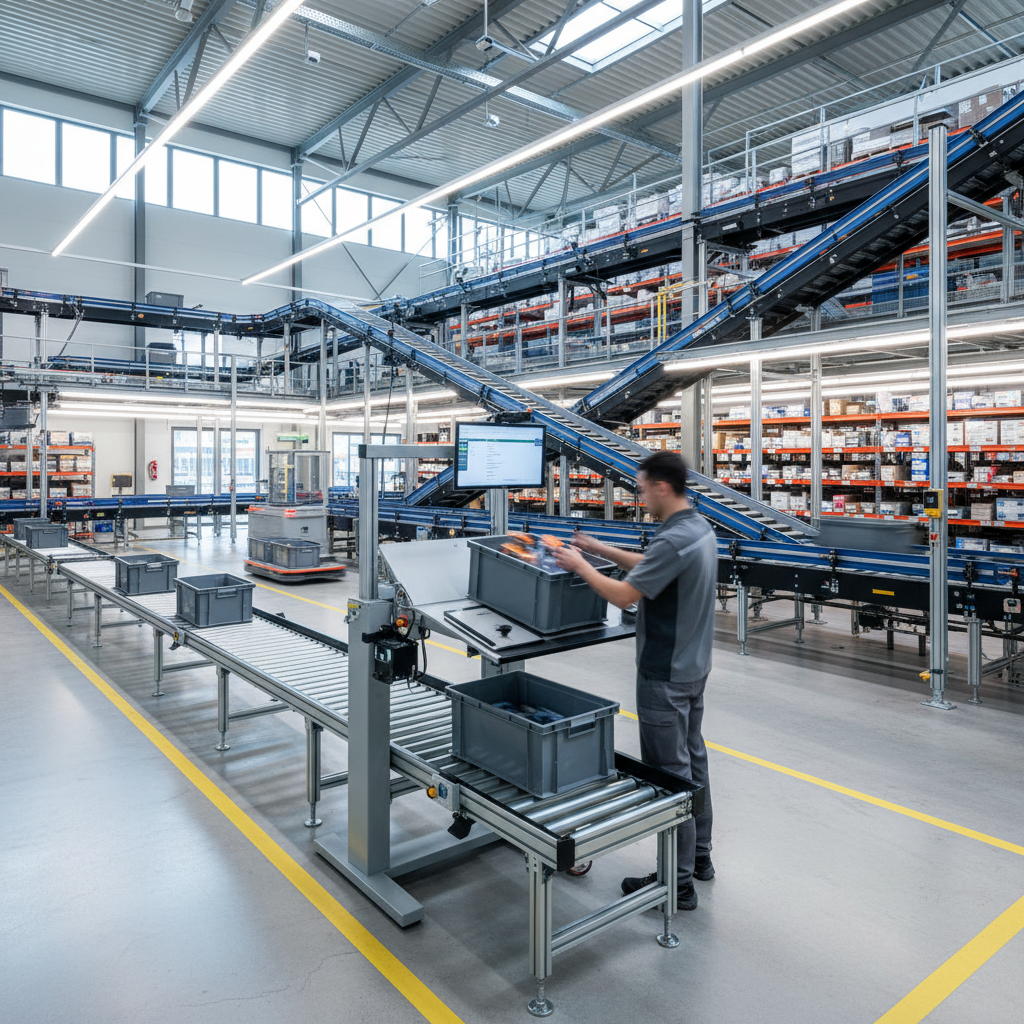
Small belt conveyors, with frame heights as low as 80-100 mm and standard belt widths from 200 mm to 500 mm, are the workhorses for moving individual items. They transport products from an automated storage and retrieval system (AS/RS) to a Goods-to-Person (GTP) picking station. With speeds typically ranging from 0.3 m/s to 1.2 m/s, they ensure a steady, gentle flow of goods, preventing bottlenecks and maintaining a high pace for pickers, who can often process hundreds of order lines per hour.
Powered Roller Conveyors for Totes and Cartons
Once items are picked and placed into an order tote or shipping carton, powered roller conveyors take over. These systems are ideal for handling standardized load carriers. In an MFC context, 24V DC motorised roller conveyors (MDR) are particularly advantageous. They operate on a run-on-demand basis, meaning a zone only activates when a tote is present, drastically reducing energy consumption compared to traditional AC-powered systems. They can handle loads up to 50 kg/m, making them perfect for moving consolidated orders towards the final packing and shipping area.
Modularity and Flexibility: The Key to Future-Proofing
The e-commerce market is volatile. Product mixes change, order volumes fluctuate, and operational needs evolve. A key advantage of modern compact conveyors is their modularity. Systems built with standardised, pre-engineered modules (straight sections, curves, mergers) can be reconfigured or expanded with minimal downtime. This allows an MFC to adapt its layout quickly, whether to add more picking stations or to change the outbound sorting process—a critical capability in the fast-paced European retail sector.
Comparing Compact Conveyor Technologies for Benelux MFCs
Choosing the right technology is critical for success. The table below compares common compact conveyor types used in micro-fulfillment applications.
| Conveyor Technology | Ideal Use Case in MFC | Typical Speed Range | Typical Load Capacity | Indicative Cost (€/meter) |
|---|---|---|---|---|
| Mini Belt Conveyor | Transporting individual, lightweight items; incline/decline. | 0.3 - 1.2 m/s | 5 - 20 kg | €400 - €700 |
| 24V DC Roller Conveyor (MDR) | Zone-by-zone tote and carton handling; accumulation. | 0.2 - 1.0 m/s | 35 - 50 kg/m | €600 - €950 |
| Modular Plastic Belt Conveyor | Handling goods with varied shapes; food-grade applications. | 0.2 - 0.8 m/s | Up to 150 kg/m | €750 - €1,200 |
| Vertical Lift / Spiral Conveyor | Moving goods between different levels to save footprint. | ~1.0 m/s | Up to 50 kg per carrier | €15,000+ (per unit) |
KPIs Improved by Smart Conveyor Implementation
- Order Processing Speed: A well-designed conveyor system can reduce the time from order receipt to dispatch from over an hour to under 10 minutes.
- Space Utilisation: Compact and vertical conveyors can increase the usable operational capacity of a given floor space by up to 40% compared to a manual, cart-based operation.
- Picking Accuracy: By automating the transport of goods, picking errors are significantly reduced, often achieving accuracy rates above 99.8%.
- Energy Consumption: The use of 24V DC motorised rollers and run-on-demand logic can cut electricity usage for conveyance by as much as 70% compared to older AC-powered systems.
European Context: A Brussels MFC Case Study
Imagine an MFC operating in a 600 m² former retail space in the Etterbeek district of Brussels, serving the dense European Quarter. The goal is sub-60-minute delivery for a curated list of 5,000 SKUs. The material flow is powered entirely by compact conveyors. Small belt conveyors feed items to four high-speed picking stations. Once an order is complete, the tote is released onto a main line of 24V DC roller conveyors that transports it to one of three packing stations. After packing, the labelled parcel is placed on a final takeaway belt conveyor that leads directly to the dispatch door where bicycle couriers are waiting. A setup like this, often leveraging plug-and-play modules like those from expert European suppliers, can be deployed in weeks, not months, which is a testament to modern engineering and modular design.
Easy Systems: Your Trusted Partner for Compact MFC Conveyor Solutions
The success of micro-fulfillment in the Benelux is not just about location; it's about intelligent, space-efficient, and reliable automation. At Easy Systems, we specialise in the design, manufacture, and implementation of modular compact conveyor systems that are the lifeblood of modern MFCs. Our solutions, engineered and produced in Europe, are specifically designed to meet the demands of urban logistics: small footprints, high energy efficiency (24V technology), and ultimate flexibility. We understand that your profitability is measured in seconds and square meters. By partnering with us, you gain access to decades of expertise in creating robust, scalable, and cost-effective conveyor solutions that turn logistical challenges into a competitive advantage, ensuring you can deliver on the promise of instant commerce.
This article is part of the Conveyor-Design knowledge hub, edited by Easy Systems engineers who design conveyor and warehouse automation systems across the Benelux every week.
Frequently asked questions
What is the typical size of a micro-fulfillment center in the Benelux?+
A typical MFC in the Benelux ranges from 250 m² to 1,500 m². The key is not the size, but the location within a densely populated urban area to facilitate rapid last-mile delivery.
How much does a compact conveyor system for an MFC cost?+
The cost varies significantly, but as an indication, simple belt conveyors can start around €400 per meter, while energy-efficient 24V DC roller systems for totes often range from €600 to €950 per meter. A complete system depends on complexity, length, and controls.
Why are 24V DC conveyors so popular in modern MFCs?+
They are popular for three main reasons: energy efficiency (they only run when needed), safety (low voltage operation), and modularity (easy to control and reconfigure zone by zone), which are all critical factors in a dynamic MFC environment.
Can conveyor systems be installed in existing buildings with low ceilings?+
Yes. Compact conveyor systems are designed with low-profile frames, some as low as 80-100 mm in height, making them ideal for retrofitting into existing urban buildings that may have architectural constraints like low ceilings.