Circular Economy in Conveyor Design: A Benelux Guide
Discover how applying circular economy and cradle-to-cradle (C2C) principles to conveyor system design is transforming logistics in the Benelux. This guide explores modularity, material passports, and the financial benefits of sustainable automation.
The shift from a linear "take-make-dispose" economy to a circular one is not just an environmental imperative but a significant economic opportunity for the European logistics sector. In the high-density, fast-paced markets of the Benelux (Belgium, Netherlands, Luxembourg), where warehouse space is at a premium and efficiency is paramount, applying circular principles to conveyor system design offers a powerful competitive edge. This article explores how cradle-to-cradle (C2C) thinking is revolutionizing conveyor design, leading to more sustainable, flexible, and cost-effective material handling solutions.
Definition
Circular Conveyor Design is an engineering philosophy based on cradle-to-cradle principles, where conveyor systems and their components are designed for disassembly, reuse, remanufacturing, and recycling. The goal is to eliminate waste and pollution by keeping materials in use at their highest possible value for as long as possible, creating a closed-loop system.
The Business Case for Circularity in Benelux Logistics
The Benelux region, with its major ports like Antwerp and Rotterdam, is a critical logistics hub for Europe. However, this density brings challenges, including high real estate costs, stringent environmental regulations (aligned with the EU Green Deal), and intense market competition. A circular approach to conveyor design directly addresses these challenges.
Reduced Total Cost of Ownership (TCO)
While the initial investment (CAPEX) for a modular, circular-ready conveyor might be slightly higher than a traditional welded system, the TCO is significantly lower. A linear model requires complete replacement for major layout changes or at the end of its life. A circular model, however, thrives on adaptation. Components are reused, reconfigured, or upgraded, drastically reducing future expenditure. Over a 10-year period, a circular conveyor system can offer a 20-30% reduction in TCO compared to its linear counterpart.
Enhanced Flexibility and Scalability
E-commerce fulfillment and third-party logistics (3PL) operations in the Benelux are characterized by fluctuating demand and evolving processes. Modular conveyor systems designed with circularity in mind allow for rapid reconfiguration. A distribution center in Brussels can easily scale up for peak season by adding pre-owned or new modules, or reconfigure a line for a new client with minimal downtime and waste. This operational agility is a crucial advantage in a volatile market.
Meeting ESG and EU Taxonomy Goals
Investors and customers alike are increasingly scrutinizing companies' Environmental, Social, and Governance (ESG) performance. The EU Taxonomy provides a classification system for sustainable economic activities. Investing in circular conveyor systems is a tangible action that contributes directly to a company's sustainability targets. It reduces resource consumption, minimizes waste sent to landfills, and lowers the carbon footprint of logistics operations, making it easier to secure green financing and win environmentally-conscious clients.
Core Principles of Cradle-to-Cradle (C2C) Conveyor Design
Cradle-to-Cradle certification provides a framework for designing products for a circular economy. Applied to conveyor systems, it translates into several key engineering and operational strategies.
1. Design for Disassembly (DfD)
This is the foundational principle. Instead of welded frames and permanent fixtures, circular conveyors use bolted connections, standardized interfaces, and modular components. This allows a technician to easily separate a motor, a roller, a belt, or a frame section for repair, replacement, or reuse in another part of the facility. For instance, a 10-meter straight section can be disassembled and reconfigured into two 5-meter sections with a curve, using standard tools and minimal labor.
2. Material Health and Passports
C2C design prioritizes the use of non-toxic, recyclable materials. Steel and aluminum are preferred for frames as they can be infinitely recycled without loss of quality. Belts and rollers are made from materials that can be either biologically or technically "upcycled." A crucial innovation is the "Material Passport," a digital record of every component in the conveyor system. This passport details the materials used, their origin, and instructions for disassembly and recycling. For a warehouse manager in Luxembourg, this means maintenance is simplified, and at the end of a component's life, its recycling path is clear and efficient, maximizing its residual value.
3. Modularity and Standardization
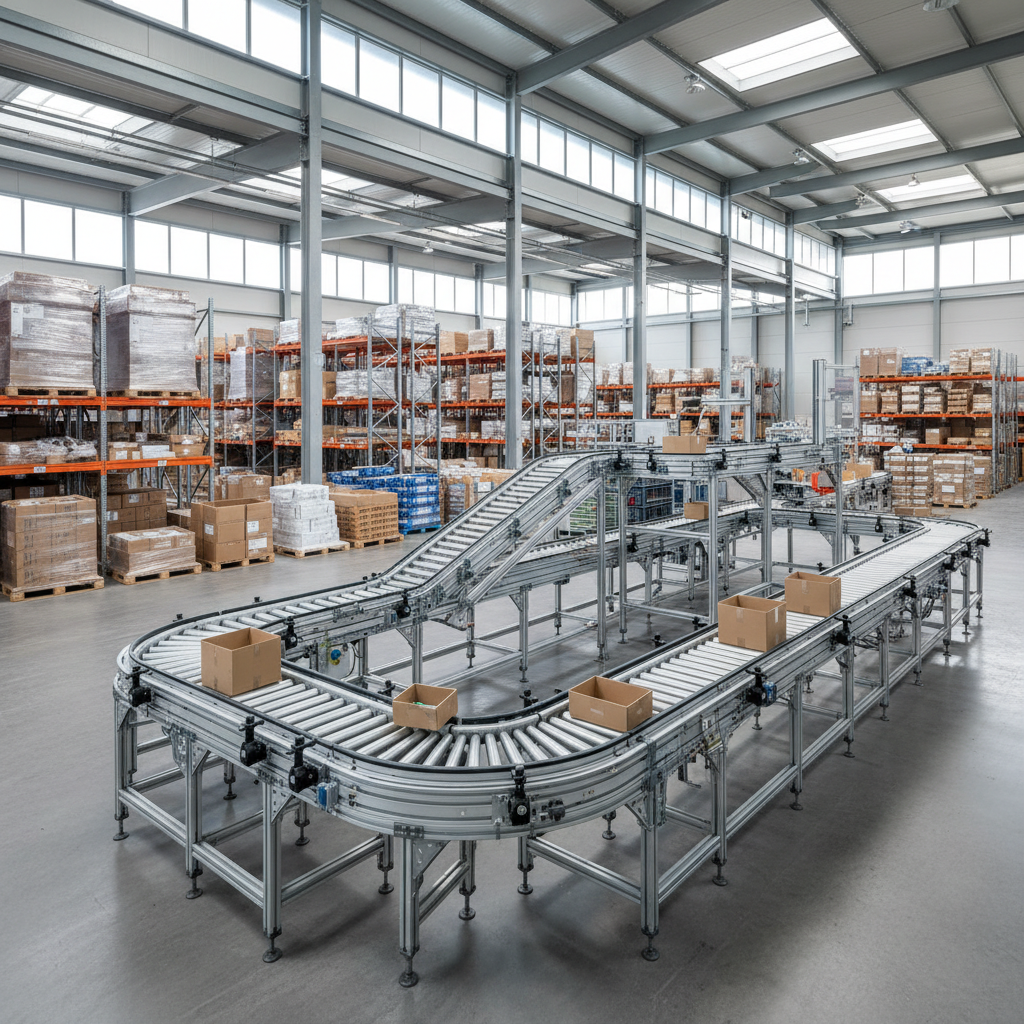
Modularity is the physical enabler of the circular economy in conveyor systems. It involves creating a "Lego-like" set of standardized modules:
- Straight sections: Typically in lengths from 500 mm to 3,000 mm.
- Curves: Standard 45° or 90° curves.
- Merges/Diverts: Standardized modules for sorting and routing.
- Drives & Controls: Plug-and-play motor-driven rollers (MDRs) and control cards that can be easily swapped or moved.
This standardization means a module from one part of the system can be seamlessly integrated elsewhere. It allows for phased investments and continuous evolution of the material handling system.
Comparison: Linear vs. Circular Conveyor Design
| Feature | Linear (Traditional) Design | Circular (C2C) Design |
|---|---|---|
| Construction | Welded frames, custom-built sections | Bolted frames, standardized modules |
| Flexibility | Low; layout changes are costly and wasteful | High; easily reconfigured, scaled, or relocated |
| End-of-Life | Scrap metal, landfill waste (belts, plastics) | Disassembly, reuse of modules, recycling of materials |
| TCO | High, due to replacement costs and downtime | Lower, due to reuse, reduced waste, and adaptability |
| Typical Lifespan | 10-15 years for the entire system | Indefinite for frames; 10-20 years for components |
| Example Cost (50m line) | Initial: €70,000. Major reconfiguration: ~€50,000 (new build) | Initial: €85,000. Major reconfiguration: ~€15,000 (labor + minor parts) |
| Sustainability | High carbon footprint, high resource depletion | Low carbon footprint, resource preservation |
Implementing Circular Conveyors: A Practical Approach
Transitioning to a circular model doesn't have to happen overnight. Here is a step-by-step approach for warehouse and production managers in the Benelux.
H3: Step 1: Audit and Assess Existing Systems
Begin by evaluating your current conveyor systems. Identify sections that are frequently changed or cause bottlenecks. Can parts be standardized? Are there opportunities to replace worn-out sections with modular, circular-ready alternatives? This audit provides a baseline and highlights areas for a pilot project.
H3: Step 2: Prioritize Modularity in New Projects
For any new conveyor installation or extension, specify circular design principles in your request for proposal (RFP). Ask potential suppliers about their approach to modularity, Design for Disassembly, and material transparency. Request evidence of systems that have been successfully reconfigured.
H3: Step 3: Embrace "Conveyor-as-a-Service" and Leasing
A growing trend is the "Conveyor-as-a-Service" (CaaS) model. In this setup, you pay for the material handling capacity (e.g., per item moved or per operational hour) rather than owning the hardware. The provider retains ownership and is responsible for maintenance, upgrades, and end-of-life management, creating a powerful incentive for them to design durable, reusable systems.
As a leading provider of intelligent and modular conveyor solutions, Easy Systems is at the forefront of this transition. Our plug-and-play systems are inherently circular, designed for disassembly and reuse. We empower businesses across the Benelux to build logistics operations that are not only efficient but also sustainable and future-proof. By working with a partner who embeds C2C principles into their core design, companies can de-risk their investment and accelerate their journey towards a circular economy. Discover our scalable and adaptable solutions at Easy Systems.
The Future is Reconfigurable
The concept of a static, unchanging warehouse layout is becoming obsolete. The future of logistics in the Benelux and across Europe belongs to facilities that can adapt in real-time to market demands. Circular conveyor design is the backbone of this agile future. It transforms a sunk cost—the fixed conveyor system—into a dynamic, valuable asset that can be rearranged, sold, or redeployed. By embracing modularity, material passports, and a cradle-to-cradle mindset, Benelux companies can build more resilient, profitable, and sustainable supply chains, ensuring their long-term success in a competitive and fast-changing world.
This article is part of the Conveyor-Design knowledge hub, edited by Easy Systems engineers who design conveyor and warehouse automation systems across the Benelux every week.
Frequently asked questions
What is the main benefit of circular conveyor design for a warehouse in the Netherlands?+
The main benefit is a significantly lower Total Cost of Ownership (TCO) and enhanced flexibility. Modular, reusable systems adapt to changing needs without costly replacements, reducing waste and downtime, which is crucial in the fast-paced Dutch logistics market.
How does Cradle-to-Cradle (C2C) differ from traditional recycling?+
Traditional recycling often 'downcycles' material, reducing its quality. C2C aims to maintain or even improve material quality through 'upcycling'. For conveyors, this means designing components that can be reused in new systems or recycled into high-quality raw materials, not just scrap.
Is a modular conveyor system robust enough for heavy industrial use?+
Absolutely. Modern modular systems are engineered with high-grade steel or aluminum and robust bolted connections. They are designed to meet and often exceed the durability of traditional welded systems, supporting loads from a few kilograms up to several hundred kg per meter.
What is a 'material passport' and why is it important?+
A material passport is a digital document that details the composition and origin of every component in a conveyor. It is crucial for a circular economy as it simplifies maintenance by identifying exact parts and provides clear instructions for proper disassembly and high-value recycling at the end of the component's life.